
U.S. Representative Darrell Issa has officially introduced a new legislative measure aimed at blocking foreign pirate websites in the United States, marking a significant escalation in the ongoing policy debate surrounding online copyright protection. While the formal text of the bill has not yet been published by congressional authorities, early drafts and previously circulated frameworks indicate that the proposal would establish formal legal procedures requiring both internet service providers (ISPs) and Domain Name System (DNS) resolvers to block access to unauthorized foreign platforms.
The introduction of the bill has immediately reignited intense policy debates on Capitol Hill, drawing swift opposition from digital rights advocates while simultaneously navigating a complex landscape of competing legislative efforts. The proposal enters a crowded legislative arena where multiple lawmakers are attempting to forge a consensus on how to curb online digital piracy without infringing upon broader internet freedoms or destabilizing vital digital infrastructure.
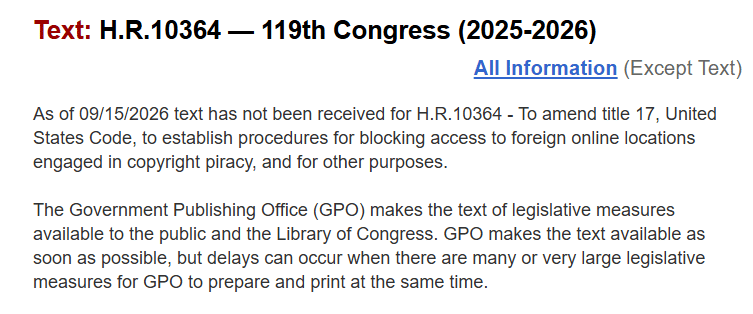
The formal introduction of H.R. 10364 in the U.S. House of Representatives represents a long-anticipated move by Rep. Issa, who chairs the House Intellectual Property subcommittee. Congressional records officially describe the measure as a bill to establish procedures for blocking access to foreign online locations engaged in copyright piracy, and for other purposes. Although the legislation currently lacks an official short title in the chamber’s records, Rep. Issa had previously circulated the proposal under the designation of the American Copyright Protection Act (ACPA).

For over a decade, mandatory site blocking at the ISP level has remained largely dormant in American legislative discussions. Such measures were effectively shelved following the widespread public backlash and subsequent abandonment of the Stop Online Piracy Act (SOPA) in 2012. However, the political landscape shifted dramatically in January of last year when Representative Zoe Lofgren introduced the Foreign Anti-Digital Piracy Act (FADPA), breathing new life into the debate over targeted network-level blocks.
Following FADPA’s introduction, momentum continued to build across Capitol Hill. Last summer, a bipartisan group of senators introduced a companion or alternative legislative draft known as Block BEARD. Concurrently, Rep. Issa continued refining his own legislative framework through stakeholder discussions and preliminary drafts. Despite these extensive preparations, the bill was not formally introduced in the House until recently, bringing the proposal into the formal legislative spotlight as Rep. Issa approaches the end of his final term in Congress.
A Site Blocking Bill Without Text Available
As of publication, the comprehensive text of H.R. 10364 has not yet been made publicly available online. Congressional records indicate that the Government Publishing Office has not yet received the official text for distribution, and Rep. Issa’s congressional office has not yet issued a formal press release detailing the final provisions of the introduced measure. Inquiries directed to Rep. Issa’s office seeking a copy of the text and official commentary did not receive an immediate response.
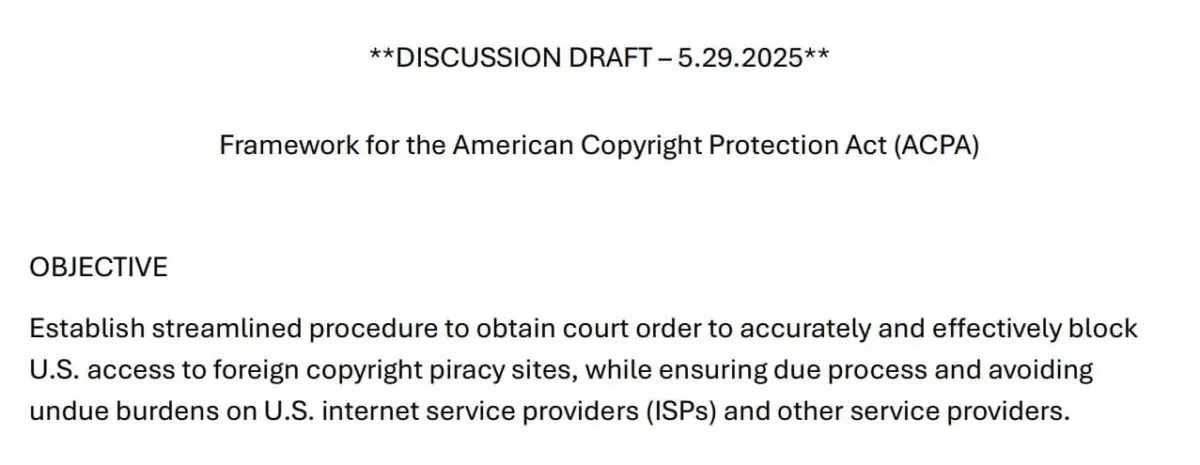
In the absence of the final text, policy analysts and legal experts are relying on the 2005 discussion draft of the American Copyright Protection Act—a copy of which was previously reviewed and analyzed by digital rights publications—as the primary indicator of the bill’s structure and intent. Under that preliminary framework, copyright holders would be granted the legal mechanism to obtain specialized court orders compelling both traditional internet service providers and large-scale DNS resolvers to block access to designated foreign pirate sites operating beyond U.S. jurisdiction.
Unlike several competing proposals, Issa’s early draft introduced several distinct administrative and procedural safeguards. Notably, the framework stipulated that the Judicial Conference would maintain a specialized roster of designated judges specifically assigned to hear all site-blocking litigation, ensuring consistency in judicial rulings. Additionally, the U.S. Copyright Office would be tasked with publishing and maintaining an official, up-to-date registry of active site-blocking orders.
Another notable element of the early ACPA draft was its specific focus on mitigating the risks of overblocking. The preliminary framework included a unique legal provision allowing third-party entities whose legitimate websites were erroneously blocked due to rightsholder errors or administrative mistakes to seek up to $250,000 in statutory compensation. It remains to be seen whether these specific accountability provisions and procedural safeguards have been retained in the final text of the newly introduced bill.
Competing Site Blocking Bills on Capitol Hill
The formal introduction of Rep. Issa’s bill comes as little surprise to legislative observers. On June 30, Rep. Issa indicated in an interview with The Capitol Forum that his intention was to introduce the anti-piracy legislation before Congress entered a scheduled district work period. Although that original timeline slipped, the measure has now landed in the House while time remains limited. Because Rep. Issa is retiring at the end of his current congressional term, the window for moving the legislation through the House is relatively narrow.
Compounding the legislative challenge is the presence of internal competition on Capitol Hill, where multiple distinct site-blocking initiatives are currently vying for legislative priority. Earlier this year, reports emerged that Senator Thom Tillis and Rep. Zoe Lofgren were actively working to merge FADPA and Block BEARD into a single, unified bicameral bill designed to coordinate site-blocking mandates across both ISPs and major DNS resolvers.
Furthermore, Rep. Lofgren subsequently confirmed that she was engaged in high-level negotiations regarding a comprehensive four-corners agreement alongside Rep. Issa and Senators Marsha Blackburn, Chris Coons, Adam Schiff, and Thom Tillis. Industry sources have previously described these various legislative tracks as independent and uncoordinated efforts. Whether the newly introduced bill represents the agreed-upon House component of a broader consensus deal remains unclear, as the inclusion of Rep. Lofgren or other key negotiators as cosponsors would indicate unified backing. If no such consensus has been reached, the House currently finds itself considering multiple competing blocking bills alongside a separate Senate version.
Immediate Opposition and Stakeholder Reactions
Even before the official text of the bill has been made accessible to the public, digital rights organizations and civil liberties groups have mobilized in opposition to the legislation. Public Knowledge, a prominent digital rights advocacy group, issued a strong warning regarding the potential dangers of the new bill, arguing that the legislative framework effectively enlists broadband providers as private copyright enforcement police.
Meredith Rose, Senior Policy Counsel at Public Knowledge, criticized the broad operational scope of the proposed framework, particularly its reliance on DNS-level blocking. Applying blocking orders to global DNS resolvers inevitably results in global network blocks, according to Rose. She noted that such a mechanism means a single judicial ruling could cut off international access to a specific website based on the filing of an individual plaintiff and expedited legal procedures.
Rose further cautioned that small businesses, independent creators, and nonprofit organizations face the most severe risks associated with broad site-blocking mandates while possessing the fewest resources to contest erroneous blocks. Pointing to regulatory experiences in Europe, she highlighted instances where aggressive site-blocking regimes inadvertently disrupted critical digital infrastructure, affecting essential services for hotels, automotive repair shops, retail stores, telehealth programs, and even non-commercial institutions.
Meanwhile, major copyright holder organizations and entertainment industry coalitions, who have long advocated for robust site-blocking tools to combat rampant digital infringement, have maintained a more subdued public posture following the bill’s introduction. The Motion Picture Association (MPA)—which previously honored Rep. Issa with its Industry Champion Award in recognition of his legislative efforts regarding intellectual property—did not immediately issue a public statement or comment upon the release of the legislation. Industry representatives did not immediately respond to requests for comment, leaving the immediate trajectory of the bill subject to ongoing negotiations as the text awaits publication and further congressional review.

Leave a Reply