
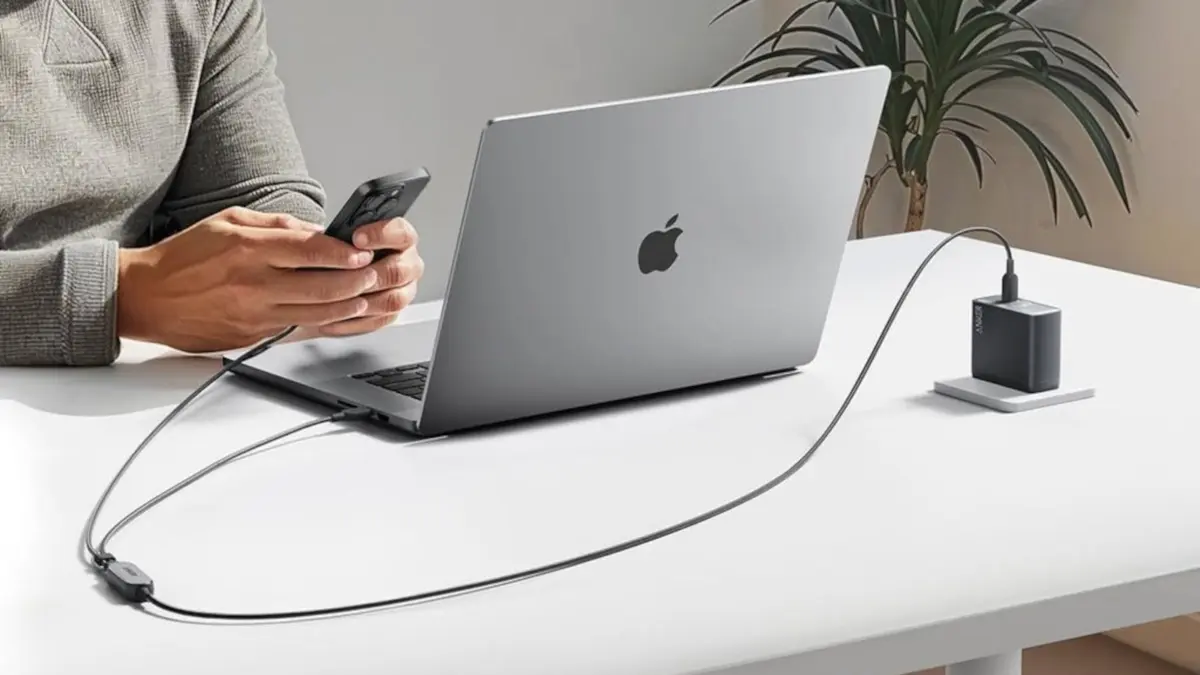
When modern consumers look at their everyday travel bags, workspaces, or nightstands, a common frustration almost always emerges: the sheer volume of devices that demand power juxtaposed against a chronic shortage of available wall chargers and outlets. Navigating the daily routine of keeping smartphones, tablets, wireless earbuds, and portable gaming consoles powered up traditionally requires either carrying a bulky, multi-port power brick equipped with several output slots, or constantly swapping individual cords in and out of a single wall adapter.
A popular alternative designed to streamline this process has now become significantly more affordable. An innovative hardware accessory from prominent tech accessory manufacturer Anker—specifically, a unique 2-in-1 USB-C splitter cable designed to maximize a single charger—is currently on sale for $15.99, matching its lowest price point ever recorded.
For tech enthusiasts and frequent travelers looking to reduce cable clutter without sacrificing high-speed charging capabilities, the discounted accessory offers a compelling solution, though prospective buyers must understand how power distribution works across multiple connected gadgets.
The Anatomy of a High-Capacity Splitter Cable
At first glance, the hardware appears straightforward, yet it solves a distinct engineering problem for users who find themselves limited by wall outlet availability. On the primary end of the accessory sits a standard USB-C connector. Users simply plug this single end into any compatible USB-C power adapter. To take full advantage of the cable’s maximum capabilities, industry experts recommend pairing it with a high-capacity power brick capable of outputting up to 140 watts of electricity, as that represents the absolute upper limit of what the cable itself is engineered to support safely.
The engineering marvel, however, lies on the opposite end of the cord. Rather than terminating in a single plug, the cable branches out into two distinct USB-C connectors. This split architecture allows a single power source to energize two different devices simultaneously. Whether a user needs to charge a smartphone alongside a tablet, a smartphone alongside a modern laptop, or a smartphone paired with a case of wireless earbuds, the cable bridges the gap between a solitary power port and a dual-device lifestyle.
Physical dimensions also play a crucial role in the design’s everyday practicality. The entire assembly spans a generous six feet in total length. The main trunk of the cable extends for five feet from the power source before branching out, while the split ends provide up to an additional foot of reach. This generous reach ensures that users can easily plug the accessory into a distant wall outlet and avoid feeling tethered uncomfortably close to the floor or furniture.

Furthermore, the physical separation allows two individuals to comfortably plug in their respective phones and continue using them for messaging, browsing, or media consumption while charging side by side. An integrated cable slider gives users the ability to shorten the split end if they prefer a tighter, more managed setup. However, tech analysts note that users should exercise a bit of caution when packing the accessory away for travel, as cables of this length and configuration can occasionally tangle if tossed loosely into a backpack or briefcase.
The Catch: Understanding Complex Power Delivery and Wattage Allocation
While the physical convenience of turning a single charging port into two is immediately apparent, the underlying electrical behavior introduces a crucial caveat that consumers must navigate. Unlike a traditional multi-port wall charger that relies on internal circuitry to independently negotiate voltage and current for each connected port, this passive-style splitter cable operates under a more complex set of power-sharing rules dictated by the order of connection and the combined demands of the hardware attached to it.
According to the manufacturer’s technical specifications, the cable only delivers its full 140-watt potential when a single device is plugged into it. In this single-device scenario, the accessory functions effectively as a heavy-duty, high-speed conduit capable of fueling power-hungry laptops like a 16-inch MacBook Pro at maximum speed.
The dynamics shift significantly the moment a second device is introduced to the circuit. When two devices are actively charging and one of those devices demands more than 100 watts of power, the cable caps its total combined output at 130 watts, dynamically dividing the electrical current between the two terminals. If neither of the connected devices requires more than 100 watts—a common scenario when charging a smartphone alongside a mid-range tablet or a set of wireless earbuds—the cable caps its overall maximum output at 100 watts.
Adding another layer of nuance to the operation is the prioritization logic built into the connection process. The first device plugged into the splitter automatically receives the higher share of the available electrical wattage. This means users must be strategic about the order in which they attach their hardware, ensuring that a high-drain device like a laptop is connected first if it requires the lion’s share of the power supply, while secondary gadgets like accessories or smartphones receive the remaining allocation.
Despite these intricate power-sharing rules, the current promotional price of $15.99 makes the accessory an attractive option for consumers seeking to minimize the number of bricks they carry while on the move. As portable technology continues to evolve toward universal USB-C standards, accessories that bridge the gap between legacy charging limitations and modern multi-device demands remain a focal point for accessory makers and consumers alike.

Leave a Reply