
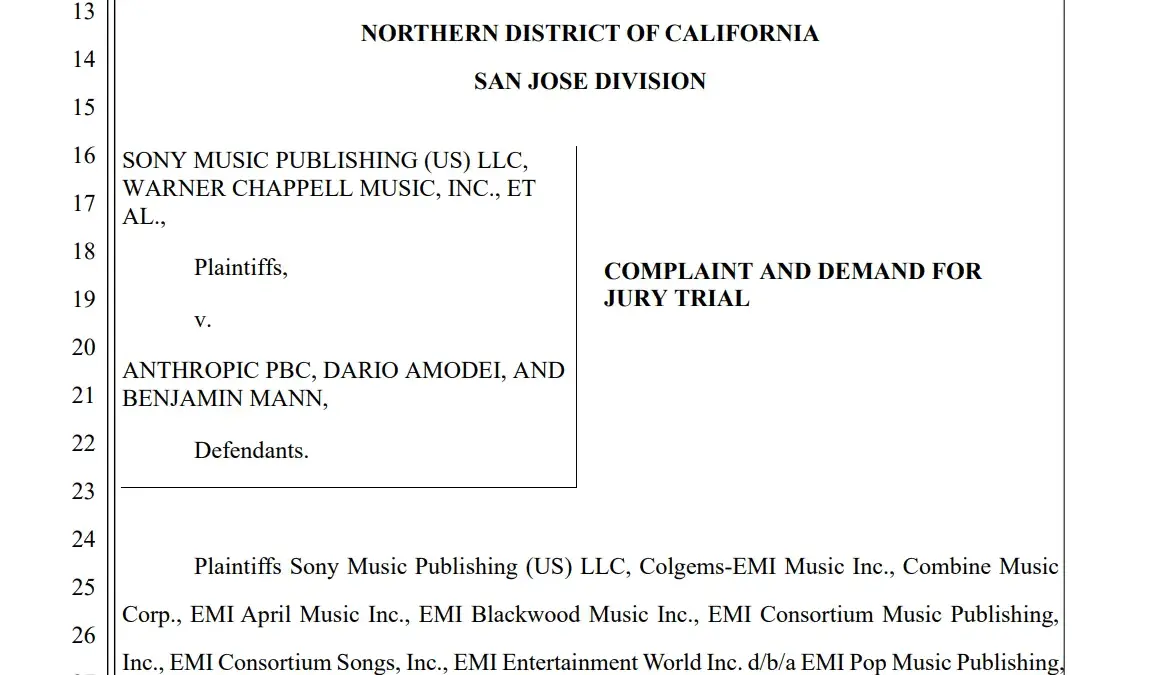
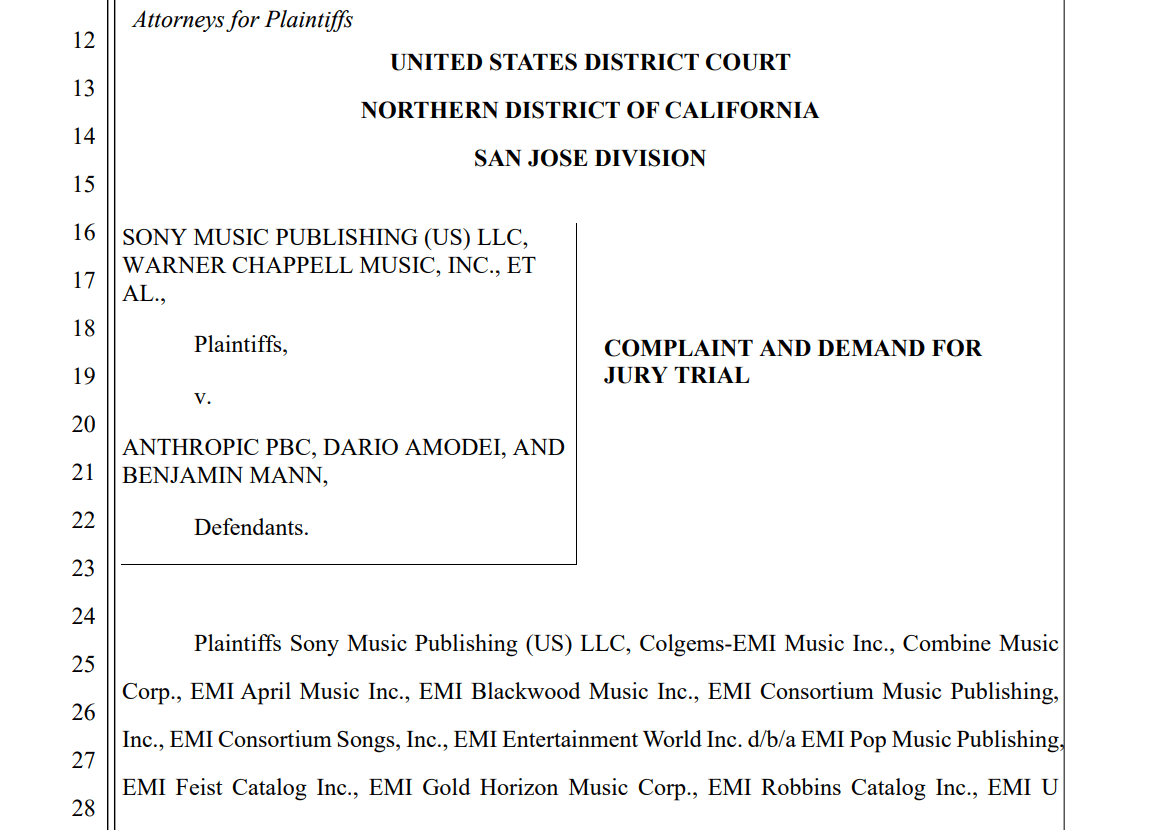
Major music publishers, including industry giants Sony and Warner, have filed a high-stakes copyright lawsuit against artificial intelligence company Anthropic in the U.S. District Court for the Northern District of California. The newly filed complaint alleges that Anthropic’s massive data collection efforts—which previously resulted in a staggering $1.5 billion settlement with book authors—also unlawfully swallowed up extensive catalogs of copyrighted songbooks, sheet music collections, and song lyrics.
The legal action represents the latest front in an escalating war between rightsholders and generative AI developers over the ingestion of copyrighted works for model training. While Anthropic successfully settled the earlier class-action lawsuit brought by book authors last September over a trove of roughly seven million pirated titles, that resolution has failed to stem the tide of independent litigation from other sectors of the creative industries. According to the fresh complaint, the same expansive data haul that fueled those earlier models also incorporated valuable musical intellectual property without authorization, licensing, or compensation.
"A Cute Little LibGen Babysitter" and Internal Acknowledgment
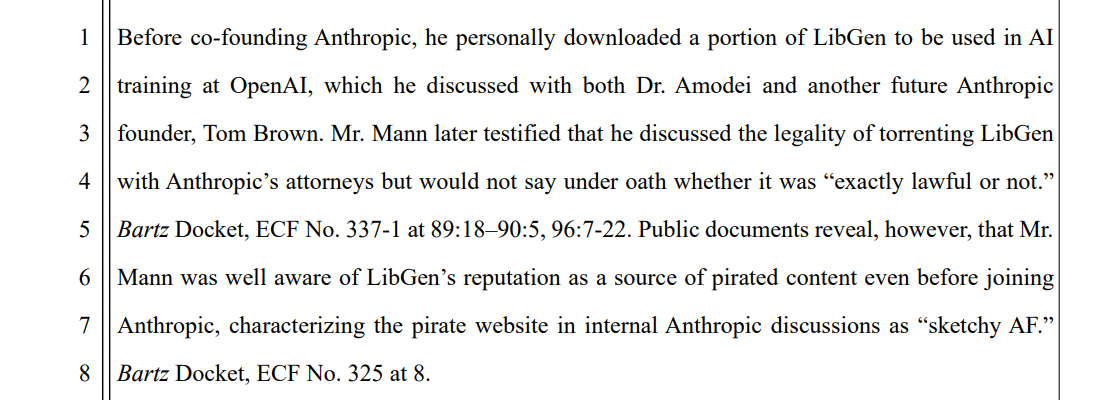
The music publishers’ complaint draws heavily upon factual revelations and evidentiary records established during prior litigation, specifically lifting key context and internal communications from the Bartz v. Anthropic proceedings. Within those court documents, internal Slack channel logs revealed that Anthropic co-founder Benjamin Mann openly discussed downloading materials from shadow libraries like Library Genesis (LibGen), even sharing screenshots of his technical activities with colleagues.

According to the legal filing, Mann engineered a custom management program to automate and oversee the bulk downloads, affectionately referring to the tool internally as "a cute little libgen babysitter." Furthermore, the chat logs indicate that Anthropic’s leadership and engineering staff were fully cognizant of the dubious legal standing of the repositories they were raiding. Internal messages show Mann characterizing LibGen as "sketchy AF," while members of Anthropic’s Archive Team went even further, explicitly labeling the platform a "blatant violation of copyright."
Despite these internal warnings regarding the origin of the material, the complaint alleges that CEO Dario Amodei ultimately approved the torrenting initiative. The filing quotes Dr. Amodei as admitting that Anthropic possessed numerous alternative avenues through which it could have lawfully acquired the copyrighted works for training purposes, but opted to utilize torrent networks instead because the method was significantly faster and entirely free of cost.
Sourcing From "A Popular (and Illegal) Library"
The scope of Anthropic’s data acquisition expanded significantly in the summer of 2022 when Mann discovered that the Pirate Library Mirror (PiLiMi) had become available for torrenting. Upon identifying the repository, Mann shared the access link with coworkers alongside the remark, "[J]ust in time!" Another employee enthusiastically responded in the chat with the phrase, "zlibrary my beloved," underscoring the team’s casual familiarity with underground digital archives.

Following this discovery, Anthropic engineers cross-referenced the five million books they had already acquired via LibGen against the seven million titles hosted on PiLiMi, subsequently downloading the remaining two million unique items. Internal records cited by the publishers indicate that employees fully understood the nature of their sources, openly describing PiLiMi in internal channels as "a popular (and illegal) library."
The music publishers argue that this systematic data harvesting swept up hundreds of proprietary songbooks and comprehensive sheet music collections. Exhibit A of the complaint highlights specific copyrighted titles targeted in the download spree, including The Beatles Complete Scores, the Best of Taylor Swift Songbook, and Bon Jovi’s These Days. The plaintiffs maintain that even after Anthropic leadership purportedly cooled on training models using unauthorized material due to rising legal liabilities, the company nevertheless elected to retain the amassed files within its central repository.
Errors in Shadow Library History
While the core allegations concerning Anthropic’s downloading behaviors are firmly anchored in previously disclosed court records, the complaint’s historical overview of shadow libraries contains notable inaccuracies. The legal filing asserts that the Federal Bureau of Investigation shut down LibGen in late 2021, prompting digital pirates to replicate its contents to establish Z-Library.
In reality, Library Genesis was never closed down by federal authorities and remains operational online today. Conversely, Z-Library was originally established years earlier in 2008 as a mirror of LibGen before expanding into one of the largest independent pirate ebook libraries on the internet. It was Z-Library—not LibGen—that ultimately lost its core internet domains to an FBI seizure in November 2022, several months after Anthropic had already concluded its bulk downloading operations. While these chronological and historical misstatements do not alter the substance of the underlying infringement claims, they highlight some confusion within the complaint’s narrative regarding the complex ecosystem of online shadow libraries.
A Torrenting Spree Sparking Multiple Lawsuits
The structure of the lawsuit uniquely targets the active torrenting process itself rather than solely focusing on the subsequent AI training phases. Because the BitTorrent protocol inherently functions by simultaneously uploading data segments to other network participants while a user downloads, the music publishers argue that Anthropic did not merely reproduce their copyrighted properties, but actively distributed them to countless external peers.
This legal theory mirrors arguments rightsholders have deployed against individual file-sharers for over two decades. However, its application is now directed toward a heavily capitalized technology firm approaching a massive corporate valuation. The plaintiffs contend that Anthropic actively sustained and normalized the broader BitTorrent piracy ecosystem through its large-scale operational methods.
This action marks the third major lawsuit spawned by Anthropic’s initial torrenting activities. Following the book authors’ $1.5 billion settlement and a separate lawsuit filed in January by music publishers including Concord, Universal, and BMG, this latest complaint may not be the final legal challenge the company faces over the data haul.
Anthropic maintains that its practices fall under the legal protections of fair use. A company spokesperson told reporters that the new filing represents a third lawsuit brought by the same legal representation, recycling allegations already addressed in active court proceedings. Anthropic emphasized its belief that AI training constitutes fair use—a principle it asserts was upheld in the Bartz ruling—and vowed to defend itself robustly against the claims.
Legal observers note, however, that the previous fair use determination applied strictly to the training phase of the AI models rather than the initial acquisition of the materials. The presiding court previously characterized the underlying downloading behavior as straightforward piracy executed on an industrial scale. The music publishers are currently demanding up to $150,000 in statutory damages for each individual infringed work. With tens of thousands of specific titles cataloged in the exhibits, potential damages could accumulate into billions of dollars as the litigation proceeds in the Northern District of California.


Leave a Reply