
Internet service provider RCN has officially asked a New Jersey federal court to reconsider a six-year-old ruling and completely dismiss a major record labels’ piracy liability lawsuit. Citing the United States Supreme Court’s landmark decision in Cox v. Sony, RCN argues that the highest court in the land has thoroughly wiped out the legal foundation underpinning the music industry’s claims. With similar "repeat infringer" lawsuits against other major internet service providers already dropped across the country, RCN maintains that its case is now the very last major label lawsuit of its kind still active in the American legal system.
For years, major record labels and Hollywood movie studios waged an aggressive, widespread campaign to hold United States internet service providers directly responsible for the copyright infringement committed by their subscribers. Operating under legal theories of contributory and vicarious infringement, rightsholders persistently argued that ISPs which failed to disconnect repeat copyright infringers should foot the bill for the consequences of that online piracy.
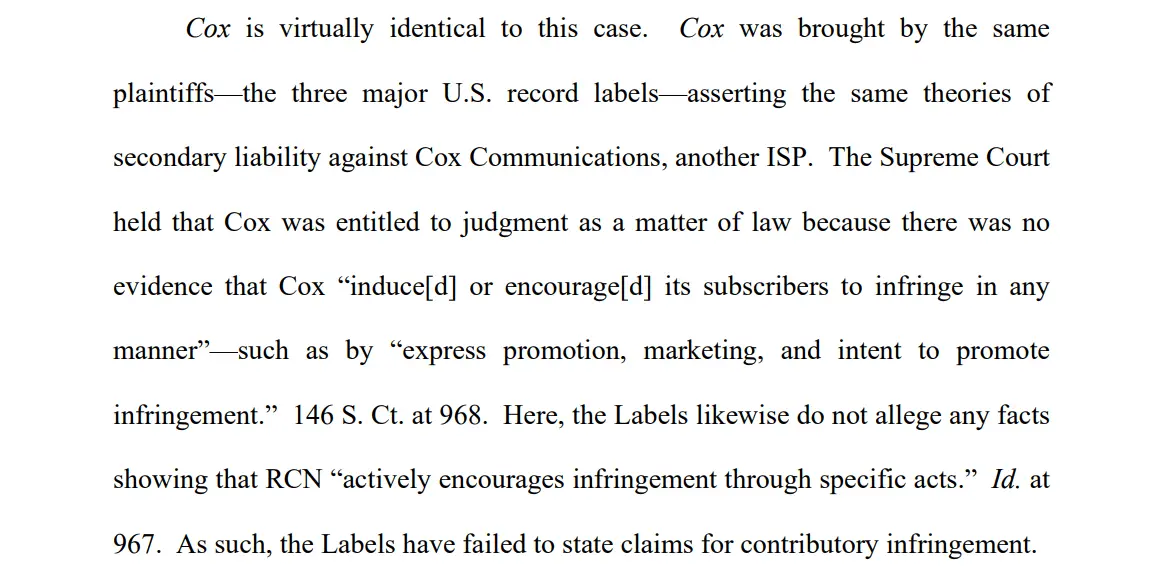
This core legal theory drastically fell apart in March, however, when the Supreme Court officially reversed a staggering billion-dollar jury verdict against Cox Communications. In that decision, the Supreme Court held that an internet service provider is not legally liable for contributory copyright infringement simply because it continues to serve subscribers whom it knows have been flagged for repeated acts of digital piracy.
Seizing upon this monumental shift in copyright jurisprudence, RCN now wants the U.S. District Court for the District of New Jersey to apply this binding precedent and finally bring an end to litigation that has been actively running since 2019.
No Inducement, No Claim
In a formal motion for reconsideration filed yesterday, RCN argues that the Supreme Court’s Cox ruling completely destroyed the legal foundation of the record labels’ amended complaint. Under the updated interpretation of the law, an internet service provider is no longer contributorily liable simply for selling general internet access while knowing that a subset of its subscribers might use that connectivity to infringe on copyrights. Furthermore, failing to cut off the internet connections of those flagged subscribers does not establish the requisite legal intent either.

Following the Cox precedent, establishing secondary liability now requires concrete proof that the provider actively and overtly encouraged copyright infringement through specific affirmative acts, or that its service has no substantial non-infringing uses whatsoever. RCN argues that neither of these conditions applies to its operations, noting that the case currently pending against it is virtually identical to the unsuccessful Cox lawsuit.
The labels’ second major claim, centered on vicarious infringement, should likewise be dismissed according to RCN’s legal team. That particular legal doctrine requires proof that the internet service provider profited directly from the piracy itself. However, the Fourth Circuit previously ruled in the Cox litigation that standard monthly subscription fees do not count as direct profits from infringement, and the Supreme Court ultimately declined to hear the labels’ appeal on that specific point.
RCN points out that its subscribers pay the exact same flat monthly price regardless of whether they are downloading copyrighted music or simply browsing social media, meaning those subscription fees do not constitute a direct financial benefit derived from acts of copyright infringement.
The ‘Last’ Case Standing
RCN stresses that virtually all of the other major repeat infringer cases filed against internet service providers have already been voluntarily dismissed by rightsholders in the wake of the high court’s decision.
In the immediate wake of the Cox ruling, the labels and other rightsholders systematically dismissed every other secondary copyright infringement case pending against ISPs, including the movie industry’s virtually identical lawsuit against RCN itself. RCN argues that the same logical outcome should have happened with this remaining music industry action.
As previously reported across the legal and tech sectors, the major record labels dropped their high-profile cases against Verizon and Altice within weeks of the Cox ruling coming down. Similarly, the film companies behind titles including The Hitman’s Wife’s Bodyguard dismissed a near-identical copyright infringement lawsuit against RCN with prejudice, and a parallel legal case against WideOpenWest came to an end a month later.
This sweeping legal precedent also reached RCN’s sister internet service provider, Grande Communications. Both providers currently operate under the Astound Broadband brand umbrella. Formally speaking, the labels’ copyright case against Grande is not entirely closed yet, because Grande still actively prefers to secure a formal, written win on the public court docket.
By RCN’s own accounting, every other secondary copyright infringement case brought against a United States internet service provider is now officially over, leaving its own ongoing litigation as the sole remaining exception in the country.
A Four-Year Standoff
The question naturally arises as to why this specific lawsuit has managed to remain pending in federal court after roughly seven years of litigation. According to RCN’s court filings, the record labels never genuinely intended to take the matter all the way to a full trial. The company argues that the case was originally filed back in 2019 primarily as strategic leverage in ongoing settlement negotiations with Grande. After that initial filing, the docket remained stagnant largely due to a protracted dispute regarding internal Digital Millennium Copyright Act records.
In May 2022, Magistrate Judge Tonianne J. Bongiovanni formally stayed all fact depositions until document discovery issues could be thoroughly resolved. That judicial stay has not been lifted once since it was put in place, despite the submission of at least 20 discovery letter briefs by the opposing parties. RCN firmly believes that the record labels are deliberately holding on to the case for ulterior motives.
Instead, it appears that the labels view the ongoing privilege dispute as a convenient form of tactical leverage, according to RCN’s statements to the court. In other words, the company suggests the labels seem to believe that RCN might eventually be willing to pay out a financial settlement simply to avoid a messy resolution of that underlying discovery issue.
The record labels have not yet filed a formal response to the newly submitted motion. In its filings, RCN is asking the district court to vacate its previous 2020 order, dismiss the amended complaint with prejudice, and the provider has also requested an opportunity for oral argument. Copies of RCN’s motion for reconsideration and the accompanying supporting memorandum, filed in the U.S. District Court for the District of New Jersey, have been made publicly available through court records.


Leave a Reply