

The motion, filed on September 4 before U.S. Judge Kathleen Williams, targets the remaining non-responsive operators behind several prominent pirate IPTV and streaming services. While the multi-million-dollar financial penalty commands attention, it is the extraordinary reach of the proposed permanent injunction that represents a major evolution in American anti-piracy litigation, mirroring dynamic site-blocking mechanisms that have been utilized across Europe for years.
The legal battle began in July when TelevisaUnivision initially secured a preliminary injunction from the federal court in Florida. That initial order targeted five core pirate IPTV services: Thunder TV, Sunset TV, Tele Latino, Pop TV, and Kaelus TV. Within mere weeks of the initial ruling, the scope of the injunction expanded dramatically to encompass hundreds of domains and dozens of intermediaries as investigators uncovered broader networks.
Because the defendants failed to show up in court to contest the allegations, TelevisaUnivision is now moving for a full default judgment. The legal paperwork identifies six named defendants behind Thunder TV, Sunset TV, and Tele Latino, while the operators of Pop TV and Kaelus TV remain unidentified John Does.

At the heart of the broadcaster’s new request is a permanent injunction designed to operate with minimal judicial oversight once established. The preliminary injunction granted this summer already permitted TelevisaUnivision to add new domains, IP addresses, and pirate services to the enforcement list without requiring the broadcaster to repeatedly return to court for judicial approval—a power the company exercised twice before the initial order was even a month old.
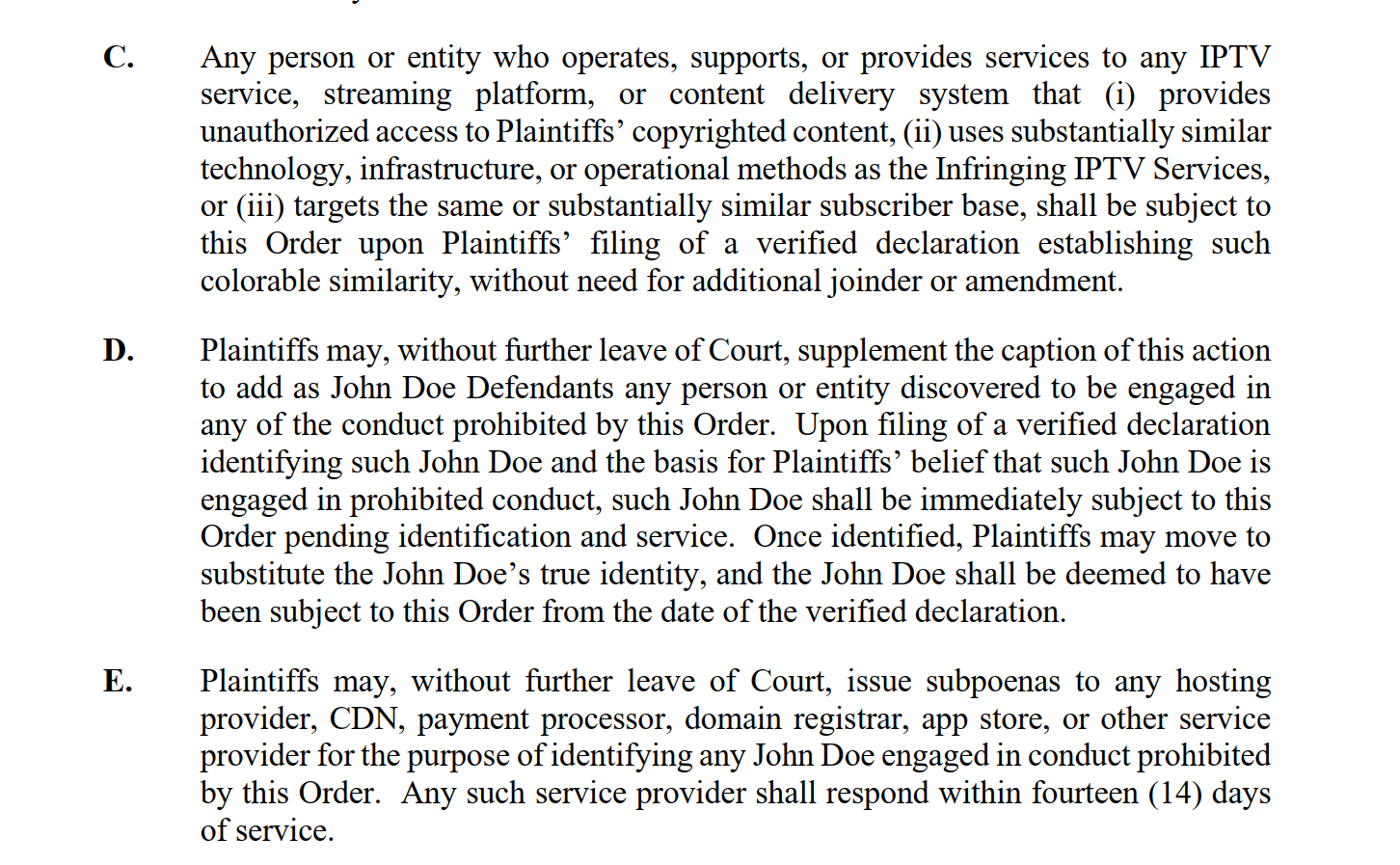
The proposed permanent order retains that mechanism while significantly expanding its scope. Under the new terms, TelevisaUnivision would be empowered to add not just new domains, but entirely new defendants without seeking further leave of court. The proposed text explicitly states that plaintiffs may supplement the case caption to include any newly discovered person or entity engaging in prohibited conduct.
Furthermore, the proposed order introduces a "colorable similarity" carveout. This provision targets any unauthorized service that provides access to TelevisaUnivision’s content, utilizes substantially similar technology, targets the same subscriber base, or operates as an alter-ego or successor to previously blocked services.
This clause addresses an ongoing evasion tactic observed by investigators. According to a supplemental declaration submitted in the case, Thunder TV itself reportedly ceased carrying TelevisaUnivision content, but its operators immediately launched a mirror application called "Black Eye" that continues to broadcast the material. Access to the Black Eye application is reportedly obtained using the exact same user credentials previously issued for Thunder TV, demonstrating the fluid nature of pirate streaming infrastructure.
The legal filings associated with the proposed permanent injunction outline a massive web of infringing infrastructure, listing nearly 600 unique domain names. These domains cover the five original services named in the complaint as well as seven additional brands that were subsequently added to the enforcement schedule, including XuperTV, Tarjeta Roja, Pirlo TV, and Roja Directa.
Individual services account for vast networks of web properties. Thunder TV and Tele Latino account for more than 90 domains each, while XuperTV—which TelevisaUnivision describes as a white-label service built on the same underlying Magis TV infrastructure as Tele Latino—adds more than 110 domains to the collective total.
To enforce the blocking measures, the injunction targets an unprecedented number of third-party intermediaries. The list includes 121 intermediaries spanning 51 domain registrars, 58 hosting and Content Delivery Network providers, five payment channels, and five app distribution platforms.
The network of implicated companies bridges multiple continents. It includes well-known U.S.-based firms such as NameCheap and GoDaddy alongside international entities such as Russia’s REGTIME-SU, Vietnam’s Mat Bao, Peru’s NIC.PE, the Dutch Registrar.eu, Iran’s Aria Shatel, and a Romanian state research institute, ICI Bucuresti.
In addition to traditional hosting and registry providers, the injunction ensnares a variety of popular web platforms and software tools. GitHub, Vercel, Canva, Wix, Squarespace, and Automattic—the company behind WordPress.com—are all listed in the filings, with each platform linked by investigators to one or more pirate domains or unauthorized streaming services.
The broad scope of the intermediary list has also generated technical discrepancies in the legal filings. The proposed injunction includes regional internet registries RIPE NCC for Europe and APNIC for the Asia-Pacific region. These organizations are incorrectly classified in the documents as web hosts or hosting providers, despite their actual function being the allocation of IP address space rather than direct web hosting or domain control.
Meanwhile, Cloudflare faces targeted data-production requirements. For roughly 90 IP addresses tied directly to the pirate domains, Cloudflare is ordered to disclose the identity of the origin server operating behind its proxy, along with the account holder’s name and associated email address.
Consumer-facing technology platforms are also directly impacted by the proposed measures. Roku and the developers behind the AFTVnews Downloader app are ordered to remove the unauthorized pirate applications from their ecosystems and actively block the numerical short codes utilized by users to sideload the software.

While the proposed permanent injunction represents a formidable administrative and technological weapon against piracy, the financial penalties sought by the broadcaster are largely symbolic given the profile of the defendants. TelevisaUnivision is seeking a total of $32.7 million in damages, divided between copyright and trademark claims. The figure includes $26.7 million for willful copyright infringement, calculated at the statutory maximum of $150,000 per registered work, alongside $6 million for willful trademark counterfeiting, set at $2 million per defendant group.
Because the defendants are foreign operators who have consistently ignored the proceedings, it is highly unlikely that the broadcaster will ever successfully collect the multi-million-dollar judgment. TelevisaUnivision acknowledges this reality in its legal strategy, utilizing the unrecoverable nature of foreign damages as a core justification for why an expansive, self-expanding permanent injunction is vital to effectively disrupt the operational capabilities and revenue streams of the pirate networks.
Multi-million-dollar default judgments have become increasingly common in U.S. anti-piracy litigation involving IPTV operations, following similar outcomes secured by major entertainment conglomerates. Earlier this year, Amazon and Netflix secured an $18.75 million judgment against a Dallas-based IPTV operator, while major Hollywood studios obtained a $9 million default judgment in a Pennsylvania federal court.
The pending motion now rests entirely with Judge Williams. Whether the proposed order’s most expansive and self-expanding provisions will survive judicial scrutiny in their current form remains to be determined.

Leave a Reply