
Virtual private network (VPN) providers boasting more than 100,000 American users could soon find themselves legally mandated to block access to pirate websites under newly surfaced legislation introduced by Representative Darrell Issa.
The full legislative text of the American Copyright Protection Act reveals a significant expansion from an earlier discussion draft circulated last year. While initial drafts focused strictly on traditional internet service providers (ISPs) and domain name system (DNS) resolvers, the final version explicitly ropes in consumer-facing VPN services. However, how these privacy-focused intermediaries are expected to enforce blocks "from the United States" remains an open question, as the legislative text leaves the specific technical implementation entirely undefined.
Representative Darrell Issa formally introduced the long-awaited site-blocking bill last week, setting the stage for a renewed legislative debate over online copyright enforcement in the United States. When the bill was first filed, its precise text was not immediately public. Initial reporting based on an earlier discussion draft indicated that the legislation would target only broadband providers and DNS resolution services.
That landscape shifted when advocacy group Public Knowledge shared a copy of the finalized bill with technology publication Ars Technica. The complete text shows that the final legislative package goes substantially further than the preliminary draft by explicitly integrating virtual private network providers into the framework of regulated entities.
VPNs Join the Blocking Mandates
Under the framework of the American Copyright Protection Act, copyright holders would be empowered to petition a federal court for a formal determination that a specific internet domain functions as a "foreign piracy site." Armed with such a declaration, rightsholders could then seek a judicial blocking order requiring specific service providers to take measures preventing users from reaching the infringing destination.
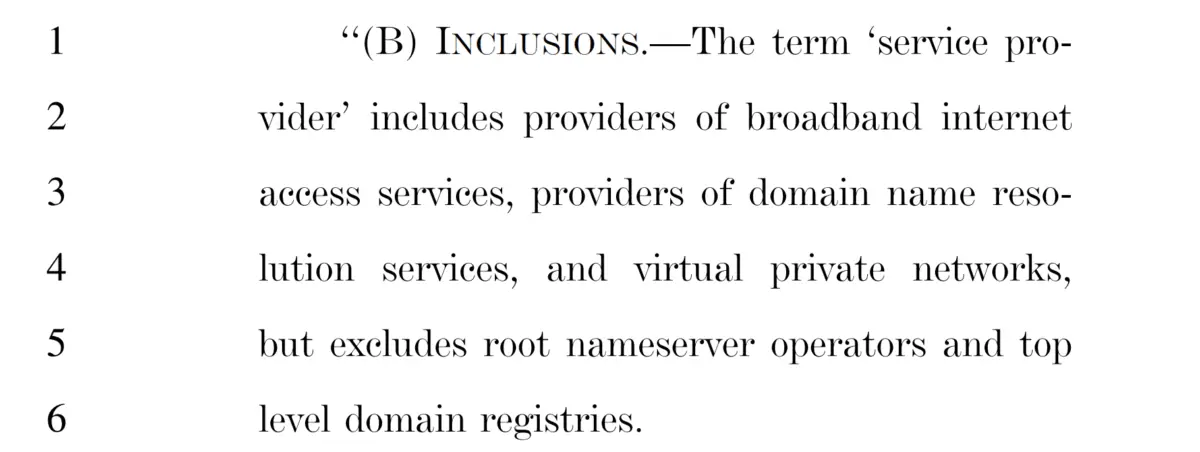
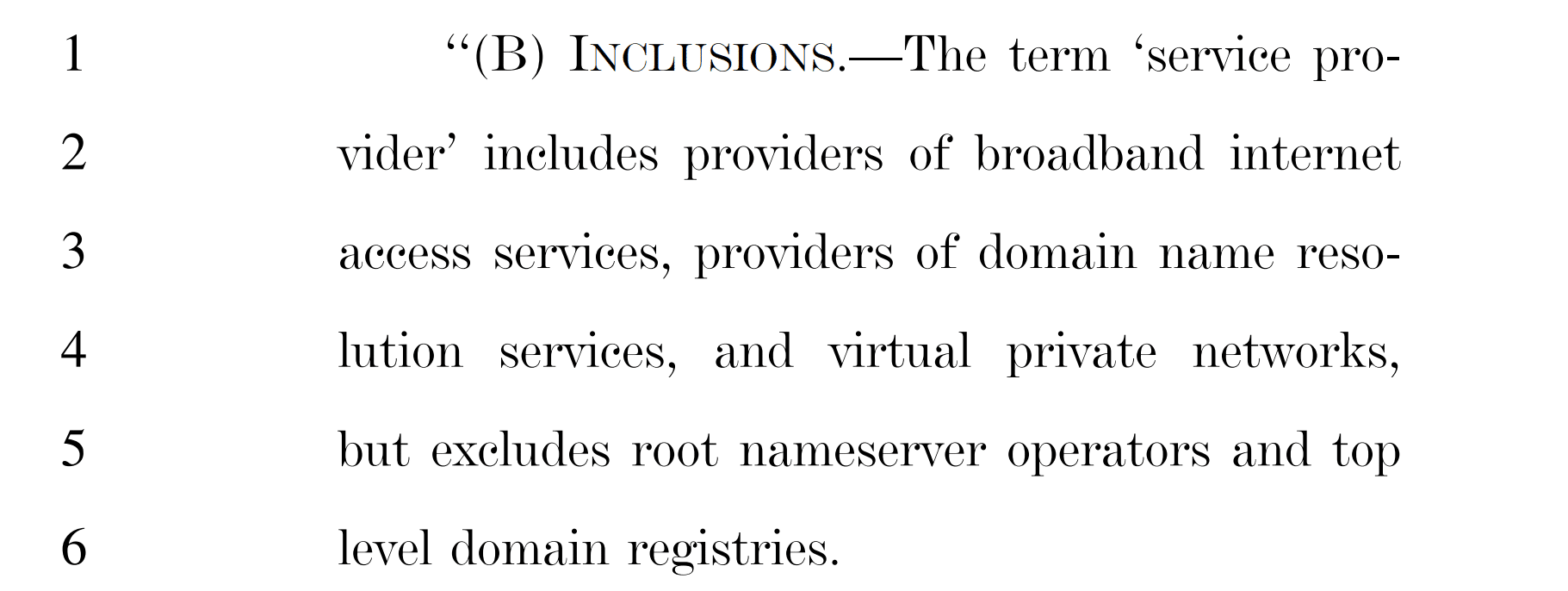
While domain name registries and root nameservers are expressly excluded from these requirements, virtual private network services are explicitly brought into the fold. The bill defines its scope by stating that the term "service provider" includes providers of broadband internet access services, providers of domain name resolution services, and virtual private networks, while excluding root nameserver operators and top-level domain registries.
This inclusion of VPNs represents a novel regulatory shift in the United States. The discussion draft reviewed by analysts previously specified that both internet service providers and DNS resolvers would be covered, making no mention of privacy tunnels or commercial proxy networks.
Although the legislation does not explicitly detail the motivations behind adding VPNs to the text, the move aligns with a broader international regulatory trend. Courts in European jurisdictions, notably in France and Spain, have increasingly issued orders compelling VPN providers to block access to unauthorized streaming and pirate websites, requiring a much wider net of digital intermediaries to participate in enforcement actions.
Crucially, smaller operations are spared from these obligations. The proposed bill carves out an exemption for any corporate entity that provides services to fewer than 100,000 monthly users or subscribers in the United States. Consequently, the legislation is tailored to target larger, mainstream commercial VPN providers rather than niche or boutique operators.
Blocking "From the United States"
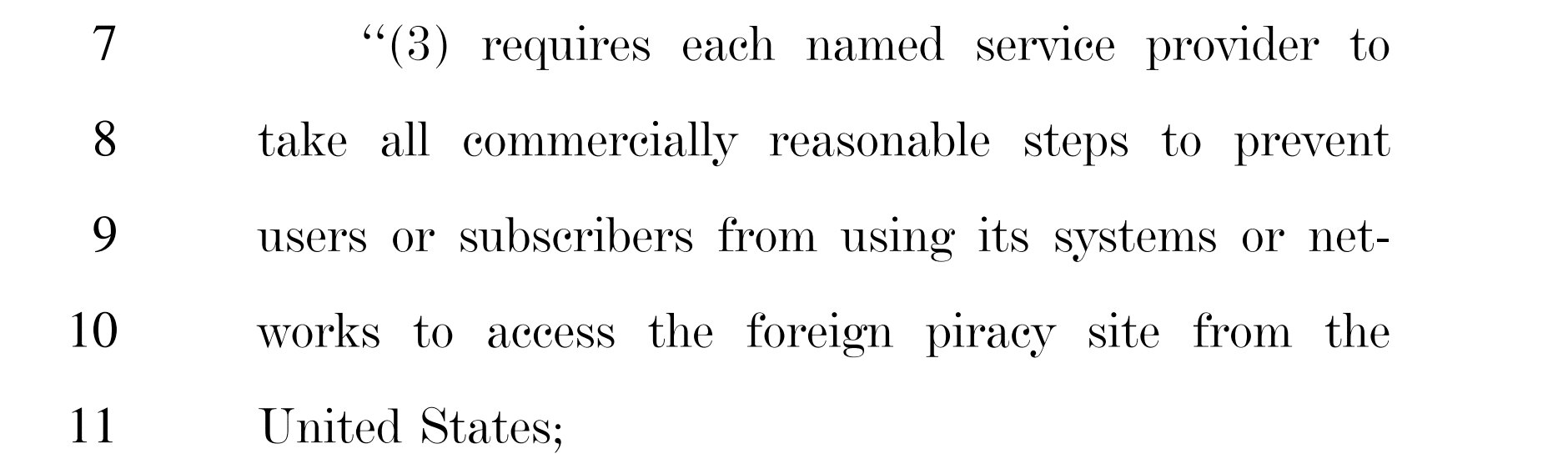
Once a federal court issues a site-blocking order, named providers face a compliance window ranging between 14 and 30 days. During this period, they are legally required to take all commercially reasonable steps to prevent users or subscribers from utilizing their systems or networks to access the designated foreign piracy site from within the United States.
For standard broadband internet service providers, meeting this requirement is relatively straightforward, typically involving DNS redirection or routing blackholes at the local network level. For a commercial VPN provider maintaining infrastructure across dozens of countries worldwide, however, the mandate introduces complex operational ambiguities.
A VPN provider could theoretically choose to implement the block exclusively on its United States-based servers. Under this approach, American subscribers would technically remain free to connect through proxy servers located in international hubs like Amsterdam or Toronto, while a foreign user connecting through a New York server might inadvertently experience the block.
Alternatively, a provider could choose to restrict access for any user connecting from an American IP address, regardless of the physical location of the server they select. Industry experts note this should be technically achievable without requiring the VPN to log or store individual user browsing histories.
Despite these distinct operational paths, the bill provides no guidance on how the technical implementation should be executed. Furthermore, federal judges are granted no authority to prescribe specific engineering techniques or mandates, leaving the tactical decisions entirely up to the service providers themselves.
VPN providers retain the right to contest their inclusion in proposed blocking orders. Before naming a provider in a final directive, the court is legally required to weigh several statutory factors, including the technical feasibility and efficacy of the proposed blocking mechanism.
Similar arguments were raised by VPN providers during legal battles in France, though they ultimately yielded limited relief. In those proceedings, a Paris court concluded that a strict zero-logs privacy policy does not legally or practically prevent a VPN provider from executing judicial site-blocking orders.
Live Sports Fast Track
Not all blocking orders governed by the legislation are subject to the standard 14-to-30-day compliance window. The proposed law empowers federal courts to shorten any statutory deadline upon a showing of good cause, a provision specifically designed to address time-sensitive events.
Representative Issa previously highlighted the rationale behind this mechanism during a congressional hearing. He emphasized that enforcement mechanisms must operate with extreme speed to protect live sports broadcasts, which lose their commercial value rapidly as games unfold. Questioning the limits of digital enforcement, he asked whether blocking actions could be executed quickly enough to neutralize clandestine commercial streams while live broadcasts are underway.
In addition to live sports, this time-sensitive fast-track carveout can be invoked to protect newly released movies and television shows that leak online shortly after their authorized release dates in the United States, specifically targeting infringements occurring within 24 hours of premiere windows.
Uncertain Legislative Future
The inclusion of VPNs is just one of several notable revisions introduced since the initial draft of the legislation circulated last year. As the debate evolves, tech policy organizations and civil liberties groups have begun voicing strong opposition. Prominent public interest groups, including Public Knowledge and the Re:Create Coalition, have issued statements criticizing the potential overreach of the bill.
Meanwhile, major rightsholders have remained relatively quiet during the initial rollout, with representatives for the Motion Picture Association indicating that formal statements would follow official press announcements from congressional offices.
Whether Representative Issa can successfully steer the legislation through Congress remains an open question. Because he is set to retire at the end of the current congressional term, he will not be positioned to reintroduce the measure if it fails to pass before the session concludes.
Adding to the legislative complexity, this is not the only site-blocking initiative currently taking shape in Washington. Lawmakers in both chambers are actively developing alternative frameworks, including a bicameral effort led by Senator Thom Tillis and Representative Zoe Lofgren.
Decades after the contentious debates that ultimately stalled the Stop Online Piracy Act, these concurrent legislative efforts signal that site-blocking policies have officially returned to the forefront of American intellectual property policy, sparking new competition among lawmakers on Capitol Hill.

Leave a Reply