Gregory Kurtzer, a prominent figure in the open-source and Linux ecosystem known for creating CentOS and co-founding Rocky Linux alongside enterprise support firm CIQ, has unveiled an entirely new operating system kernel. However, unlike his previous endeavors in the community-driven enterprise Linux space, Kurtzer did not write the majority of this code himself. Instead, the heavy lifting of implementation was executed entirely by an artificial intelligence agent.
The project, designated as Ginux, represents a radical experiment in systems software development. Rather than acting as a derivative or a fork of the traditional Linux kernel, Ginux is an independent, Rust-first x86-64 operating system kernel written completely from scratch.
Meet Ginux: Linux Userspace Without Linux Underneath
Announced publicly via social media, Ginux features its own proprietary memory management, process scheduler, process model, filesystems, networking stack, and device support infrastructure. Despite operating completely independently of the Linux kernel source tree, Ginux maintains binary compatibility by implementing the Linux Application Binary Interface (ABI). This crucial design choice enables existing, compiled Linux binaries to execute directly on top of the Ginux kernel without requiring any source code modifications.
In conceptual terms, the project treats Linux merely as a "personality" exposed by the underlying operating system rather than the core kernel itself.
While the naming convention of Ginux might initially suggest a hybrid or derivative of GNU and Linux, Kurtzer has clarified that this is not the case. The letter "G" in the project’s title officially stands for GPT, a tongue-in-cheek nod included in the software’s README file to keep his own ego in check. The entire codebase was generated by GPT-5.6 Sol working within a continuous development loop.
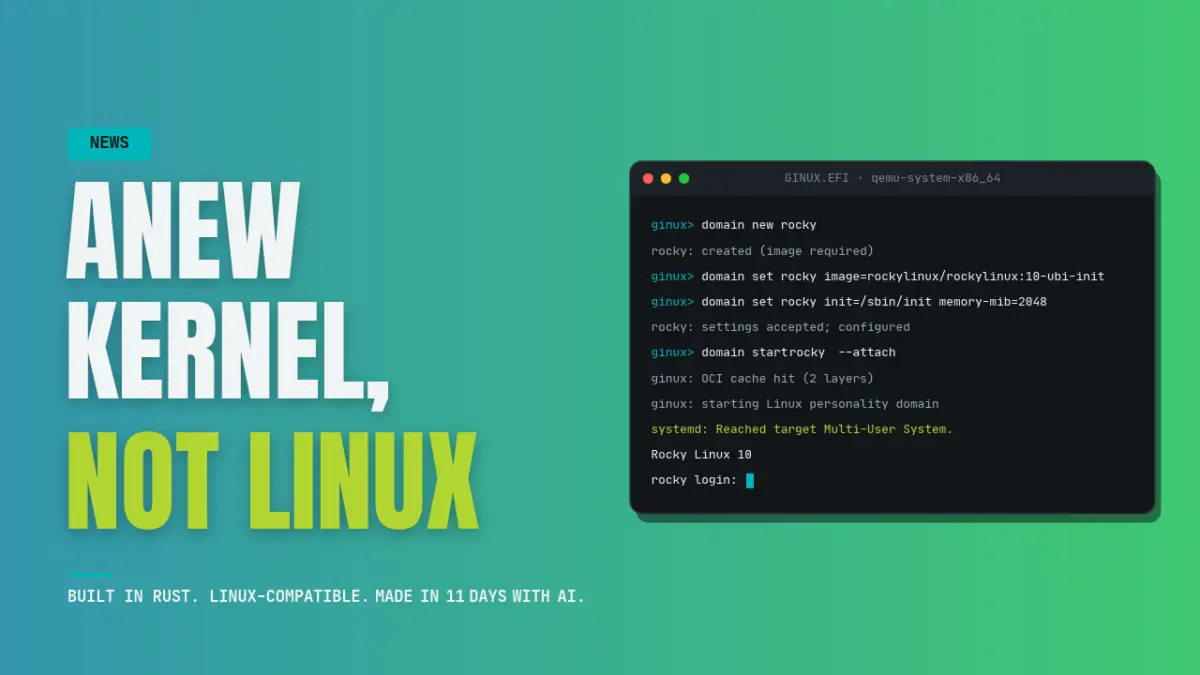
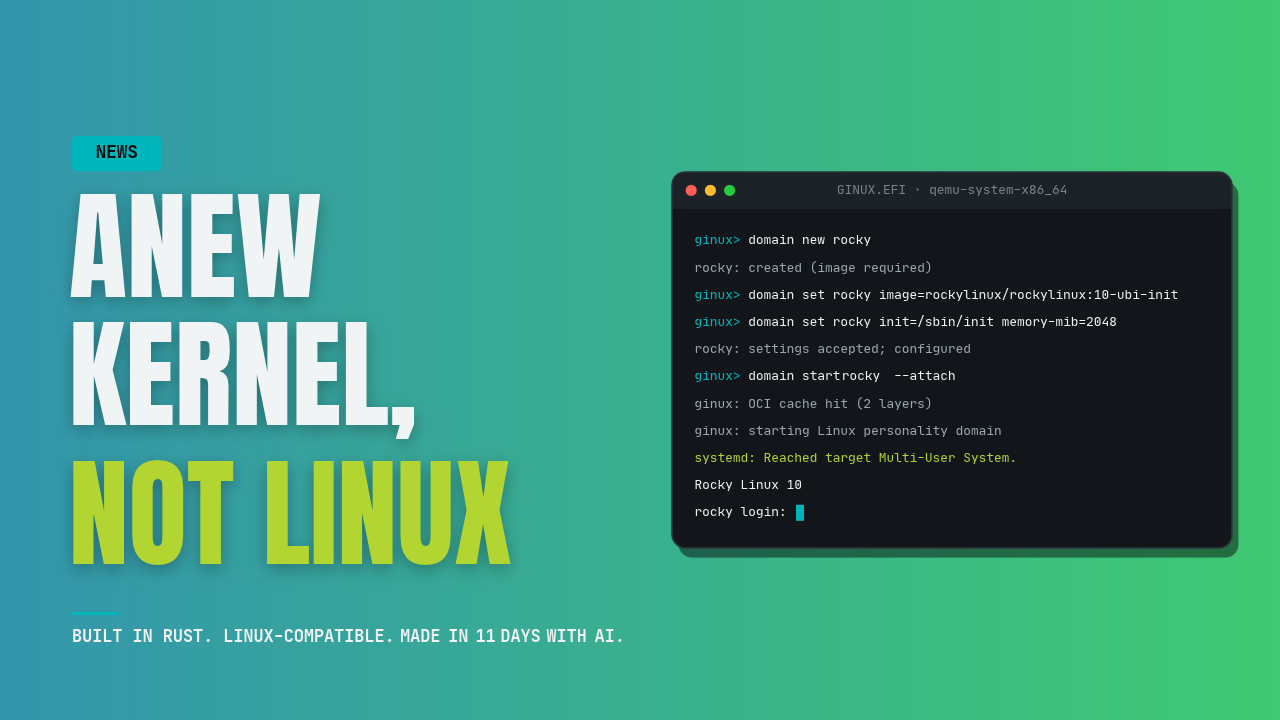
Kurtzer formally announced the project on social media, stating that he built a new Linux-compatible operating system kernel capable of booting Rocky Linux 10 complete with systemd in just eleven days. He achieved this milestone by pioneering what he terms Human-Directed Agentic Engineering.
What Ginux Can Accomplish Today
At its current stage of development, Ginux compiles into a single GINUX.EFI image capable of booting directly through UEFI firmware without relying on any host Linux kernel. The architecture isolates workloads into distinct "domains," each maintaining its own independent processes, address space, filesystems, and lifecycle management. According to the project documentation, these domains enforce significantly stronger security boundaries than traditional OCI containers or Linux namespaces.
Furthermore, Ginux can pull, parse, and verify OCI container images to assemble the root filesystem for a given domain. This capability forms the mechanism through which the kernel successfully boots Rocky Linux 10 all the way to systemd’s multi-user target environment. Selected Alpine Linux utilities utilizing the musl C library and BusyBox are also capable of running successfully within the environment.
Despite these technical achievements, expectations remain tempered. The software currently functions strictly within a QEMU virtual machine environment. It lacks physical hardware profiles, native support for modern high-performance interfaces like NVMe drives or discrete GPUs, and has not undergone independent security audits. Consequently, the project is distributed under the Apache 2.0 license strictly as a research prototype rather than a production-ready alternative to established operating systems.
Understanding Human-Directed Agentic Engineering
The development methodology behind Ginux, which Kurtzer has detailed in an extensive technical report published on Zenodo, may ultimately prove to be the most significant aspect of the release. Rather than relying on simple, ad-hoc prompts, the development process required a highly structured division of labor between human expertise and automated execution.
Under this framework, the human operator assumes responsibility for defining system architecture, establishing strict constraints, setting developmental milestones, writing acceptance criteria, and determining when a specific phase of work is complete. Meanwhile, the AI agent manages the iterative implementation loop: writing code, compiling it, booting the image in a virtualized environment, testing functionality, diagnosing failures, revising the codebase, and verifying the results against predetermined executable standards.
For Ginux, this workflow manifested as a persistent OpenAI Codex task utilizing GPT-5.6 Sol continuously over an eleven-day period. The collaboration yielded approximately 139,000 retained lines of functional implementation and test code spanning more than 1,000 distinct commits. Comprehensive architecture documents ensured the agent remained aligned with the project’s long-term design goals, while complex userspace environments like Rocky Linux served as rigorous testing grounds that caught subtle bugs which synthetic unit tests failed to detect.

Crucially, the "human-directed" qualifier remains essential to understanding the experiment. The process extends far beyond casually asking a chatbot to write a functional kernel without errors. Instead, it demonstrates the leverage achieved when an experienced systems architect with decades of domain knowledge directs an advanced agent capable of handling high-volume coding tasks.
The Intersection of Deep Expertise and Artificial Intelligence
Kurtzer remains cautious about overstating the current capabilities of AI in systems engineering. He notes that while artificial intelligence can successfully generate complex systems software, the fundamental challenges of ensuring long-term compatibility, robust security, comprehensive hardware support, adherence to industry standards, community adoption, and ongoing maintenance remain the true barriers to entry.
While a research prototype successfully booting systemd inside a virtual machine does not signal the immediate obsolescence of Linux—given the decades of collaborative code review, hardware enablement, and community development backing it—the project underscores a dramatic shift in productivity. Generating a brand-new, enterprise-compatible kernel from scratch in just eleven days using a frontier AI model highlights how rapidly development timelines can compress.
Rather than replacing human technical expertise, the project illustrates how an engineer possessing deep domain knowledge can leverage modern AI tools to condense years of laborious implementation work into a matter of days. When experienced professionals pair their expertise with advanced agentic workflows, projects that historically required large engineering teams and multi-year timelines begin to resemble accelerated prototyping efforts.