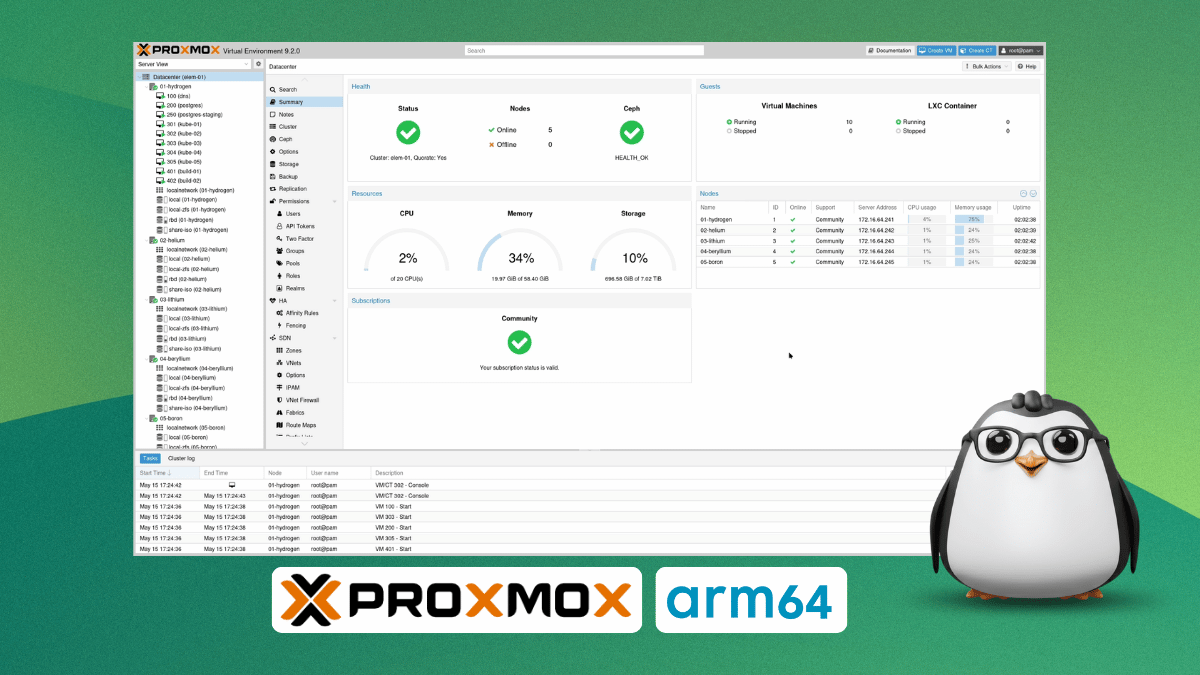
Tesco, the multinational supermarket titan with extensive operations spanning the United Kingdom and various European regions, is actively seeking new leadership to spearhead a major technological transition. The corporate group has posted a high-level job listing for a Head of Software Engineering to run its crucial Edge Platform. According to details first uncovered by industry publication The Register, the primary mandate for this new engineering leader will be orchestrating a wholesale migration away from VMware virtualization software toward Proxmox for all the IT infrastructure operating inside its physical brick-and-mortar store locations.
This strategic pivot marks a significant development in the retail giant’s enterprise architecture strategy. While public visibility into the migration plan has thus far been limited to this single career listing, the initiative points toward a substantial architectural shift. Tesco has not yet publicly disclosed the total number of retail stores covered under this sweeping migration initiative, nor has it provided a detailed timeline specifying how rapidly the nationwide and international rollout will proceed. Nevertheless, the search for a dedicated engineering head highlights the urgency and scale of the operational changes underway.
What Edge Means for a Supermarket
In modern enterprise computing terminology, edge computing refers to the practice of placing servers, storage infrastructure, and software applications as close as possible to the physical location where business operations actually take place. For a major traditional supermarket chain, that operational frontline is the local neighborhood store rather than a distant, centralized corporate datacenter.
Tesco’s internal documentation and career disclosures describe its proprietary Edge Platform as the foundational computing environment and software stack that allows critical applications to run seamlessly across hundreds of individual retail locations. Day-to-day supermarket operations—including customer checkouts, electronic payment processing, inventory management, and staff-facing administrative applications—entirely depend on the stability, speed, and reliability of this edge ecosystem.

The technical scope of this platform encompasses standard Linux operating systems, specialized server hardware, virtualization layers, and enterprise storage arrays. Maintaining these local systems presents unique engineering challenges. Individual store locations must maintain high availability and continue working reliably even when wide-area network connectivity is disrupted or when local hardware resources experience constraints. A poorly managed infrastructure change or a flawed software update at the edge can immediately interfere with store operations, slow down checkout queues, frustrate staff members, and negatively impact the overall customer shopping experience.
The Ask
To successfully execute this complex transition, the incoming Head of Software Engineering will face a demanding dual mandate. The first core responsibility centers entirely on the migration itself. This involves defining repeatable, standardized deployment architectures capable of supporting diverse store formats and hardware configurations. The engineering leader will be expected to oversee rigorous testing protocols for every system iteration prior to initiating gradual rollouts. Furthermore, they must champion automation across the entire lifecycle, encompassing automated installations, seamless upgrades, rapid rollbacks, and disaster recovery procedures.
Along this migration path, the engineering chief will also be tasked with actively managing technical dependencies and potential operational risks. Safeguarding critical store operations against downtime or failure during the transition period is an absolute prerequisite.
The second major responsibility involves building and scaling a unified management platform capable of overseeing every single retail location. This system is envisioned as an API-first framework designed specifically for automated provisioning, continuous monitoring, software patching, and remote infrastructure diagnostics. The management platform must be robust enough to cope with intermittent store network outages and prevent infrastructure drift, a common issue where individual store systems gradually diverge from their intended golden configuration.

Additionally, this overarching platform is expected to evolve independently from any single underlying infrastructure technology wherever practical, preventing future vendor lock-in. The successful candidate will assume leadership over multiple teams of engineering managers and principal engineers, with the job requirements explicitly citing deep technical proficiencies in enterprise languages and tools such as Java, Python, and Terraform.
Where the Exit Stands
The underlying motivations for Tesco’s sudden and dramatic architectural pivot away from VMware become clearer when examining the broader commercial relationship between the supermarket chain and VMware’s parent company, Broadcom. Tesco previously acquired perpetual VMware software licenses back in 2021, securing what leadership assumed would be long-term stability for its enterprise virtualization layer. However, following Broadcom’s acquisition of the virtualization giant, the corporate strategy shifted abruptly, and Broadcom officially ceased supporting those perpetual licensing models in January 2026.
Faced with the abrupt termination of vendor support, Tesco and other corporate clients have been forced to rely on costly third-party providers just to keep their legacy VMware environments operational in the interim. The fallout from these licensing changes has spilled over from technical boardrooms into the legal arena. In an active lawsuit filed against Broadcom, Tesco accuses the technology conglomerate of refusing to honor the terms of the original 2021 agreement and of leveraging its dominant market position to impose unreasonable commercial terms.
Within its legal filings, Tesco asserts that the end of 2027 represents the absolute earliest date by which it can realistically complete the complex migration off VMware infrastructure. The company has explicitly characterized this forced timeline as a significant, high-impact risk to its ongoing retail business operations. Underscoring the intensity of the commercial dispute, Tesco’s court documents allege that a contract renewal offer presented by Broadcom earlier this year came in at approximately 175 percent above the pricing structure guaranteed under its 2021 contract terms. As Tesco moves forward with its search for specialized engineering leadership, the race is officially on to decouple its store operations from VMware before time runs out.