As Ethernet Virtual Private Network (EVPN) fabrics become the standard architecture for modern data centers and cloud environments, network operators routinely encounter MAC/IP routes and MAC mobility events. While these occurrences are historically treated as normal operational artifacts—often triggered by routine virtual machine (VM) migrations—security experts warn that the underlying mechanisms governing MAC learning and mobility can be exploited. Recent technical analysis highlights how inherent design assumptions within EVPN control planes and classic Ethernet architecture may expose data center fabrics to subtle traffic redirection risks.
Understanding Normal MAC Mobility Versus Exploitation
In a standard virtualized infrastructure, live migration moves a running virtual machine from one hypervisor to another without altering its assigned MAC address. Upon arrival at the new host, the VM transmits a gratuitous Address Resolution Protocol (ARP) message, allowing the local leaf switch to learn the MAC address immediately before the information propagates across the broader network fabric. Border Gateway Protocol (BGP) then updates the routing paths with a single update, enabling active sessions to persist uninterrupted. A VM that undergoes hundreds of migrations will legitimately increment its move counter each time.
However, security researchers caution that assumptions regarding the legitimacy of these counters can be dangerous. A MAC address belonging to a static, non-migrating server can exhibit an escalating sequence number simply because another host within the same broadcast domain is continuously generating Ethernet frames bearing that exact address.
To trace the root of this vulnerability, engineers examine how MAC learning has evolved. Before the widespread adoption of EVPN, MAC learning operated entirely within the data plane. Switches and Provider Edge (PE) routers discovered MAC addresses by inspecting source addresses in incoming frames, populating forwarding tables, and letting entries age out after periods of inactivity.
EVPN fundamentally shifted this paradigm by moving MAC learning into the control plane. While a PE still learns local MAC addresses from the data plane when traffic arrives on an access port, it subsequently advertises those addresses to all other PEs via BGP. Remote PE routers learn subsequent MAC locations exclusively from these control-plane advertisements rather than through traditional flooding.

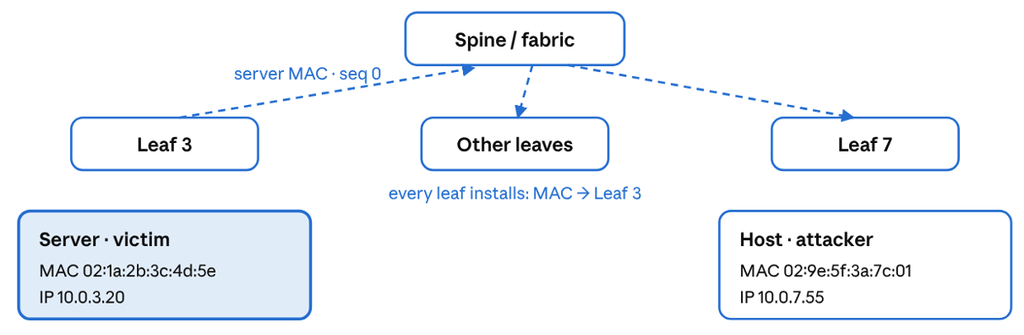
Consequently, a MAC move transforms into an explicit, trackable event. When a PE locally learns a MAC address it previously classified as remote, it re-advertises that address with a MAC mobility sequence number incremented by one. In legacy environments, a poisoned MAC injection would eventually age out, requiring continuous reinjection to maintain efficacy. Under EVPN, however, a forged frame directly influences a BGP advertisement with an elevated sequence number. Every PE across the fabric trusts and installs this updated information, relying upon it until the legitimate host eventually re-advertises its own presence.
The Exploitation Vector and Control-Plane Trust
This architectural vulnerability exposes a foundational weakness inherited from classic Ethernet: the protocol does not verify the ownership of a source MAC address. Any connected host can insert a neighbor’s MAC address into the source field of its frames, and the local leaf switch cannot distinguish the transmission from one originating from the legitimate owner. Exploiting this behavior requires neither privileged network access nor sophisticated packet manipulation tools.
Because Ethernet forwarding relies strictly on destination addresses rather than source addresses, an attacker does not need to intercept traffic originating from the victim. Instead, the attacker aims to attract traffic destined for the victim. Once the forged source address is processed, EVPN distributes the new route across the fabric, causing every leaf switch to update its forwarding entries to point toward the attacker’s port.
Workloads that communicate infrequently widen this operational vulnerability window. For instance, a storage target or backend database that remains idle for extended periods is a more attractive target for sustained spoofing than a heavily active, high-traffic virtual machine. While this form of manipulation does not grant direct administrative access to the underlying fabric, it expands an unauthorized actor’s visibility into bridge domains and diverts intended traffic streams.
The real-world impact of such manipulation often correlates with the nature of the workloads residing behind specific access ports. Hypervisors hosting direct virtual machines are typically more vulnerable to these hijacking attempts, whereas modern container platforms often introduce additional internal switching layers that complicate exploitation.

PE Behavior, Sequence Numbers, and Duplicate Detection Mechanisms
The operational mechanics of these events are governed by the MAC Mobility Extended Community, defined under RFC 7432 and integrated with MAC/IP Advertisement (Type-2) routes. This community is a transitive BGP Extended Community carried within the same UPDATE message as the Type-2 route. Every PE that imports the EVPN instance Route Target propagates the update, ensuring the mobility attribute accompanies the route across route reflectors.
When a PE learns a MAC address locally, it evaluates existing local entries, compares sequence numbers, and generates appropriate advertisements based on whether the move originates from a locally attached device or a remote PE.
To mitigate runaway mobility scenarios, RFC 7432 includes duplicate-detection guidelines. If a PE observes a MAC address moving a specified number of times within a defined timeframe—with default parameters often set to five moves within 180 seconds—it is expected to alert network operators and temporarily suppress the generation and processing of MAC/IP routes for that specific address.
However, hardware and software implementations across vendor platforms vary significantly in how they handle these events. For example, some vendors suppress a flagged MAC address until an operator manually clears the restriction, while others flush the address entirely and enforce a lengthy recovery period before retrying route processing.
These operational discrepancies underscore why the underlying threat relies on a combination of unauthenticated MAC origins and conservative rate-limiting safeguards. An attacker who strategically paces their transmissions to remain beneath default frequency thresholds can bypass detection triggers entirely. Furthermore, because counters are maintained independently per PE, activity distributed across multiple leaf switches is even less likely to raise automated alarms. Once monitoring windows expire, counters reset, allowing malicious activities to resume with minimal friction.
Even when duplicate-MAC protection mechanisms are triggered, they typically log a routine duplication event rather than flagging a malicious attack. These alerts frequently surface on different segments of the network fabric relative to where the anomalous activity originated, leaving route reflectors as the primary diagnostic viewpoint—a location operators rarely investigate first during initial triage.
Production Detection and Architectural Considerations
To address these visibility gaps in production environments, network operators increasingly turn to advanced telemetry. Rather than manually reviewing route-reflector logs, engineering teams can export real-time routing updates using the BGP Monitoring Protocol (BMP) defined in RFC 7854, streaming data to dedicated collectors. By continuously monitoring EVIs, MAC addresses, originators, Ethernet Segment Identifiers (ESIs), sticky flags, and sequence numbers, operators can detect anomalous route fluctuations more effectively.
This telemetry data must be cross-referenced against access-layer intelligence, including DHCP snooping bindings, IEEE 802.1X session tables, and IPAM inventories. Any Type-2 route conflicting with authenticated physical records warrants immediate scrutiny. Additionally, integrating duplicate-MAC and MAC-move syslog alerts into centralized Security Information and Event Management (SIEM) platforms helps engineering teams tune alerting thresholds and filter out operational noise.
Ultimately, the core challenge facing modern EVPN fabrics centers on an architectural question of trust. EVPN is intentionally engineered to trust information propagated by every leaf switch, accepting locally learned MAC addresses and remote BGP advertisements as authoritative without demanding additional cryptographic or contextual verification.
While data center operators naturally resist introducing heavy processing overhead that could degrade line-rate forwarding performance, security experts emphasize that trust must be anchored at the access edge. Implementing robust validation controls—such as port MAC limits, DHCP snooping, ARP inspection, IEEE 802.1X authentication, and sticky MAC entries for critical infrastructure—creates a more resilient security model. Without strict identity validation at the access layer, the EVPN control plane will faithfully propagate manipulated routing information at scale, making access-layer security an indispensable prerequisite for safeguarding the broader network fabric.