The landscape of Linux system administration and fleet management is undergoing a profound paradigm shift, driven by industry veterans who helped shape modern open-source infrastructure. Amutable, the innovative startup co-founded earlier this year by prominent developers Lennart Poettering, Christian Brauner, and Chris Kühl, has officially lifted the curtain on its flagship managed service offering: Amutable Foundations. Designed to revolutionize how organizations manage, secure, and update large-scale Linux deployments, Foundations merges cutting-edge immutable infrastructure principles with a managed control plane aimed at eliminating traditional administrative overhead and enhancing system security.
Prior to announcing this comprehensive managed platform, Amutable laid a solid technical groundwork by releasing two foundational open-source tools to the community. The first of these, known as "tine," is a Buck2-based build system specifically engineered to compose operating system images, made available under the Mozilla Public License 2.0. The second tool, "Quarry," leverages the Update Framework (TUF) to securely distribute those meticulously crafted images across machines, and is distributed under the Apache 2.0 license.
What Amutable Foundations brings to the enterprise table is a fully managed service layer built on top of these pillars. In this ecosystem, Amutable takes responsibility for running the operating system images, maintaining update repositories, operating the control plane, and delivering vulnerability fixes for organizations and individual operators who manage their own physical or virtual infrastructure. While the underlying build and distribution tools are open-source, the exact licensing terms for the company-run proprietary control components have not yet been formally stated, and the initial preview announcement leaves open the question of how much of Foundations beyond tine and Quarry will eventually be opened to the public.
What’s in the System?
At its core, Foundations is built around a rigid philosophy of immutability and cryptographic verification. The system architecture relies on read-only system volumes that are aggressively protected by the Linux kernel’s dm-verity subsystem, combined with signed unified kernel images and a measured boot process. Within this paradigm, both software packages and system configurations ship strictly as cryptographically signed images. A machine will only boot what has been explicitly signed, ensuring absolute integrity from the moment power is applied.
One of the most radical departures from traditional Linux administration found in Foundations is the deliberate absence of a traditional package manager, interactive shells, and Secure Shell (SSH) access. In an Amutable environment, system administrators do not log into individual machines to patch packages, edit configuration files, or troubleshoot runtime issues. Instead, any desired change or update means deploying a brand-new, fully signed image to every machine across the entire fleet.
This methodology ensures that images are entirely reproducible, complete with a comprehensive Software Bill of Materials (SBOM). Furthermore, these images are built from strictly pinned inputs of whatever upstream Linux distribution an organization chooses to utilize, with the tine build system possessing the native capability to import packages seamlessly from established distributions like Fedora or CentOS Stream.
How Machines Prove Their State
Security and compliance in Foundations are maintained through a continuous, cryptographic attestation loop rather than manual auditing. Each machine in a fleet automatically dispatches a signed report at regular intervals and during every boot sequence. This attestation report exhaustively records everything the machine has booted, spanning from the firmware and boot loader all the way up to the kernel, the operating system layers, and the active configuration parameters.

These digital signatures are backed securely by a Trusted Platform Module (TPM) or a CPU equipped with modern confidential computing support. For legacy infrastructure lacking such specialized hardware, machines can fall back gracefully to a software-based key.
Amutable’s centralized control plane is responsible for verifying these incoming reports, working directly with systemd-report—an experimental command introduced in systemd version 260, which the startup actively helped develop. The control plane compares each machine’s actual runtime report against its officially declared state, immediately flagging any systems that drift or deviate from the expected baseline.
Under this operational model, automated rollouts and updates only proceed for as long as machines can continuously prove they are operating in a verified, healthy state. System operators interact with their infrastructure through a structured, declarative interface rather than logging into interactive consoles. Software updates are delivered through isolated, per-machine repositories that can be linked together, with all downloads rigorously checked against signed metadata to guard against tampering, replay attacks, and unauthorized rollbacks.
This cryptographic proof of state is not merely used for monitoring; it is deeply integrated into operational access control. For instance, the system uses these state proofs to decide whether a node is permitted to join a cluster or receive sensitive data. In Amutable’s demonstration scenarios, database credentials are systematically withheld from any machine that attempts to boot with an outdated or unverified configuration.
Get into the Preview
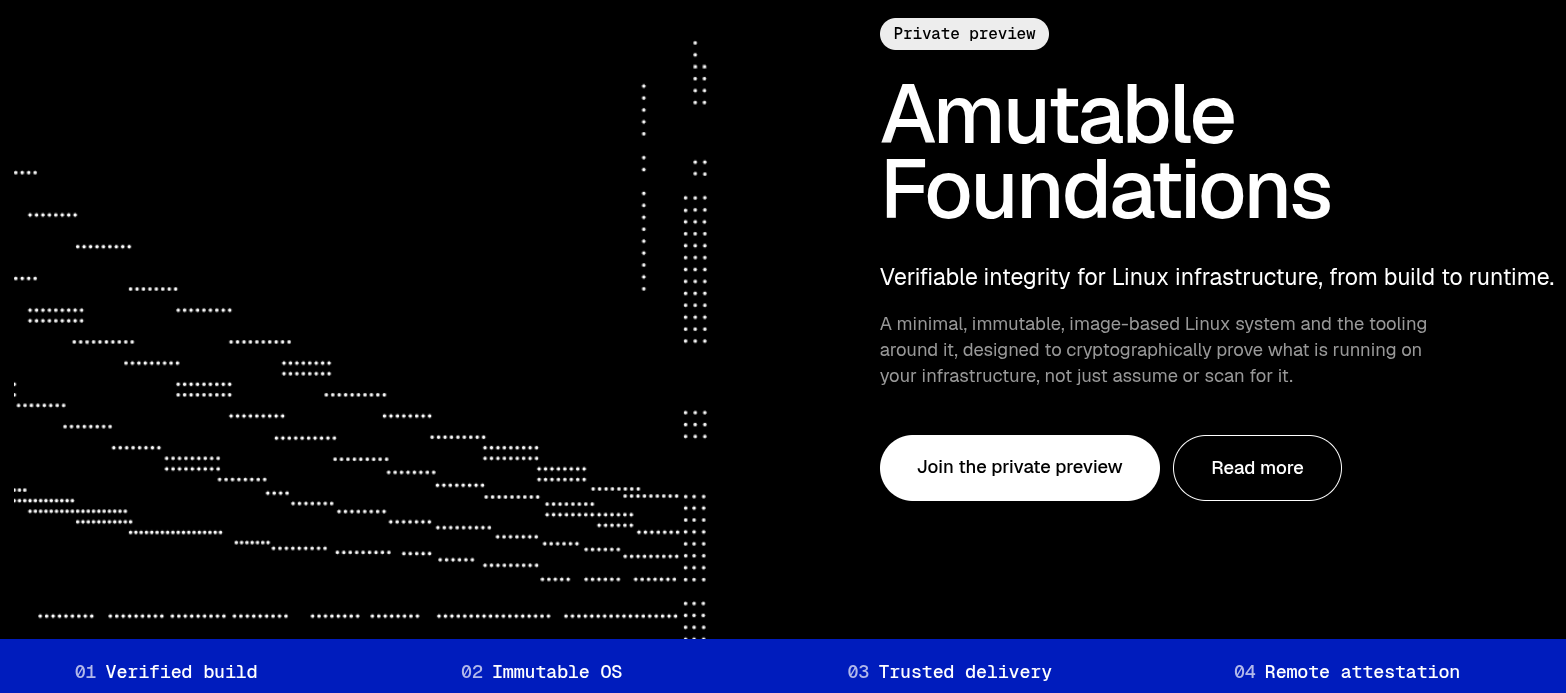
As Amutable prepares to bring its vision to the wider enterprise market, the company is actively seeking forward-thinking teams that manage complex Linux fleets and require robust, verifiable guarantees regarding the state of each machine. The startup expects to begin onboarding its first wave of designated "design partners" over the coming weeks.
These early partners will gain privileged access to the platform, establish a direct communication channel with the core developers, and wield direct influence over the future roadmap of the product. Organizations interested in participating can fill out a detailed signup form requesting professional credentials, company size, and industry context.
Looking ahead, Amutable is also setting its sights on native Kubernetes integration. Industry professionals and curious engineers eager to learn more about Foundations and its upcoming cloud-native capabilities can find the Amutable team present at Booth 347 during this year’s KubeCon North America conference in Salt Lake City.