Launched in February, TorrentClaw has rapidly established itself as a novel force within the digital landscape of torrent search engines and content aggregators. Built upon a foundation that combines links gathered from its proprietary Distributed Hash Table (DHT) crawler alongside dozens of external torrent sites and indexers, the platform has scaled dramatically. In just a few short months of operation, the site has amassed an extensive index containing more than six million torrents. This sprawling catalog spans everything from obscure independent projects to the latest Hollywood blockbusters and highly anticipated television series, positioning the engine as a prominent destination for users navigating the decentralized web.
At first glance, visitors to the homepage are immediately struck by a visual aesthetic that is notably more modern, polished, and streamlined than traditional torrent indexes. The interface carries unmistakable hallmarks of artificial intelligence-driven design, a characteristic that the platform’s operators do not attempt to conceal. On the contrary, artificial intelligence forms the literal and figurative heartbeat of TorrentClaw, playing a central, indispensable role in both its underlying technical development and its broader public-facing marketing strategy.
According to the platform’s core developers—who collectively operate under the pseudonym Deivid Soto—the entire architecture of TorrentClaw is conceived, constructed, and maintained with heavy reliance on modern AI workflows. Describing the technical stack behind the operation, Soto explains that the foundational framework relies heavily on Claude Code. This primary engine is combined strategically with a series of localized large language models tailored specifically to handle complex execution, parsing, and data ingestion tasks running continuously in the background.
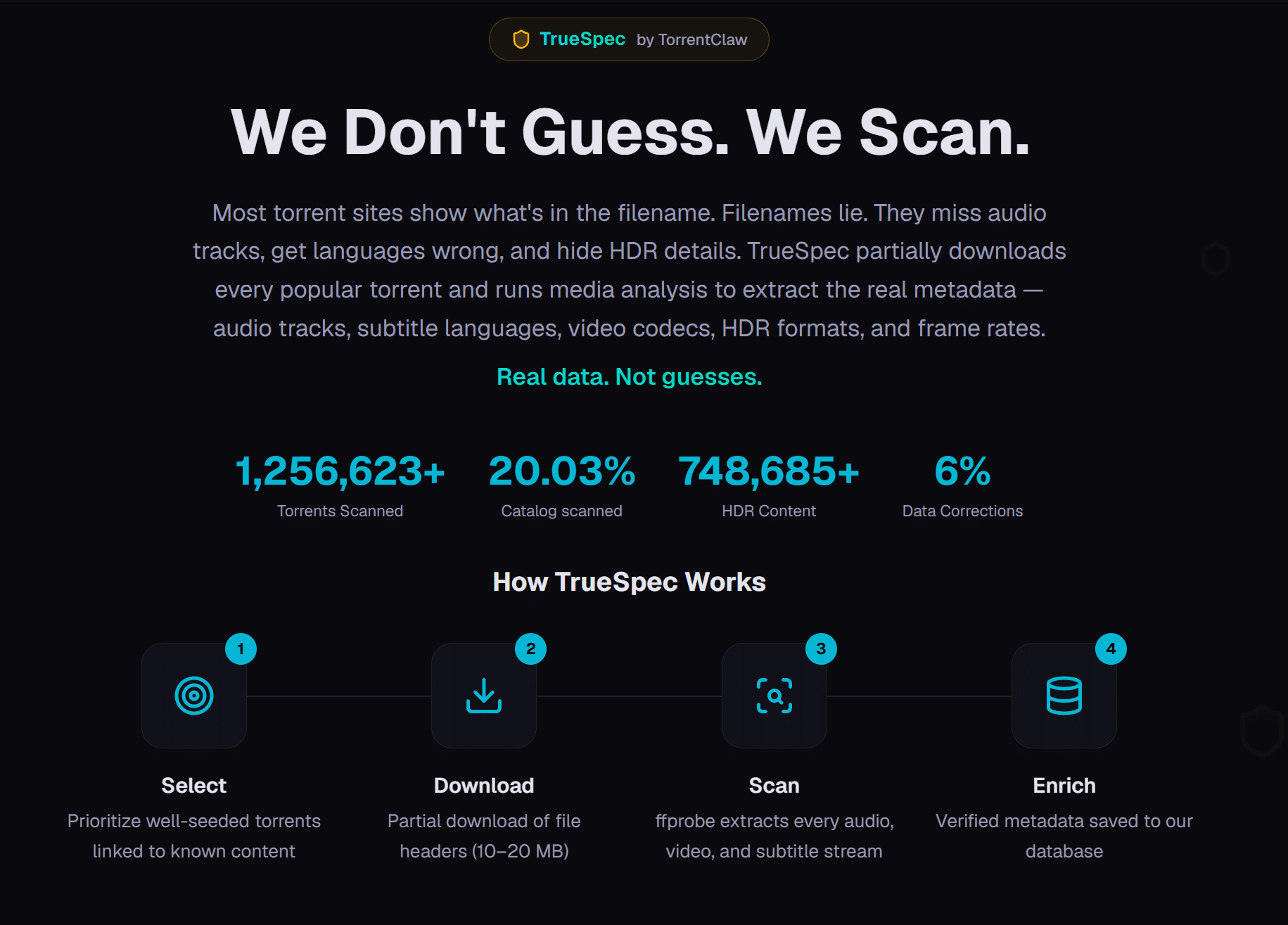
The practical application of these AI systems is evident across multiple facets of the site’s operations. For instance, artificial intelligence is deployed dynamically to parse raw torrent metadata and accurately match unstructured titles to verified film and television databases, ensuring that thousands of daily uploads are neatly organized without requiring massive manual intervention. This automated categorization process takes over administrative burdens that would traditionally demand extensive human moderation teams. Beyond simple data sorting, AI tools have been instrumental in constructing entirely novel utilities designed to protect the user base from common hazards inherent in decentralized file-sharing ecosystems. Among these custom-built innovations is a signature verification system known as TrueSpec, engineered specifically to audit torrents and determine whether files actually contain the media their release titles claim to offer, while simultaneously surfacing potential malware risks.
TrueSpec: Download and Verify
Within traditional torrent ecosystems, release names serve as the primary source of information for individuals searching for content. These standardized strings of text typically disclose vital technical details, including video resolution, audio codecs, compression formats, and the identity of the release group responsible for distributing the file. However, despite their widespread use, these names offer no inherent guarantee of accuracy. Mislabeled files, bait-and-switch uploads, and malicious payloads frequently infiltrate public networks. On well-run, private tracker communities, such discrepancies are typically managed manually by vigilant moderation staff. Conversely, automated public indexes and DHT scrapers generally lack the resources or active moderation personnel required to vet millions of incoming files. This persistent security gap provided the primary motivation for the development of TrueSpec.
TrueSpec operates by programmatically interacting with the underlying peer-to-peer swarms of indexed files. When evaluating a title, the system joins the active torrent swarm, reads the internal file structure and directory listing, and downloads a minimal fraction of the data pieces. Specifically, the tool retrieves just enough data—typically between 10 and 20 megabytes per torrent—to allow professional media analysis tools, such as the open-source utility ffprobe, to inspect the underlying video container headers and verify its structural integrity.
In addition to confirming that a video file matches its advertised resolution and runtime, TrueSpec subjects suspicious files to secondary security checks. The system extracts cryptographic hashes from executable files or suspicious payloads within the torrent package and queries them against VirusTotal’s extensive threat database. If the file size falls beneath established thresholds, the system automatically uploads the file fragments for a comprehensive remote scan. It is important to note that TorrentClaw does not operate its own proprietary antivirus engine; instead, all malware verdicts and security ratings are derived directly from VirusTotal’s aggregated threat intelligence feeds.
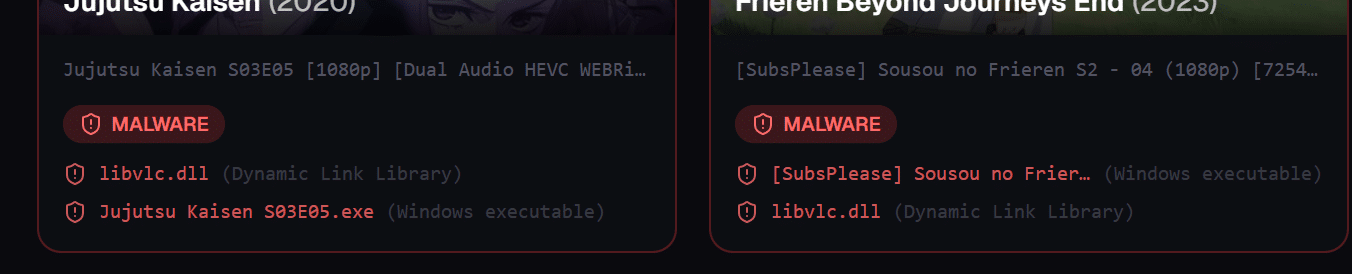
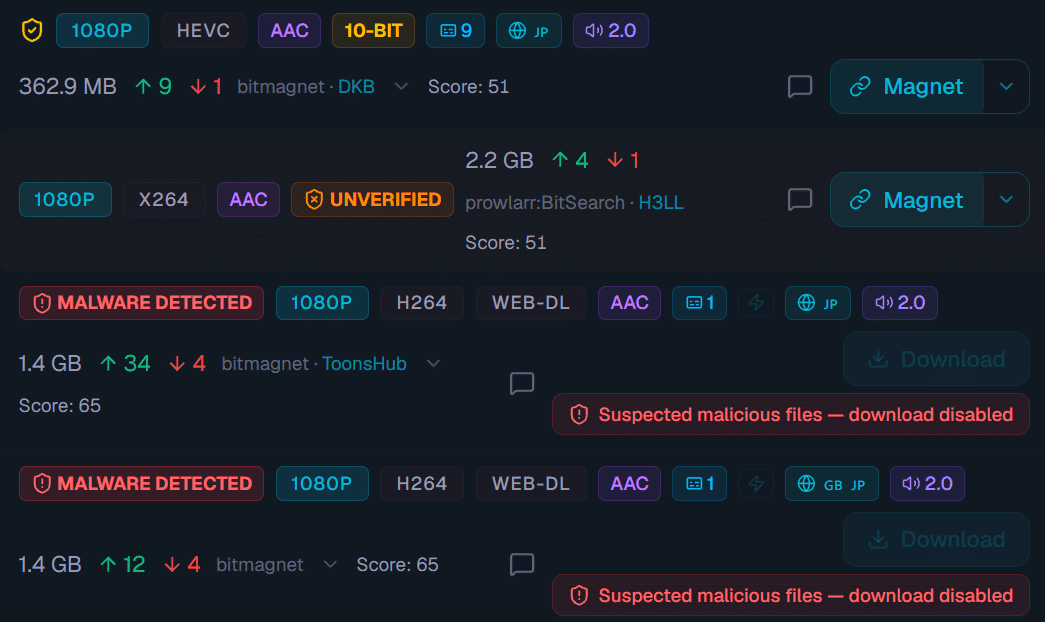
When TrueSpec successfully flags a file as containing malicious code, the torrent is not entirely removed from the platform’s searchable index. Instead, the listing remains visible to users but is prominently branded with a clear warning label reading "Malware detected," while the associated download links and magnet buttons are systematically disabled. To illustrate the real-world utility of this safeguard, developers noted an instance involving a fake episode of a popular animated series, Jujutsu Kaisen. Despite being flagged and having its download functionality disabled on TorrentClaw due to malware detection, the identical malicious torrent continued to circulate freely on external indexes while maintaining dozens of active seeders.
Not Perfect
Despite its innovative approach to automated safety, the TrueSpec system is not infallible, and its operational history reflects the challenges inherent in scaling automated content auditing. During early developmental datasets compiled in July, an initial run flagged an alarming 6,450 suspected malware cases. However, subsequent manual audits revealed that a significant portion of these flags were false positives. Among the misidentified items were entirely harmless legacy files, such as the well-known text and execution markers historically associated with older archiving groups, specialized fansub scripts designed to switch audio tracks dynamically on-the-fly, and basic scripts intended merely to open standard web pages in a browser.
Refined data collected later in the autumn painted a much more accurate and discerning picture of the platform’s security landscape. By narrowing its criteria to classify files as malware only when external threat databases like VirusTotal provide unambiguous confirmation, the count of verified malicious files dropped significantly to 34 instances. Independent reviews of these confirmed cases, which link directly to individual VirusTotal reports within the platform’s backend data logs, demonstrate a high degree of precision for the remaining flags.
Nevertheless, experts note that this current detection count is likely conservative. TrueSpec does not download large executable payloads, concentrates its verification efforts primarily on well-seeded torrent swarms, and remains entirely incapable of auditing dead or inactive swarms that lack active peers. Furthermore, because TorrentClaw’s primary indexing focus remains centered squarely on feature films and television series, pirated software applications, PC games, and independent software releases are largely omitted from the verification pipeline.
Malware detection represents only a fraction of TrueSpec’s overarching diagnostic capabilities. Across hundreds of thousands of probed torrents, a small percentage—approximately 1,265 files, representing less than 0.2 percent of the total checked inventory—were flagged as deceptive. These classifications typically covered deceptive submissions, such as executable programs disguised as video files or listings featuring grossly exaggerated video resolutions.

Interestingly, the single most common category of "mislabeling" identified by the system is largely harmless. More than half of all probed torrents—roughly 55 percent—include supplementary subtitle tracks that are not explicitly mentioned in the primary release title. TorrentClaw flags these omissions as missing metadata labels. However, industry standards and traditional scene distribution rules do not typically require subtitle languages to be embedded in standard release naming conventions unless the subtitles are permanently hardcoded directly into the video stream.
VLC Player Malware
A close examination of the confirmed malware cases uncovered by TrueSpec reveals a distinct and recurring tactical pattern. In 31 out of the 34 confirmed malicious incidents, the offending torrent packages contain a specific triad of files: an executable file cleverly renamed to match the title of a newly released film or television episode, a dynamic link library file named libvlc.dll, and a genuinely playable video file nested neatly within a secondary subfolder.
Upon technical analysis, the executable application included in these packages is revealed to be a verbatim, unaltered copy of the genuine VLC media player released by VideoLAN, complete with its official, valid digital code signature. The malicious component resides entirely within the accompanying DLL file. When the user launches the media player, the application automatically loads the compromised dynamic link library through standard execution procedures, triggering a payload that security engines universally flag as a dangerous trojan or information-stealing utility.
These malicious torrent packages are routinely disguised using the titles of high-profile entertainment properties. Recent examples identified by the verification engine include leaked or early-release episodes of trending streaming series such as The Boys, Jujutsu Kaisen, and Frieren, alongside major cinematic releases including Dune: Part Three and upcoming animated features. To maximize user deception, the uploaders frequently append the recognized monikers of established distribution and fansub groups, such as SubsPlease, ETHEL, and YTS, lending an undeserved air of authenticity to the compromised files.
This specific vector of attack is well-documented within cybersecurity research circles. Earlier in the year, independent security analysts detailed a coordinated distribution campaign that leveraged compromised accounts to upload fraudulent releases mimicking trusted fansub groups onto public indexes, successfully propagating information-stealing malware to unsuspecting viewers. TorrentClaw’s logging indicates that the 31 malicious torrents identified by its systems were initially harvested between February and August. The vast majority—22 instances—were discovered directly through the platform’s internal DHT crawler, while the remainder were ingested from external aggregators such as Nyaa, The Pirate Bay, and TorrentDownload. Notably, all of these malicious listings possessed active seeders at the time of initial indexing, and a significant portion remained active in public swarms months later.
Built For AI, By AI
TrueSpec represents only one component of TorrentClaw’s distinct technological ecosystem. In a move that further separates the platform from legacy directory sites, the service provides a native Model Context Protocol (MCP) server. This specialized integration allows modern artificial intelligence assistants and development environments, such as Claude and Cursor, to directly interface with the search index, query the database, and fetch .torrent files autonomously.
From a practical standpoint, this architecture enables users to instruct an AI assistant to locate a specific media release and retrieve the corresponding torrent file entirely through conversational prompts, without ever needing to visit the web interface. According to developers, this API sees substantial traffic, with individual automated accounts making upward of 10,000 API requests per day—suggesting that third-party services and automated scripts are actively integrating the search engine into their own workflows.
Despite the computational complexity involved in running continuous DHT scraping, metadata parsing, and partial file verification, the operational overhead remains remarkably low. Platform operators noted that the entire infrastructure required to execute TrueSpec operated on a modest cluster of just three server nodes, with combined monthly hosting expenses well under fifty dollars. Highlighting the economic feasibility of the system, Soto emphasized an implicit takeaway for the broader industry: if comprehensive, automated file verification can be achieved at such minimal cost, the absence of similar safety measures across other major indexers is a choice rather than a technical limitation.
At the same time, the practice of programmatically downloading partial content from hundreds of thousands of decentralized torrent swarms introduces significant legal vulnerabilities. While TorrentClaw’s official Digital Millennium Copyright Act (DMCA) policy explicitly states that the platform does not host, store, upload, or physically distribute copyrighted files, rightsholders and intellectual property enforcement agencies may interpret automated crawling and verification routines differently.
Addressing potential legal scrutiny, Soto describes TrueSpec strictly as a specialized, read-only client that neither uploads nor participates in data seeding. The software merely connects to the swarm long enough to fetch the initial data blocks required to read container headers before purging the cache entirely. The developers maintain that no content is permanently retained or served to end-users, and that the platform processes every valid takedown notice it receives.
In keeping with its overarching operational philosophy, TorrentClaw even utilizes artificial intelligence to manage its legal compliance workflows. The site introduced an AI-managed takedown processing system designed to handle inbound copyright infringement notices efficiently. Prior to the implementation of this automated system, the platform had accumulated roughly 300 notices, the vast majority of which consisted of duplicate submissions.
To sustain its infrastructure and ongoing development, TorrentClaw has introduced tiered subscription models. The platform offers a basic professional tier for $3.99 per month, alongside an enhanced bundle priced at $6.99 monthly that integrates a virtual private network service. Whether this commercial monetization model will prove viable within a legal environment hostile to commercialized piracy services remains to be seen, as paid platforms historically attract significantly higher levels of scrutiny from legal enforcement bodies than their entirely free counterparts.