The shifting tides of global Internet infrastructure took center stage in mid-October 2026 as network operators, engineers, and industry leaders gathered in Miami, Florida, for the North American Network Operators Group (NANOG) 98 meeting. Delivering the opening keynote presentation, Paul Brodsky of TeleGeography provided a comprehensive look at the historical trajectories, current pressures, and future economic realities shaping the backbone of the global network.
The overarching story of Internet infrastructure since its commercial inception has been defined by unrelenting demand growth. During the early 1990s, growth rates surged at extraordinary levels as the United States’ core National Science Foundation Network (NSFNET) transitioned into a mixed infrastructure. In this new era, commercial providers were established in parallel with existing academic and research networks, making annual growth rates of 100% common across all segments of the system.
Managing such massive expansion over extended periods poses severe operational challenges. It demands a continuous refresh of underlying hardware alongside periodic, comprehensive overhauls of internal network architecture. While overall growth rates have naturally moderated from those unsustainable early peaks, positive expansion has persisted to the present day, keeping the pressure on network operators and infrastructure planners.
To cope with this relentless tide, the industry recently completed a major architectural shift. This involved the large-scale adoption of replicated service points and the overlay of content distribution networks (CDNs). By pre-provisioning content and services closer to end users, network operators successfully matched modern demands for on-demand access. The primary motivation behind this redesign was to push growth pressures and the associated infrastructure investment costs out to the network edge, thereby relieving strain on operators managing the inner core of the network.
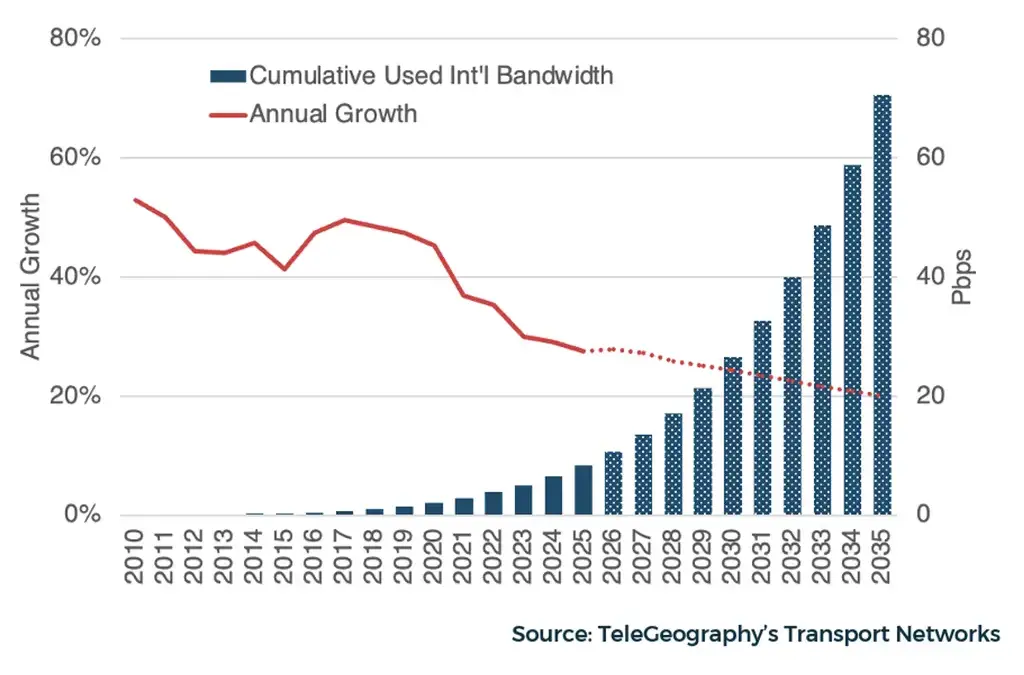
This structural decentralization has proven somewhat effective at managing aggregate growth. When examining international bandwidth expansion over the past 15 years, annual growth rates appear to be declining year-by-year. However, today’s annualized growth rate of roughly 30% still represents a massive absolute increase in total international capacity requirements. Each successive year demands increasing volumes of in-service capacity—currently sitting at two Petabits per second (Pbps) annually—a figure projected to surge past ten Pbps of additional global capacity per year by 2035.

Compounding this rising demand is the finite service life of subsea cable infrastructure, which typically spans approximately 25 years. A substantial portion of the international cable capacity installed around the turn of the century has now reached the end of its operational lifecycle. Industry estimates indicate that roughly a quarter of the world’s current subsea cable kilometers will be decommissioned and retired by 2030.
Fortunately, the technological capacity of submarine cables has advanced dramatically. Modern systems incorporate a greater number of fiber pairs within a single physical cable, expand optical transmission capacity through the deployment of L and C band optics, and increasingly utilize two-core fiber strands instead of traditional single-core designs. These innovations have consistently driven down the unit cost of capacity, a trend clearly reflected in the market lease prices for major transatlantic and transpacific routes. Falling unit costs naturally expose latent demand, which in turn fuels further investments in capacity. These higher-capacity systems can subsequently operate with greater efficiency, driving the unit costs of future cable installations down even further.
The convergence of aging submarine cable inventories, improving system efficiencies, growing overall traffic demand, and an industry-wide desire for route diversity and resilience is spurring sustained capital expenditure. Current announcements for new cable projects indicate that global investments will range between USD 5 billion and USD 6 billion annually over the 2026 through 2029 period.
Funding sources for these massive capital projects have shifted markedly in recent years. Major hyperscalers—specifically Google, Meta, Microsoft, and Amazon—have significantly expanded their direct financial involvement in submarine cable development. Today, approximately 38% of cable investments are funded entirely by these four technology giants to operate as private services for their own exclusive use. An additional 25% of projects involve hyperscaler participation through consortium arrangements, while the remaining 37% of funding proceeds entirely without hyperscaler involvement.
This investment landscape varies considerably by geographic region. The transatlantic route has become the most extreme example of privately owned and operated subsea infrastructure, with roughly 85% of its capacity now funded directly by private hyperscalers. Google and Meta have emerged as the most active players in this arena, maintaining extensive private portfolios of owned cables.

This rapid pivot toward private cable infrastructure stems from the high degree of economic concentration within the modern Internet market. Substantial market shares have enabled hyperscalers to accumulate deep capital reserves, empowering them to construct and operate private cable systems that grant them complete control over service delivery without third-party dependencies. Conversely, traditional consortium models have become less appealing when a single dominant lessee controls a massive proportion of a cable’s total capacity. If such a dominant tenant were to withdraw, the financial viability of the consortium could collapse, leaving founding entities with stranded assets. Consequently, the rise of private cable systems emerged as a natural market adaptation.
Despite their efficiency, these private cable networks have drawn scrutiny from various quarters. Several governments have voiced concerns regarding the growing centralization of international communications conduits under the control of foreign private entities. This trend also raises difficult questions concerning national sovereign control over the specialized submarine repair vessel fleet and existing maintenance pooling arrangements established within formal submarine cable maintenance zones. Given that these international links constitute critical national infrastructure capable of suffering severe economic and societal consequences if disrupted, relying on foreign private entities for essential communications platforms can introduce strategic vulnerabilities.
The contemporary dominance of fiber-optic cables represents a complete displacement of an earlier era’s heavy reliance on satellite communications. Throughout the 1960s, geostationary orbit (GEO) satellite systems were utilized to support nearly all forms of international communication. However, the geostationary orbital plane remains a constrained resource, currently accommodating 569 active spacecraft. Furthermore, bouncing data packets off a spacecraft stationed 36,000 kilometers above the Earth introduces unavoidable latency. Once submarine fiber networks matured, major users transitioned their international communications traffic to terrestrial and subsea lines as rapidly as those networks expanded their geographic reach.
Services that remained anchored to geostationary spacecraft were largely restricted to broadcast applications and communications directed toward otherwise unreachable destinations. However, continuous refinements in signal processing capabilities combined with the advent of reusable rocketry have enabled a new generation of physically compact spacecraft deployed into Low Earth Orbit (LEO). Because these LEO satellites maintain a relatively small signal footprint, constellations require thousands of individual spacecraft, with user connections handing off seamlessly from satellite to satellite every few seconds. This architecture sustains data throughput rates scaling into hundreds of megabits per second.
Advanced inter-satellite laser links allow data packets to be relayed directly across the spacecraft constellation, spanning vast oceans while relying on a comparatively sparse network of terrestrial ground stations. For end users equipped with appropriate antennas, the capacity and latency profiles of LEO services are increasingly comparable to traditional terrestrial broadband infrastructure.
The capital expenditure required to deploy these satellite networks is immense. SpaceX has invested over USD 20 billion into its Starlink platform, and Amazon’s competing LEO initiative is projected to incur a similar USD 20 billion investment. By comparison, the total projected capital expenditure for all new submarine cable systems globally between 2026 and 2029 amounts to approximately USD 22 billion.
Financial returns on these respective investments highlight divergent business models. During the third quarter of 2026, Starlink reported quarterly revenues of USD 5.25 billion alongside a net profit of USD 2.4 billion, translating to an annualized profit of roughly USD 9.6 billion on its initial USD 20 billion outlay—representing an impressive return on capital of 48%. In contrast, institutional investors backing consortium submarine cables typically target a return of 12% to 14%, while traditional terrestrial broadband infrastructure generally yields a return on investment between 5.5% and 9%.
The primary financial divergence between subsea cables and LEO satellite platforms lies in their distinct market positioning. Starlink operates primarily as a last-mile access provider utilizing a direct retail model to service niche user segments located in remote or underserved geographic regions. As a retail provider of last resort enjoying an effective monopoly within those specific sectors, Starlink can command premium pricing without splitting revenues through intermediary retail chains. Furthermore, the steep USD 20 billion capital barrier required to enter the LEO market effectively deters broader direct competition. Submarine cable systems, by comparison, feature significantly lower capital barriers to entry—ranging between USD 100 million and USD 400 million per system—with their more modest financial returns reflecting a higher baseline likelihood of competitive market pressure.
While Amazon’s forthcoming LEO service introduces the potential to disrupt Starlink’s market position, the ultimate strategic positioning of Amazon’s service remains to be seen. Industry analysts emphasize that LEO satellite constellations and submarine cables ultimately serve distinct, non-overlapping market segments with little direct competition. LEO systems specialize in last-mile connectivity for challenging environments, whereas submarine cable systems provide high-volume, low-risk platforms capable of moving bulk data across the core of globally distributed digital platforms. Rather than competing head-to-head, these technologies function as complementary pillars of the modern global network.