
Each year, the Office of the United States Trade Representative invites rightsholders from various entertainment and technology sectors to nominate the foreign piracy websites and services they consider to be the most severe threats to intellectual property.
The resulting list of notorious markets traditionally focuses on a familiar cast of digital infractions, including torrent indexing platforms, cyberlockers, and unauthorized streaming portals. In recent years, however, the scope of these nominations has expanded to encompass hosting companies, cloud infrastructure providers, and other digital intermediaries that facilitate large-scale copyright infringement.
Last week, the Entertainment Software Association, which represents many of the world’s leading video game developers and publishers, submitted its latest round of official recommendations to the trade representative. While the submission includes several established targets within the digital piracy ecosystem, it also trains its crosshairs on an entity that does not operate a traditional website of its own, signaling a strategic shift in how the industry approaches upstream piracy operations.
A Game Cracker as a Piracy Market
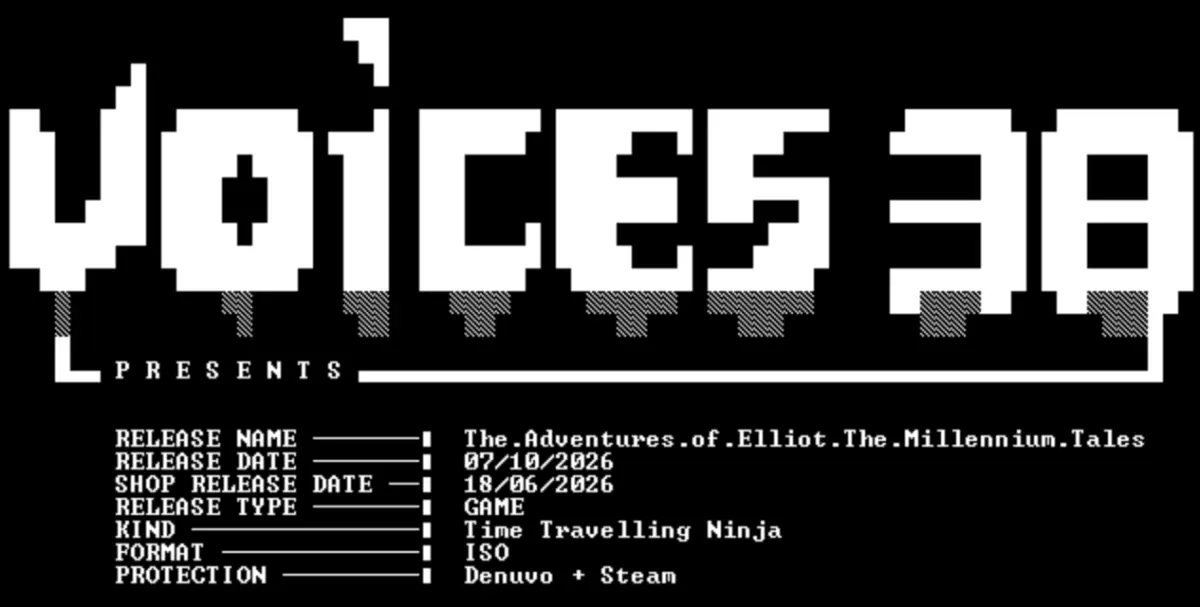
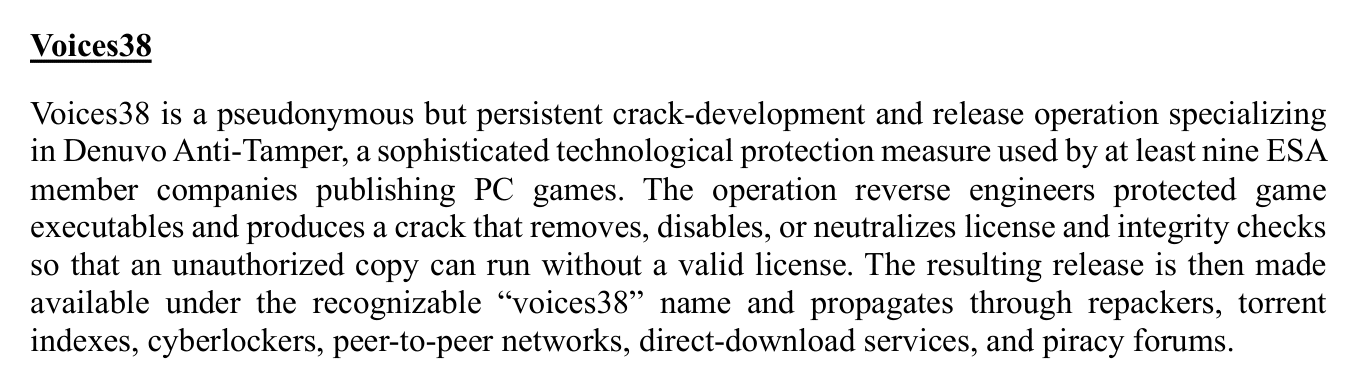
At the forefront of the ESA’s latest submission is an anonymous software cracker operating under the handle "voices38." The video game industry advocacy group describes this elusive figure as a persistent and highly specialized operation dedicated to defeating Denuvo Anti-Tamper, the sophisticated digital rights management and technical protection measure utilized by at least nine major ESA member companies to safeguard their intellectual property against unauthorized distribution.

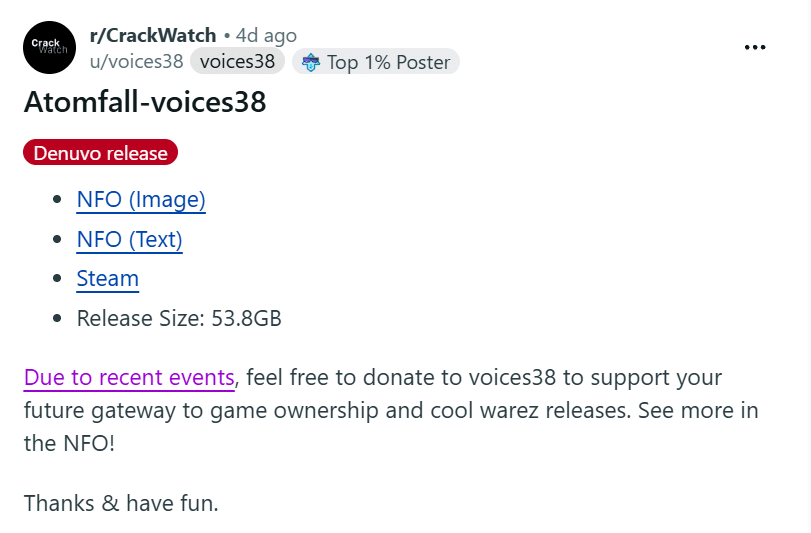
According to the industry group’s findings, the r/CrackWatch index on Reddit attributes approximately two dozen cracked or entirely bypassed games to the "voices38" identifier. The ESA emphasizes that this anonymous cracker plays a foundational role in the modern gaming piracy ecosystem, serving as the primary source for releases that are subsequently harvested, repackaged, and distributed by torrent sites, cyberlockers, and specialized piracy forums across the global web.
In its official filing, the organization argues that focusing solely on downstream distribution channels creates a blind spot in enforcement efforts. Each individual crack unlocks an entire downstream market for unauthorized copies of a video game title. For major releases that no other cracking actor has managed to make usable, the intervention of "voices38" creates the sole functioning pirated copy available for those secondary markets to offer. Consequently, the ESA contends that ignoring the upstream operation that determines whether protected games can be distributed at all overlooks the true root of the commercial infringement chain.
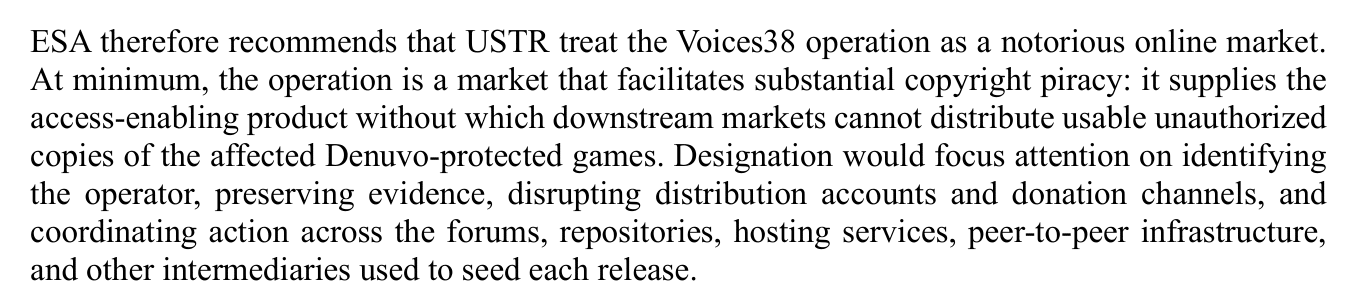
The fact that the cracker lacks a public identity, a traditional corporate structure, or even a conventional homepage should not disqualify the operation from a notorious designation, the ESA maintains. On the contrary, the group argues that formally labeling the entity as a notorious market could catalyze concerted international action and focus necessary attention on identifying the operator, preserving vital digital evidence, disrupting distribution accounts, and cutting off financial donation channels. Furthermore, such a designation could aid in coordinating enforcement actions across the diverse array of forums, code repositories, hosting services, and peer-to-peer infrastructure used to seed each unauthorized release.
Ideally, the video game association aims to unmask the individual or individuals behind the popular cracker handle, an objective shared by other stakeholders within the industry. Identifying the anonymous operator is also the core focus of ongoing legal actions unfolding within the United States federal court system.
Lawsuits and Persistent Releases
Last month, Denuvo initiated legal proceedings against "voices38" in a California federal court, subsequently asking for judicial permission to issue subpoenas to major digital platforms including Discord, Valve, and Reddit in an effort to trace financial and digital footprints. Although the ESA’s trade submission does not explicitly mention this ongoing federal lawsuit, the parallel tracks highlight a coordinated industry push to dismantle the bottleneck of high-profile game cracking.
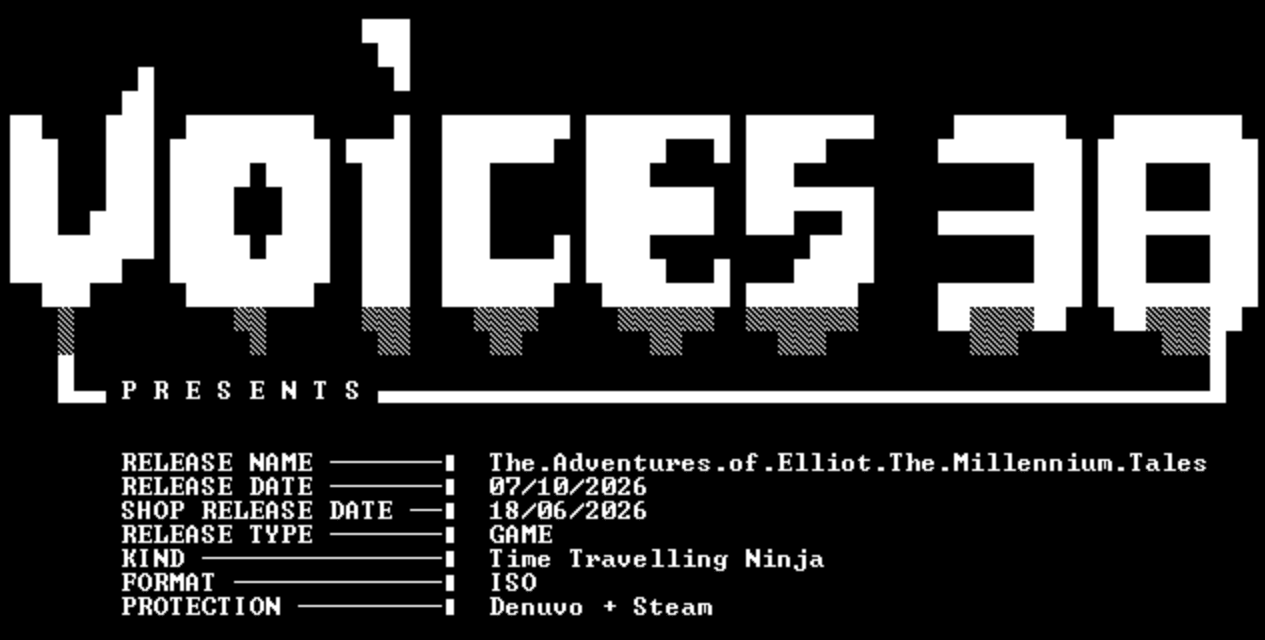
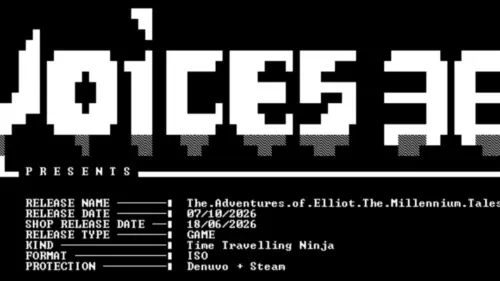
So far, however, the mounting legal pressure and public exposure have not stemmed the flow of newly cracked software. Following a relatively quiet period of activity, "voices38" recently released unauthorized cracks for high-profile titles such as Atomfall and The Adventures of Elliot: The Millennium Tales, alongside a critical crackfix for the Dead Space Remake.
These releases swiftly propagated across international peer-to-peer networks, torrent indices, and commercial cyberlockers. Prominent software repacker FitGirl quickly incorporated the newly available cracks into compressed distributions, bringing the discussion directly to the ESA’s next major target on the global piracy landscape.
Billion-Dollar Scale of FitGirl
Having already been featured prominently in the U.S. Trade Representative’s notorious markets lists for previous years, the popular repack site FitGirl has earned another formal recommendation from the ESA for the upcoming review cycle.
Despite national-level domain blocking and internet service provider restrictions implemented in countries such as Germany, Italy, and Spain, the ESA notes that these regulatory hurdles have produced minimal operational impact. The high-traffic repack portal recorded nearly 42 million visits during the month of August alone, continuing to offer a vast catalogue of video games published by ESA member companies with complete immunity to standard copyright enforcement mechanisms.
The scale and persistence of the operation demonstrate that prior site blocking and official designations have failed to induce meaningful remediation by the site’s anonymous operator, according to the gaming association. Takedown notices sent directly by the ESA are routinely ignored, with zero infringing links removed from the platform across a twelve-month observation window.
To quantify the economic impact of these distribution networks, the game companies calculated estimated losses down to the final cent. Between March and August of this year, the ESA detected more than 15.4 million distinct users participating in peer-to-peer swarms specifically for games repacked and distributed by FitGirl. Multiplying that user count by a standard retail price point of $69.99 for every individual detected in a swarm yielded an estimated lost market value exceeding $1.08 billion.
Other major targets in the submission exhibit a similarly low rate of compliance. The alternative distribution hub DODI-Repacks removed only a fraction of reported infringing links, while RuTracker, the prominent Russian-language torrent platform, complied with a negligible percentage of the copyright notices issued by the ESA over the past year.
To combat these unresponsive entities, the trade submission suggests that investigators track digital financial flows, including cryptocurrency transactions directed toward platforms that utilize strict Know Your Customer verification protocols, as a viable pathway toward unmasking anonymous operators.
Handheld Consoles and Digital Super-Fakes
This year’s review conducted by the trade representative carries a specialized focus on high-quality counterfeit merchandise commonly referred to as "superfakes." The ESA seized upon this thematic emphasis to draw an explicit parallel within the digital entertainment sector, highlighting specialized handheld emulation consoles that come preloaded with vast libraries of pirated video games.
The industry group formally nominated Anbernic.com, which serves as the official storefront for a widely distributed line of portable handheld emulation devices. According to the ESA, these hardware units are routinely shipped or marketed alongside removable memory cards containing hundreds or thousands of unauthorized, pirated games. Furthermore, the association noted that these preloaded emulation systems are readily available for purchase through mainstream global e-commerce giants such as Amazon and eBay.
The comprehensive filing also targets digital marketplaces including G2A, FunPay, and Eldorado.gg, where verified user accounts and virtual in-game items are frequently bought and sold. Additionally, the submission takes aim at hardware cheat vendors such as Cronus Zen, arguing that commercial cheating devices functionally belong on anti-piracy watchlists because they intentionally circumvent the technical protection measures integrated into modern video game software.
With the submission period now closed, the final determination rests with the Office of the United States Trade Representative, which will weigh the ESA’s extensive recommendations alongside inputs from other intellectual property sectors to compile the official Notorious Markets list.
Leave a Reply