

Launched in February, a relatively new torrent search engine named TorrentClaw is quietly disrupting the traditional landscape of peer-to-peer file sharing. By leveraging an in-house DHT crawler alongside links gathered from dozens of external torrent sites and aggregators, the platform has rapidly expanded. In just a few short months, TorrentClaw has grown into a massive index housing more than six million torrents, encompassing everything from indie releases to the latest Hollywood blockbusters and hit television series.
While the sheer volume of its catalog is impressive, what truly sets TorrentClaw apart from its legacy counterparts is its underlying architecture. The homepage immediately signals a departure from traditional, text-heavy torrent indexes, presenting a sleek, modern interface with unmistakable signs of AI-driven design. This aesthetic choice is no coincidence; artificial intelligence plays a central role in every facet of the site’s development, operation, and marketing strategy.
According to the developers behind TorrentClaw—who collectively operate under the pseudonym Deivid Soto—the entire platform is largely built and run with the assistance of advanced artificial intelligence models. "Basically, the core framework is Claude Code combined with local LLMs for specific execution and ingestion tasks," Soto explains.
Rather than relying solely on manual curation or rigid keyword matching, AI is deployed to seamlessly match raw torrents to proper film and television titles, ensuring that the database remains neatly organized. This automated categorization process shoulders the immense administrative burden that would typically require a dedicated team of human moderators. Beyond mere organization, AI has also been instrumental in engineering entirely novel tools designed to improve the end-user experience, most notably a verification system called TrueSpec.
TrueSpec: Download and Verify
On the vast majority of traditional torrent search engines, users are forced to rely heavily on release names as their primary source of information. These titles typically contain technical details such as video resolution, audio codecs, and the identity of the release group, but there is rarely any guarantee that this metadata is accurate. On well-run, private trackers, mislabeled files are swiftly caught and corrected by vigilant human moderators. However, most automated public indexes lack active moderation, leaving users vulnerable to misleading or deceptive uploads.
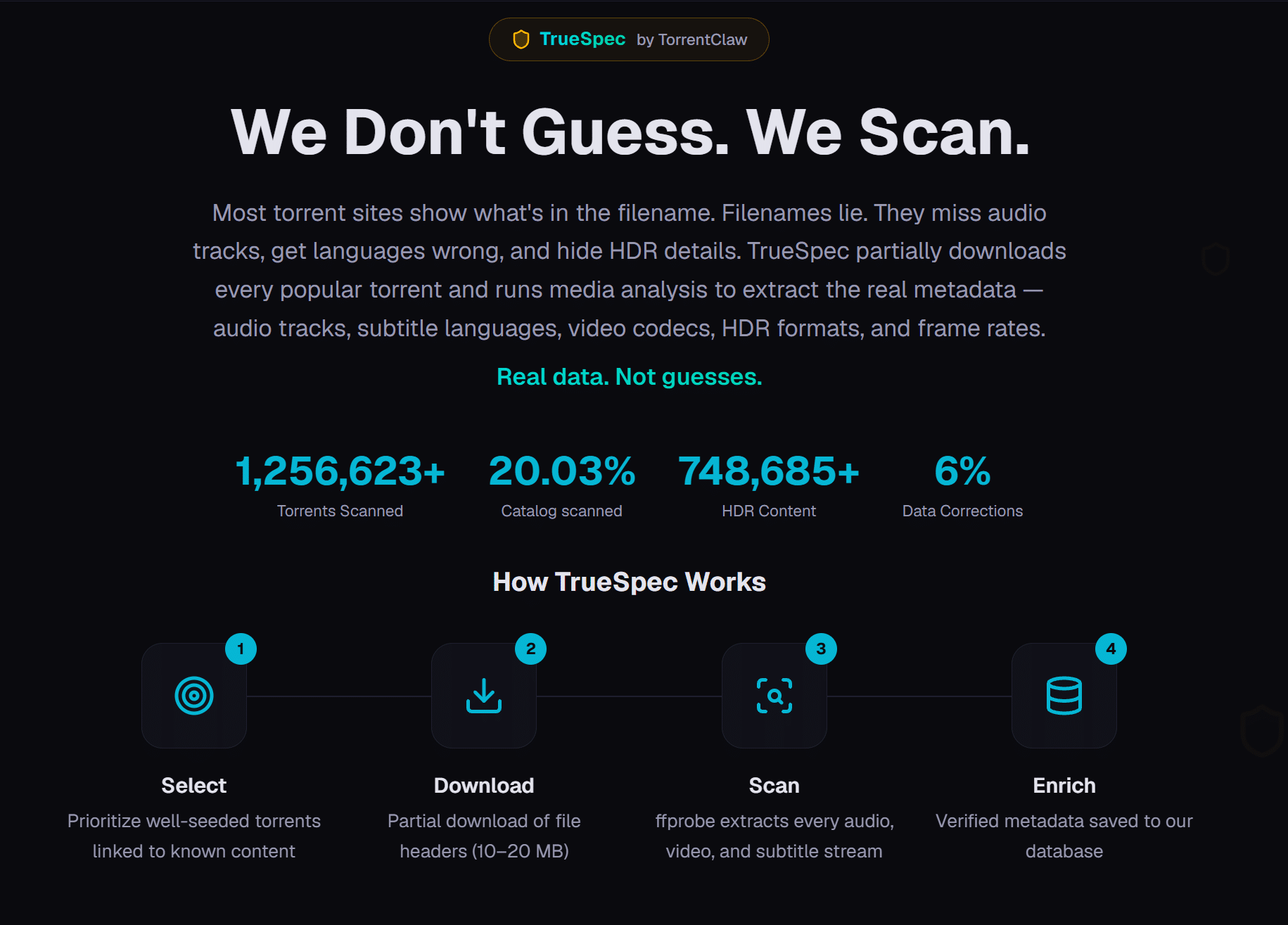
This is the exact problem that TrueSpec was designed to solve. When a new torrent is indexed, TrueSpec actively joins the BitTorrent swarm, reads the internal file listing, and downloads just enough data pieces to analyze the video file using the robust multimedia analysis tool ffprobe. According to the site and its developers, this verification process requires a surprisingly minimal amount of bandwidth, consuming only between 10 and 20 megabytes per torrent.
In addition to confirming whether a video file matches its title, TrueSpec also evaluates suspicious files for potential security threats. It checks file hashes against VirusTotal and, provided the files are small enough, automatically uploads them for a comprehensive security scan. It is important to note that TorrentClaw does not operate its own standalone virus scanner; instead, all malware verdicts are derived directly from VirusTotal’s intelligence engine.
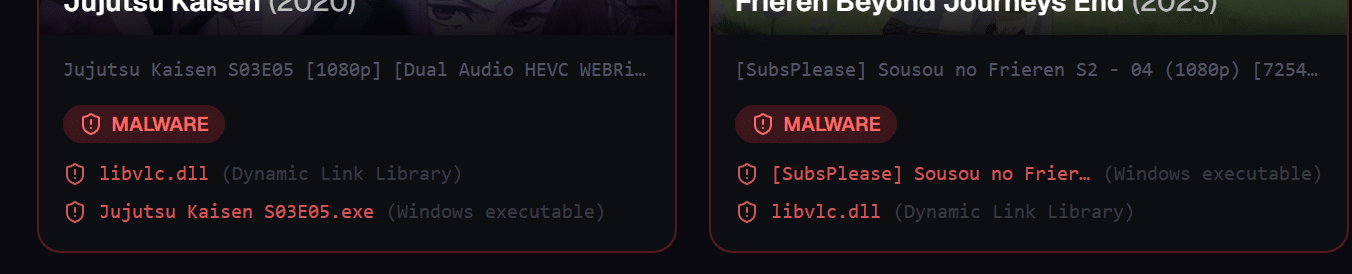
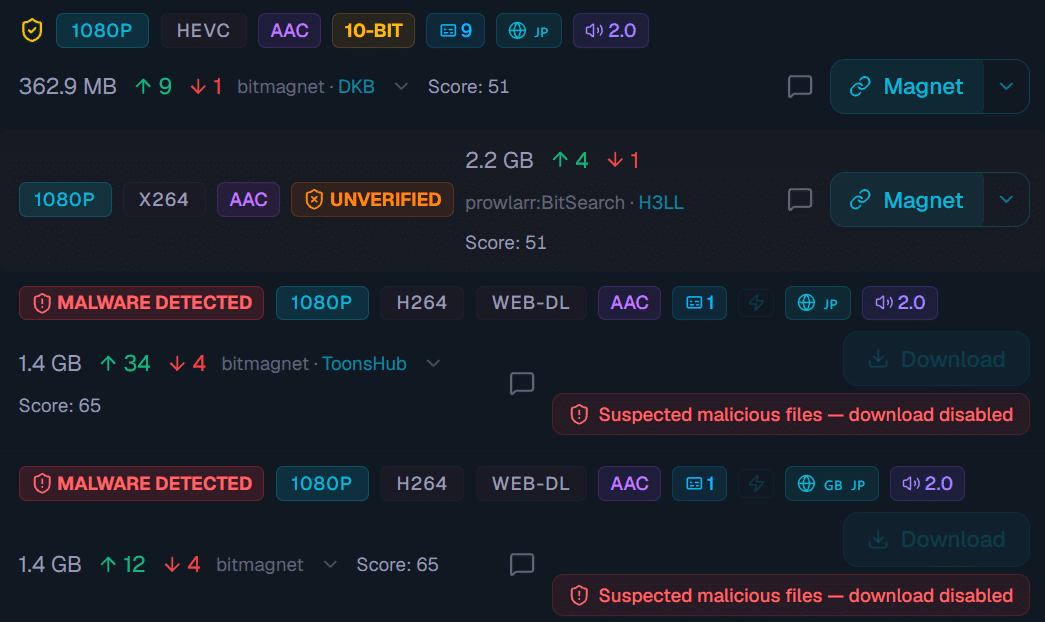
When TrueSpec successfully identifies malicious content, the platform does not necessarily banish the torrent from its index entirely. Instead, the listing remains visible on the site but is clearly marked with a prominent "Malware detected" label, while the corresponding download button is permanently disabled. For instance, a fake episode of the popular anime series Jujutsu Kaisen was previously flagged with this warning while still maintaining 34 active seeders and remaining freely accessible on several external hosting sites.

Evolution of the Verification System
Like any automated security measure, the TrueSpec system has undergone significant refinement and is not entirely infallible. Earlier iterations of the dataset in July painted a stark picture, counting thousands of suspected malware cases that ultimately turned out to be false positives. Among these flagged files were harmless items such as the legacy RARBG_DO_NOT_MIRROR.exe file, ordinary fansub scripts designed to switch audio languages, and benign scripts intended simply to open a web browser.
Updated data from late September reflects a much more rigorous approach. TorrentClaw now officially registers a file as malware only when VirusTotal explicitly confirms the threat. Under these stricter parameters, the confirmed malware count dropped to just 34 torrents. A review of the platform’s underlying evidence links every single confirmed case directly to an official VirusTotal report.
Despite these improvements, the current malware count is likely still an underestimation. TrueSpec intentionally avoids downloading large executable files, prioritizes well-seeded torrents for performance reasons, and cannot analyze dead swarms whatsoever. Furthermore, because TorrentClaw heavily prioritizes films and television shows in its indexing, pirated software and PC games—which represent a primary vector for malware distribution—are largely excluded from the platform’s scope.
Malware detection, however, represents only a fraction of what TrueSpec monitors. Out of nearly 687,000 probed torrents, more than 1,200 were flagged as deceptive due to programs disguised as videos or deliberately fake resolutions, accounting for less than 0.2 percent of the checked catalog. Meanwhile, the most common discrepancy flagged by the system is entirely harmless: more than half of all probed torrents include secondary subtitle tracks that were simply omitted from the official release names.

Uncovering VLC Player Malware Campaigns
A closer examination of the confirmed malware torrents reveals a distinct and coordinated pattern. In 31 out of the 34 confirmed cases, the malicious torrent packages an executable file named after a current film or television episode alongside a file called libvlc.dll and a playable video tucked away inside a subfolder.
The application itself is not a custom Trojan built from scratch, but rather a renamed copy of the genuine VLC media player. According to TorrentClaw, the executable is entirely identical to the official release distributed by VideoLAN and even retains its legitimate digital code signature. The malicious payload is entirely contained within the libvlc.dll file, which the media player automatically loads upon startup, triggering detections from various antivirus engines as a dangerous trojan.
These malicious payloads are routinely disguised using the titles of high-profile entertainment releases, including episodes of hit series like The Boys, Jujutsu Kaisen, and Frieren, as well as major feature films such as Dune: Part Three and Zootopia 2. To lend an air of legitimacy, many of these uploads also carry the established names of prominent release and distribution groups, including SubsPlease, ETHEL, and YTS.
This specific vector of attack is well-documented within the cybersecurity community. Earlier in the year, security researchers detailed a widespread malicious campaign that utilized fake SubsPlease releases hosted on public trackers to distribute the Vidar infostealer via compromised publisher accounts. TorrentClaw’s internal data shows that the 31 related torrents were harvested between February and August, with the majority originating from its own DHT crawler alongside contributions from external sources like Nyaa, The Pirate Bay, and TorrentDownload.
Built For AI, By AI
TrueSpec is far from the only innovative feature distinguishing TorrentClaw from traditional search engines. In a move that fully embraces modern technological workflows, the platform also offers a Model Context Protocol (MCP) server. This integration allows AI assistants such as Claude and Cursor to directly query the torrent index and fetch .torrent files on behalf of users.
Technically speaking, this functionality means that individuals can prompt an artificial intelligence assistant to locate a specific media release and download the corresponding file without ever needing to navigate to the TorrentClaw website directly. According to Soto, some connected accounts generate upwards of 10,000 API requests daily, indicating heavy utilization by external websites, applications, or automated services.
Perhaps most remarkably, running a resource-intensive verification pipeline like TrueSpec remains surprisingly inexpensive. In July, Soto noted that the entire verification infrastructure operated across just three nodes costing a combined total well under $50 per month. The implicit takeaway, Soto suggests, is that if automated verification can be executed this cheaply, any major torrent indexer could theoretically implement similar safety measures, yet none choose to do so.
Of course, partially downloading content from hundreds of thousands of swarms is not without potential legal complications. TorrentClaw’s official DMCA policy explicitly states that the website does not host, store, upload, or distribute physical files, but copyright holders frequently view automated indexing and sampling practices differently.
When questioned about the operational nature of TrueSpec, Soto characterizes the verification tool as a strictly read-only client that neither uploads data nor participates in seeding swarms. The system merely retrieves the initial fragments of a video file to read container headers before permanently wiping the data. "It deletes everything once the analysis is done. We don’t store or serve any content, and we process every valid takedown notice we receive," Soto affirms.
To manage incoming legal requests, TorrentClaw has once again turned to automation, introducing an AI-managed DMCA handling system in late September that has processed dozens of notices. Prior to this implementation, the site had received a few hundred traditional takedown requests, many of which were duplicate filings.
As TorrentClaw continues to evolve, it has also introduced commercial tiers to offset operational expenses, offering a PRO subscription for $3.99 per month alongside a PRO+ package bundled with a virtual private network for $6.99. Whether this monetization model will endure in the face of legal scrutiny remains to be seen, but historical precedent suggests that commercialized torrent platforms inevitably attract heightened attention from rightsholders.


Leave a Reply