
Every year, the Office of the United States Trade Representative (USTR) issues a call to rightsholders around the globe, asking them to nominate the foreign piracy sites and services they consider to be the most severe threats to intellectual property. The resulting compilation, traditionally known as the Notorious Markets list, has historically cast a wide net, capturing notorious torrent indexes, cyberlockers, and unauthorized streaming portals. In recent years, the scope has expanded to encompass hosting providers and various digital intermediaries that facilitate the frictionless distribution of unauthorized media.
Last week, the Entertainment Software Association (ESA), a prominent trade group representing many of the world’s leading video game developers and publishers, submitted its latest round of official recommendations to the USTR. While the filing contains several familiar targets that have populated the list in previous iterations, it also introduces a novel and unconventional target: an elusive game-cracking entity that operates entirely without a traditional website or public landing page.
A Game Cracker Categorized as a Piracy Market
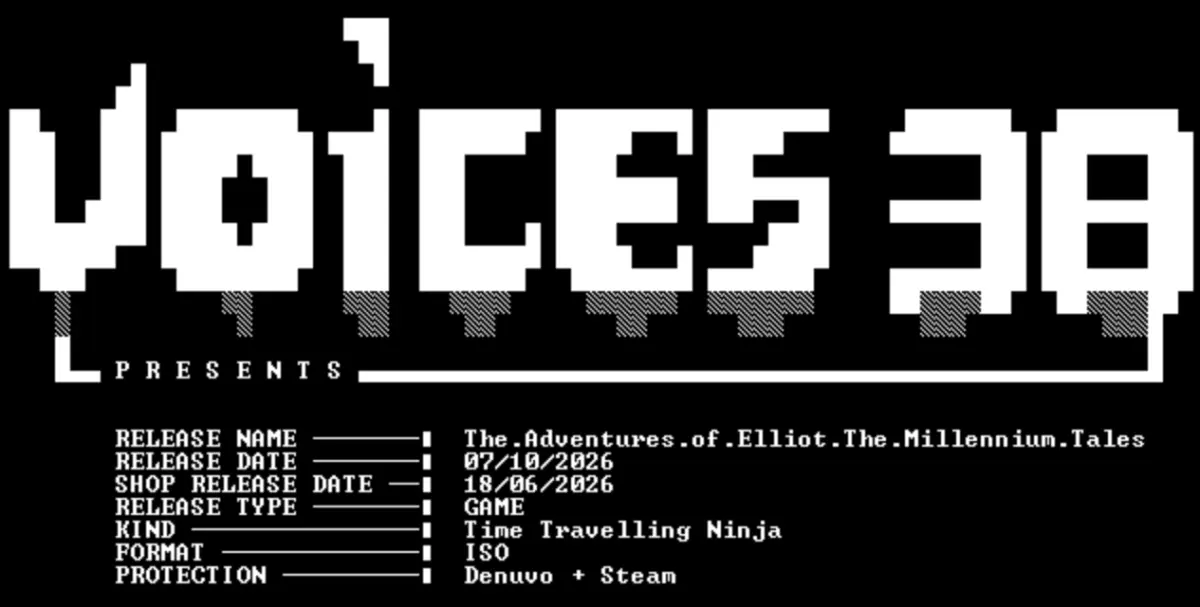
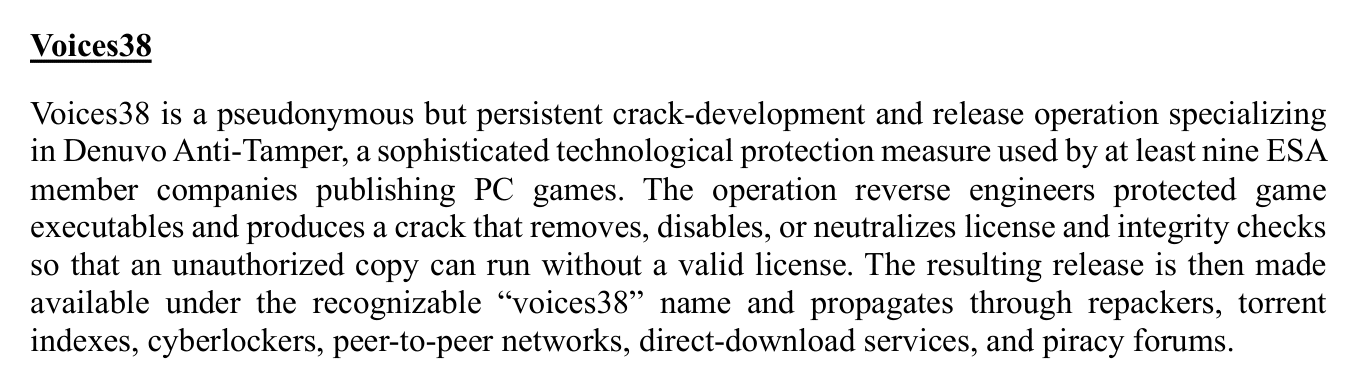
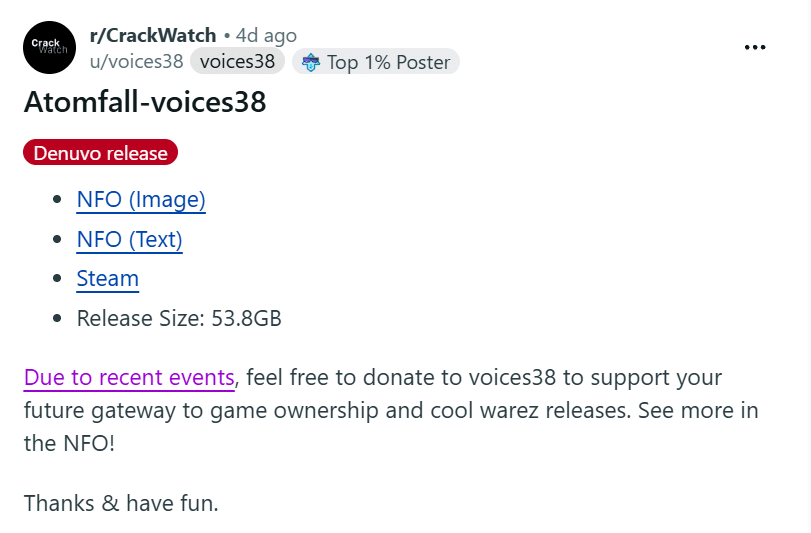
At the forefront of the ESA’s newest submissions is an anonymous entity known by the handle "voices38." According to the trade group’s filing, this anonymous cracker represents a persistent and highly specialized operation dedicated to defeating Denuvo Anti-Tamper, the sophisticated digital rights management (DRM) and technical protection measure relied upon by at least nine major ESA member companies to safeguard their intellectual property.
The ESA points to data from community indexes such as Reddit’s r/CrackWatch, which attributes approximately two dozen cracked or heavily bypassed video games to the "voices38" handle. The industry association emphasizes that this upstream actor plays a foundational role in the wider digital piracy ecosystem. Once a protected title is successfully compromised, its releases are rapidly ingested, repackaged, and seeded by downstream actors, including high-profile repack sites, peer-to-peer torrent trackers, cyberlockers, and dedicated piracy forums.

In its submission, the ESA argues that treating only the downstream distribution platforms as illicit markets fundamentally misunderstands the mechanics of modern game piracy. The organization asserts that the upstream operation is the absolute linchpin determining whether newly protected titles can ever be offered by secondary distributors.
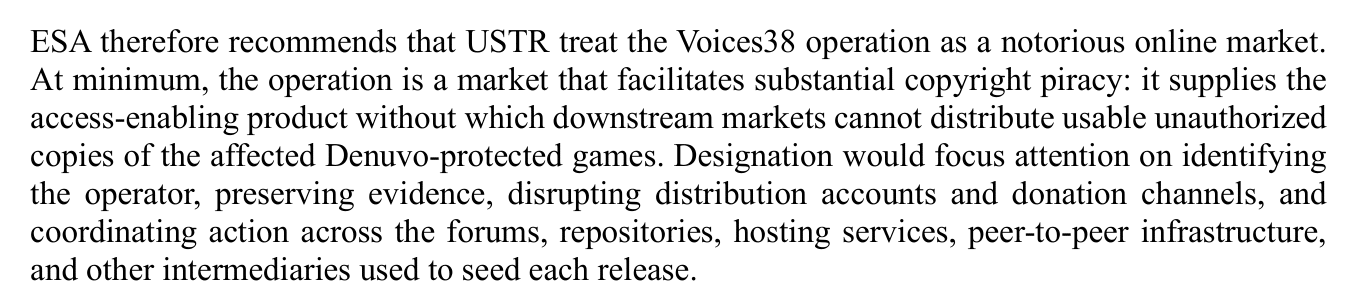
"Each crack therefore unlocks an entire downstream market for an unauthorized copy of that title. For a title that no other actor has made usable, but for Voices38’s crack there would be no functioning pirated copy for those markets to offer," the ESA submission outlines. "Treating only those downstream services as markets would overlook the upstream operation that determines whether protected games can be offered by them at all."
The absence of a conventional public identity, traditional storefront, or standard homepage should not exempt the operation from a formal Notorious Markets designation, the trade group argues. On the contrary, the ESA maintains that an official USTR listing could serve as a valuable catalyst, helping rightsholders coordinate targeted enforcement actions against the anonymous adversary.
Such a designation, the filing notes, would focus international and domestic attention on identifying the physical operator behind the handle, preserving digital evidence, disrupting distribution accounts, cutting off cryptocurrency donation channels, and orchestrating cross-platform countermeasures across the forums, repositories, hosting services, and peer-to-peer infrastructure utilized to disseminate each release. Ideally, the ESA would welcome the unmasking of the individual or group operating behind the handle, aligning with parallel efforts currently unfolding within the American legal system.
Legal Challenges Continue Amid Unabated Releases
The push for identification mirrors parallel efforts by Denuvo itself. Last month, representatives for Denuvo initiated legal action against "voices38" in a U.S. federal court in California, subsequently requesting judicial permission to issue subpoenas to major technology and social platforms including Discord, Valve, and Reddit in an attempt to unmask the operator through financial and communications records. The ESA’s submission notably omits explicit reference to this ongoing federal lawsuit.
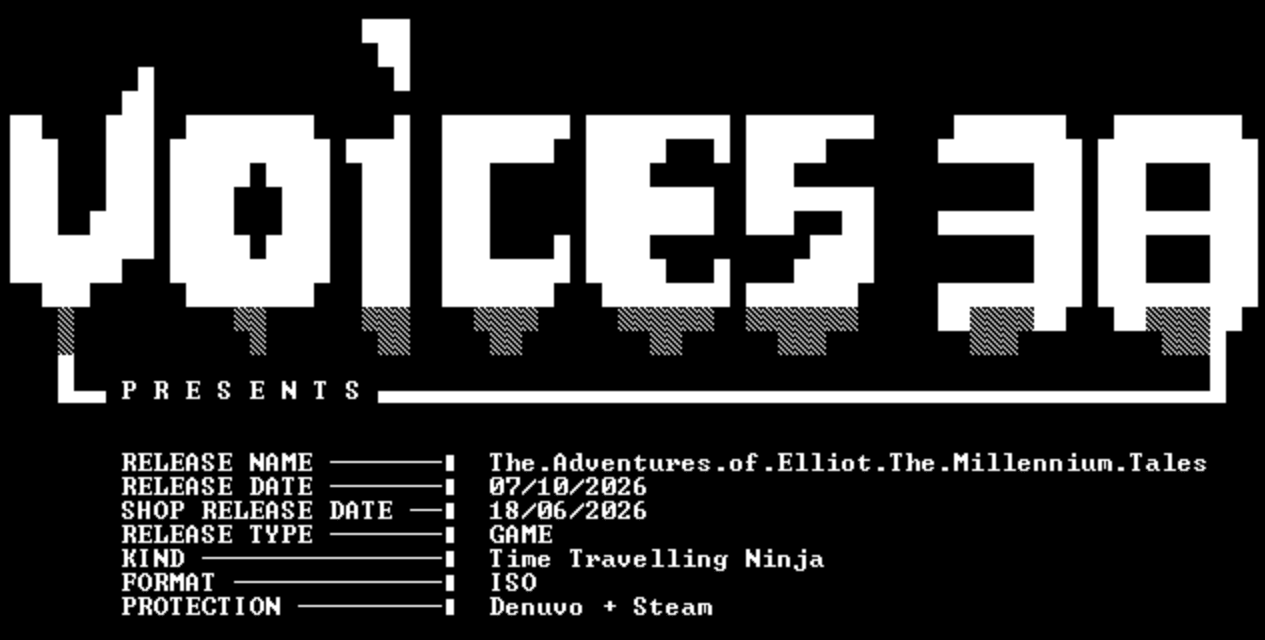
Despite mounting legal pressures and industry scrutiny, the flow of cracked releases has continued largely unabated. Following a brief period of relative quiet, the "voices38" handle deployed fresh cracks for titles such as Atomfall and The Adventures of Elliot: The Millennium Tales, alongside a dedicated crackfix for the Dead Space Remake.
These freshly minted cracks swiftly migrated across the digital landscape, finding homes on major torrent distribution hubs and cyberlockers. Within days, prominent repackers integrated the files into their own distributions, steering the conversation back toward another primary fixture of the ESA’s regulatory crosshairs.
Multi-Billion Dollar Scrutiny on FitGirl
Having previously secured prominent placement in the USTR’s 2024 and 2025 Notorious Markets lists, the widely known repack distribution site FitGirl has once again earned a firm recommendation from the ESA for the upcoming review cycle.
Even though domain-level blocking measures have been successfully implemented against FitGirl in several key European jurisdictions, including Germany, Italy, and Spain, the ESA notes that these regulatory interventions have yielded negligible practical impact on the platform’s operational scale. According to the trade group’s monitoring data, the repack portal attracted roughly 41.77 million visits in the month of August alone, continuing to offer a vast catalog of titles published by ESA member companies with complete impunity.
"FitGirl’s scale and persistence demonstrate that prior blocking and designation have not induced meaningful remediation by its operator. ESA’s takedown notices to the site are ignored, with zero links removed between August 2025 and August 2026," the ESA states in its filing.
To underscore the economic gravity of the situation, the video game publishers calculated estimated financial losses tied to the platform down to the single cent, attaching a staggering multi-billion-dollar valuation to the activity.
Between March and August 2026, the ESA claims its monitoring systems detected 15,484,145 distinct users participating in peer-to-peer swarms for games processed and distributed by FitGirl. Multiplying that user count by a standard baseline retail price of $69.99 per title resulted in an estimated lost market value of $1,083,735,308.55.
Other prominent distribution hubs exhibit similarly low levels of compliance with intellectual property notices. According to the trade group, DODI-Repacks voluntarily removed approximately 22 percent of reported links, while RuTracker, the prominent Russian-language torrent index that recently found itself squarely in the sights of video game publishers, complied with a mere 3 percent of the ESA’s formal takedown notices over the preceding year.
To counter operators who ignore traditional notices, the ESA highlights the utility of financial tracking. By following cryptocurrency transactions that ultimately route through Know Your Customer (KYC)-vetted centralized exchanges such as Binance, rightsholders hope to pierce the veil of anonymity surrounding these lucrative distribution networks.
Handheld Emulation Consoles and Digital Marketplaces
The current USTR review cycle features an explicit strategic focus on high-quality counterfeit merchandise commonly referred to as "superfakes." Seizing upon this thematic emphasis, the ESA has directed the USTR’s attention toward a specific hardware category: portable handheld emulation consoles that arrive preloaded with extensive libraries of unauthorized video games, which the group characterizes as the hardware equivalent of digital superfakes.
The association specifically highlights Anbernic.com, the official storefront for a popular family of handheld emulation devices. The ESA asserts that these systems are frequently sold or subsequently shipped with inserted memory cards containing hundreds or thousands of pirated commercial video games, noting that the hardware is readily accessible through mainstream consumer retail platforms like Amazon and eBay.
Beyond traditional software repositories and hardware manufacturers, the filing widens its scope to encompass digital trading platforms such as G2A, FunPay, and Eldorado.gg, where users buy and sell pre-owned game accounts and virtual in-game assets. Furthermore, the submission includes commercial cheat developers and hardware vendors, such as Cronus Zen. The ESA argues that sophisticated cheating devices merit inclusion on piracy-focused regulatory lists because their core function relies on circumventing and disabling the technological protection measures embedded within modern video games.
The final determination now rests entirely with the USTR, which will review the extensive submissions from rightsholders, industry associations, and public stakeholders before compiling its definitive Notorious Markets list. Because the previous edition was formally published in March, interested parties may face a prolonged wait before the agency releases its final findings.

Leave a Reply