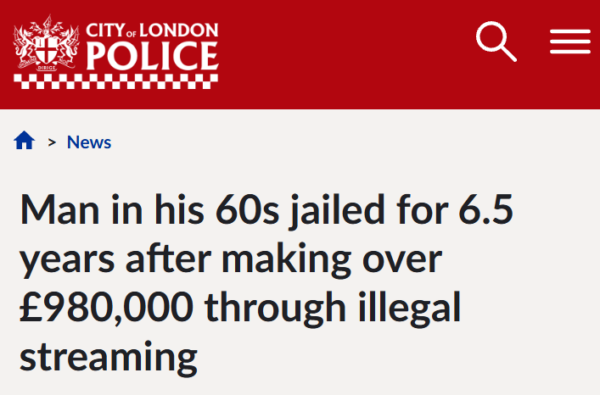
On August 27, the City of London Police published a high-profile press release carrying a striking headline: "Man in his 60s jailed for 6.5 years after making over £980,000 through illegal streaming."
Within days, that exact framing echoed across the media landscape, repeated verbatim in numerous online news outlets, technology blogs, and trade publications. The official announcement was bolstered by heavyweights in the entertainment and sports industries, featuring supporting statements from the Federation Against Copyright Theft (FACT), the Premier League, Sky, and BBC Studios. Demonstrating a coordinated communications effort, FACT published the identical press release on its own website the following day, ensuring maximum visibility for the conviction.
According to the official police statement, a 68-year-old man from Chorley was "found guilty of conspiracy to defraud" at Preston Crown Court. The prosecution detailed how his illicit business relied on a sprawling infrastructure of 80 servers, selling subscription packages to customers worldwide with a particular focus on British expatriates. Over a disputed three-year period, the operation allegedly generated £980,812 in illicit revenue.
Yet, as has frequently been the case with law enforcement actions targeting digital piracy in the United Kingdom, crucial details were conspicuously absent from the official narrative. Neither the City of London Police nor FACT mentioned the actual name of the pirate service at the heart of the case, nor did they clarify precisely when the underlying offenses took place or outline the specific legal reasoning behind the final court outcome.

Left with significant information gaps, various mainstream news organizations attempted to piece the narrative together independently, frequently misinterpreting the timeline. The Mirror, for instance, ran an urgent headline reading, "Massive streaming crackdown blocks more UK homes from watching Sky for free."
The Mirror reported to its readers that a "major closure has taken place after a man behind a popular illegal streaming service was recently arrested," claiming that the sudden server seizure left unsuspecting customers "with nothing more than blank screens." The framing strongly implied that the police action was a brand-new, cutting-edge disruption.
Other publications followed suit with similar assumptions. International Broadcasting Convention (IBC) coverage reported that all 80 servers "have now been seized," while a French news site declared that British justice had "just dismantled" the operation. Meanwhile, cybersecurity outlet BleepingComputer warned that the seized hardware "may lead to the identification of users" who could potentially face individual fines for consuming pirated content.
However, a closer journalistic investigation reveals that this case is not recent at all. In reality, the sweeping law enforcement raid that dismantled Milan Ibrahim’s operation dates back to August 2016, more than a decade before the police published their triumphant press release.
Pleaded Guilty
While the official press releases correctly identified the three-year duration of the operation, the rest of the factual picture required deeper digging to uncover.
After multiple inquiries and credential verification checks, Preston Crown Court confirmed that Milan Ibrahim did not simply receive a trial verdict of being "found guilty." Instead, he formally pleaded guilty to the charges against him. To clarify the precise indictment, the court directed inquiries to the Crown Prosecution Service (CPS), which ultimately named the dismantled service and answered follow-up questions partly on background.
According to the CPS, Ibrahim entered his formal guilty pleas five days into his ongoing trial.
In legal terms, a guilty plea carries a distinct procedural weight compared to being found guilty by a jury verdict alone. When questioned about the discrepancy in the official police phrasing, a spokesperson for the City of London Police defended the terminology, stating, "The jury did find him guilty but he plead [sic] guilty before. The terminology is fine to use for either."
Legal procedure typically dictates that when a defendant changes their plea midway through a trial after a jury has already been sworn in, the jury is instructed to return a formal guilty verdict to officially close the matter, anchoring the final conviction squarely on the defendant’s admission.

Which Three Years?
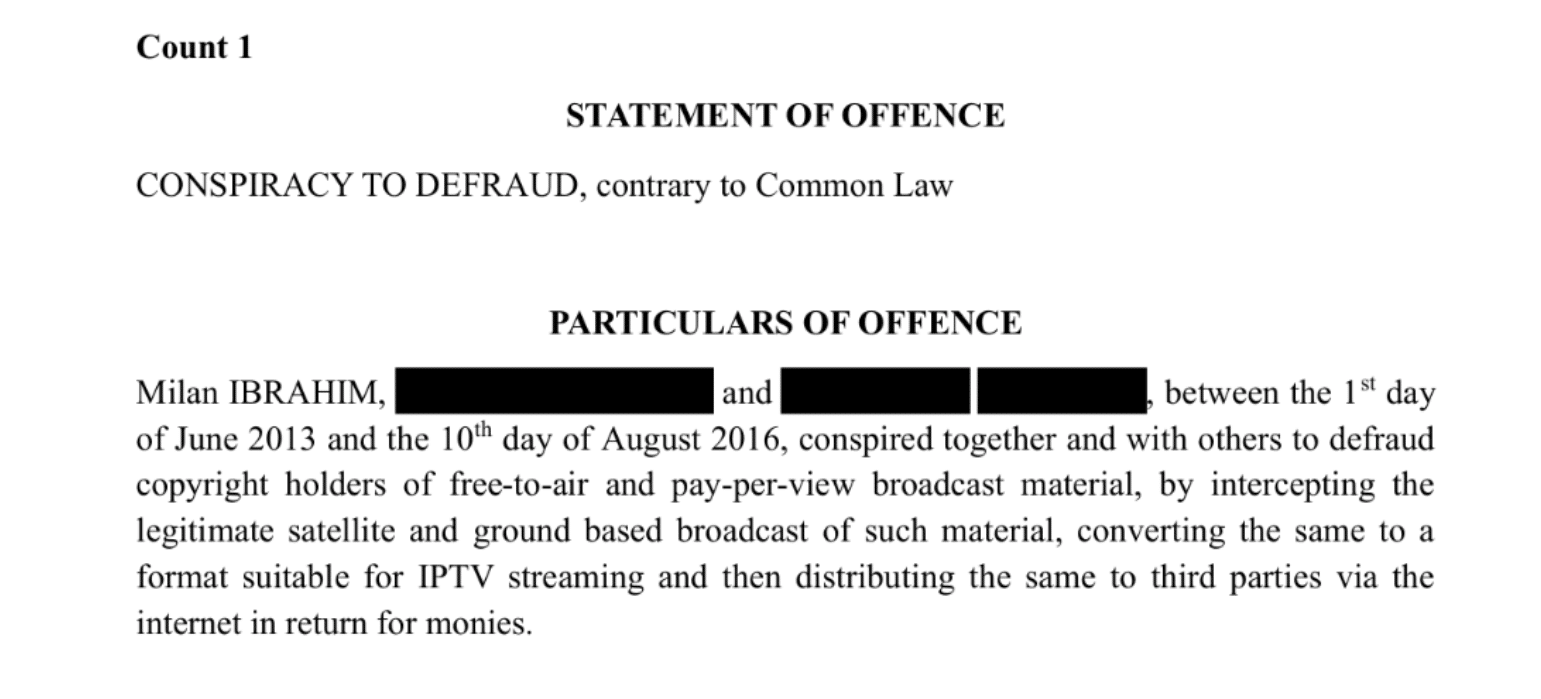
A review of the formal court indictment resolves the confusion surrounding the timeline, revealing that the case is far from contemporary. The documentation shows that all three counts against Ibrahim span a strict chronological window from June 1, 2013, to August 10, 2016.
That terminal end date marks the exact day of a coordinated law enforcement raid. On August 10, 2016, the City of London Police Intellectual Property Crime Unit (PIPCU) executed simultaneous search warrants at a business premises and three residential addresses in Chorley. During those operations, officers arrested three men—aged 36, 40, and 58—on suspicion of conspiracy to defraud and money laundering offenses. Milan Ibrahim was 58 years old at the time of that initial raid. The police press release issued in late August made no mention of this decade-old history.
Independent reporting from the time shows that the raid was documented by industry observers years ago. Industry sources speaking to reporters immediately following the 2016 operations pointed directly toward a Chorley-based enterprise supplying unauthorized IPTV subscription packages to British expatriates living abroad.
The Crown Prosecution Service confirmed that the previously unnamed illicit enterprise was initially known under the banner of "Ex Pat TV" before later rebranding as "My TV Abroad." This corporate rebrand occurred shortly before law enforcement intervened in 2016.

With those specific historical names recovered, archival records confirm the existence of the service’s web presence. An archived snapshot of the domain captured on July 15, 2016—less than four weeks before PIPCU raided the properties—displays a prominent banner announcing the transition: "BIG RE-BRAND! Ex-Pat TV is now My TV Abroad."
Marketing materials recovered from the archived site promised subscribers "live UK channels, anywhere in the world" starting from just £19 per month, explicitly assuring customers that no virtual private network (VPN) was required to bypass regional geoblocks. The website’s footer explicitly credited a web designer operating out of Chorley.
This means FACT’s identification of the service, which it heavily promoted in its recent promotional materials, actually took place over ten years ago—a crucial contextual detail that was completely omitted from the modern announcements.
From Three Defendants to One
Another significant omission in the recent police communications involves the number of individuals originally targeted by the prosecution. While the modern press release focuses exclusively on a single defendant, the original indictment named three separate individuals. Alongside Milan Ibrahim, two other men were initially charged with conspiracy to defraud copyright holders by distributing live television streams, unauthorized movie content, and modified satellite decoders to commercial establishments.
While Milan Ibrahim ultimately pleaded guilty to the primary counts, the two co-defendants did not receive criminal convictions. The Crown Prosecution Service elected not to proceed with the prosecution against either of the remaining two men. Legal observers understand that Ibrahim was viewed by prosecutors as the primary mastermind and instigator behind the enterprise, and the cases against his co-defendants were resolved as part of the legal mechanics surrounding his guilty plea, though the exact terms of that arrangement have not been publicly detailed.
None of these historical nuances alter the immediate legal outcome for the defendant. Ibrahim is currently serving his six-and-a-half-year custodial sentence. Furthermore, law enforcement agencies have confirmed that he faces ongoing Proceeds of Crime Act (POCA) hearings designed to recover the £980,812 attributed to the illegal operation—a financial penalty that was clearly outlined in the original police statements.
For accurate and thorough news reporting, however, comprehensive context remains essential. The fact that the pirate IPTV service—operating variously as Ex Pat TV and My TV Abroad—was physically raided and shuttered a decade ago, and that the long-awaited prison sentence followed a mid-trial guilty plea rather than a contemporary police sweep, are far from trivial details. The same applies to the presence of co-defendants on the original indictment who ultimately faced no convictions.
Why law enforcement and anti-piracy bodies chose to present these events without their proper historical framework remains unexplained. A copy of the revised indictment in the matter of R v Ibrahim and others at Preston Crown Court remains accessible through legal documentation, with the names of the unconvicted co-defendants redacted to protect their privacy.