The global internet infrastructure has successfully weathered a major cryptographic update following the DNS root Key Signing Key (KSK) rollover that took place on October 11, 2026. According to measurement data released by APNIC Labs, the transition occurred without triggering major network outages, validating the collaborative efforts of network operators, software developers, and standard bodies worldwide.
This latest update follows previous tracking reports published in May and October 2026 ahead of the scheduled root key rollover. Network researchers once again utilized the Key Signing Key (KSK) Sentinel signal to monitor which autonomous systems and recursive resolvers successfully tracked the rolling of the root key in real time.

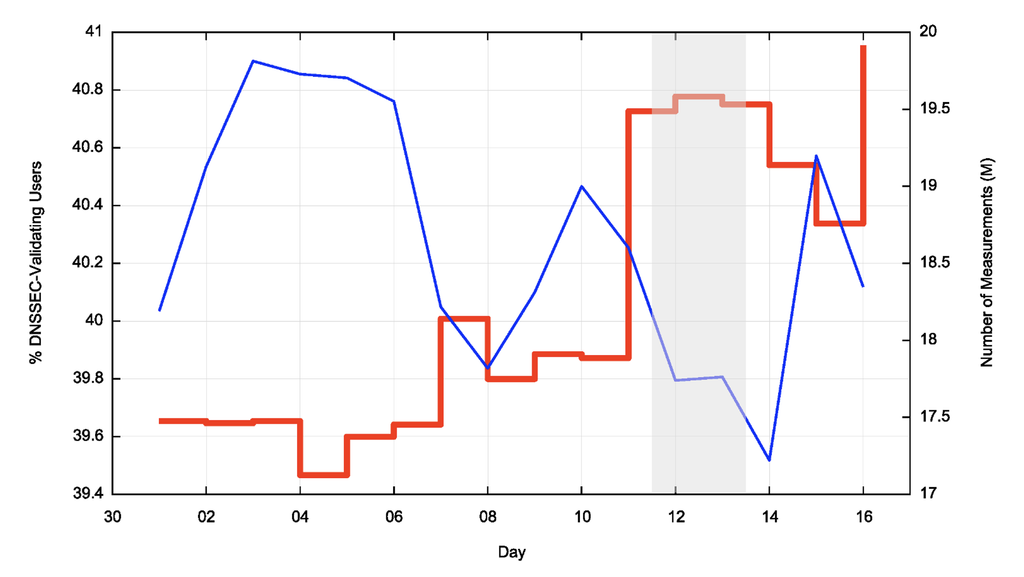
The big picture analysis, derived from advertisement-based measurement networks during the first sixteen days of October, provides a clear view of global DNSSEC validation stability. The observation period highlighted a crucial 48-hour window starting from the exact moment of the KSK roll at 14:00 UTC on October 11, extending through the cached lifetime of root zone DNSKEY records in validating resolvers.
Throughout the operational window, daily measurement ad presentation rates remained well within normal statistical variations. More importantly, the global average DNSSEC validation rate experienced a slight upward tick, rising from a pre-roll baseline of 39.7% to a post-roll value of 40.6%. This global average indicates that the key was rolled successfully and that validating resolvers seamlessly adopted the new cryptographic trust anchors.
However, global averages can frequently mask distinct regional behaviors and individual network configurations. A closer examination of specific economies with large populations of DNSSEC-validating users reveals divergent trajectories during the rollover window.

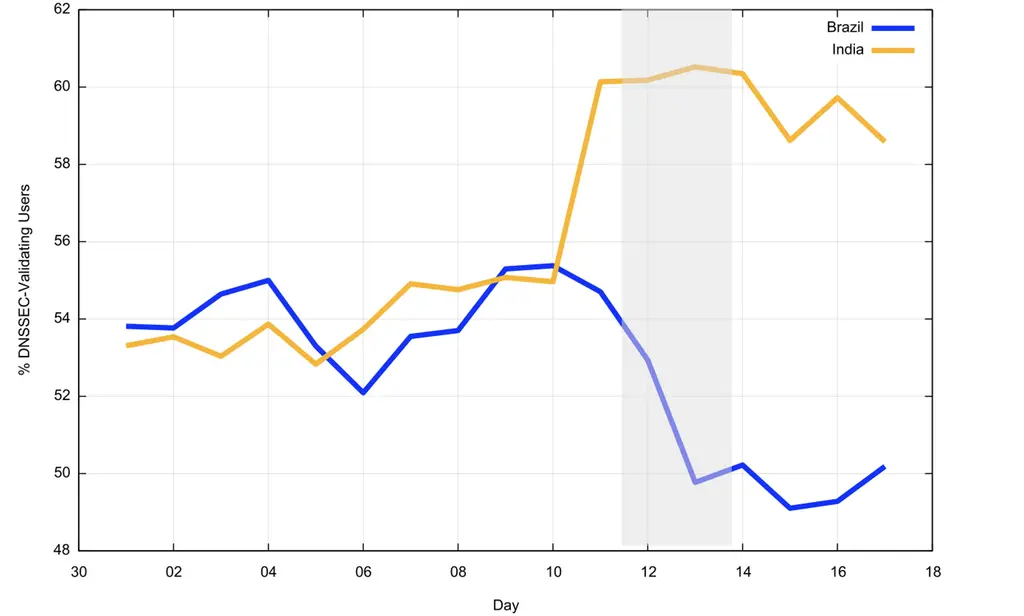
In India and Brazil, both of which traditionally benefit from ISP-provisioned recursive resolvers performing DNSSEC validation, outcomes varied based on proactive communication. Researchers were able to contact a major Indian Internet Service Provider on October 9 after spotting KSK Sentinel signals indicating that their resolvers had failed to acquire local trust in the incoming key. Because the ISP reacted swiftly, the overall DNSSEC validation rate among measured Indian users actually climbed from 55% to 59% across the rollover.
A different scenario unfolded in Brazil, where outreach to local ISPs proved less successful within the same timeframe. Consequently, the DNSSEC validation rate among measured users in Brazil slipped from 54% to 50% following the root key roll.
Prior to the event, researchers had compiled a watchlist of fifty networks exhibiting the lowest acceptance rates for the incoming key, despite showing support for the Key Sentinel mechanism. Surprisingly, subsequent tracking up to October 18 revealed that none of these networks were left stranded. Every single one of these previously flagged networks successfully integrated the new KSK into their trusted key sets between October 7 and October 13, displaying a surprisingly uniform pattern of adoption that is rarely observed in the sprawling architecture of the Domain Name System.
To gauge broader operational impacts, analysts tracked the distribution of DNSSEC validation changes across more than 13,500 individual networks that yielded sufficient sample sizes before and after the rollover. A small subset of 35 networks recorded a dramatic positive surge in validation exceeding 50%, likely reflecting configurations that inherently trusted the incoming key while dropping the incumbent one. Expanding the criteria, 594 networks registered a moderate validation increase of 10% or more.
Conversely, negative shifts were also documented. Fifty-eight networks saw their DNSSEC validation rates drop by 50% or more, while 660 networks experienced declines exceeding 10%.
Translating these percentage shifts into user populations provides a clearer picture of human impact. Total global internet users situated behind DNSSEC-validating resolvers stand at approximately 1.7 billion out of a total estimated user population exceeding 4.3 billion. Prior to the key rollover, the validating population sat at roughly 1.65 billion. Across the transition, the network observed a net global increase of approximately 45.8 million DNSSEC-validating users.
Individual economies experienced contrasting fortunes in user metrics. India led the positive growth economies, adding a net increase of over 45.4 million validating users, followed by Viet Nam with a gain of over 9.1 million, and Algeria with nearly 3.3 million additional validating users. Other economies registering notable net growth included Morocco, Kazakhstan, Slovakia, Iran, Thailand, Sri Lanka, and Lithuania.
On the other hand, several economies recorded notable net declines in validating user populations during the same window. Brazil experienced the largest drop, decreasing by nearly 7.8 million validating users. The Russian Federation followed with a decrease of roughly 3.1 million users, while China saw a drop of approximately 1.7 million. Additional reductions were recorded in the United States, Bulgaria, Bangladesh, Japan, Uganda, Pakistan, and Egypt.
Because the DNS operates as a massively distributed yet loosely coupled ecosystem, precise top-down coordination remains impossible, meaning system-wide variations are inevitable. Assessing success in such an environment requires a tolerance for these organic discrepancies. Measured against these systemic realities, the October 2026 KSK roll has been deemed a definitive success, ensuring the ongoing security and cryptographic integrity of the foundational layer of the internet.