A federal magistrate judge has ordered Meta Platforms to disclose the names of all employees who participated in decisions to acquire pirated book datasets via BitTorrent to train its Llama artificial intelligence models. The ruling marks a significant development in ongoing copyright litigation, piercing through Meta’s defense that its data acquisition was merely the result of decentralized team consensus rather than top-down corporate direction.
Magistrate Judge Thomas Hixson issued the order following a heated discovery dispute between Meta and publisher Entrepreneur Media, which publishes Entrepreneur magazine. Entrepreneur Media is one of several plaintiffs pursuing legal action against the tech giant over its controversial use of shadow libraries to gather training data for its generative AI systems.
While a separate class action brought by authors such as Richard Kadrey and Sarah Silverman established that training AI models on copyrighted books constitutes fair use—a major victory for Meta—the BitTorrent-related claims have survived as a crucial battleground. Plaintiffs argue that regardless of how the data was ultimately used within the AI models, the method of acquisition involved widespread copyright infringement and illegal distribution.

The Mystery of the Missing Decision-Makers
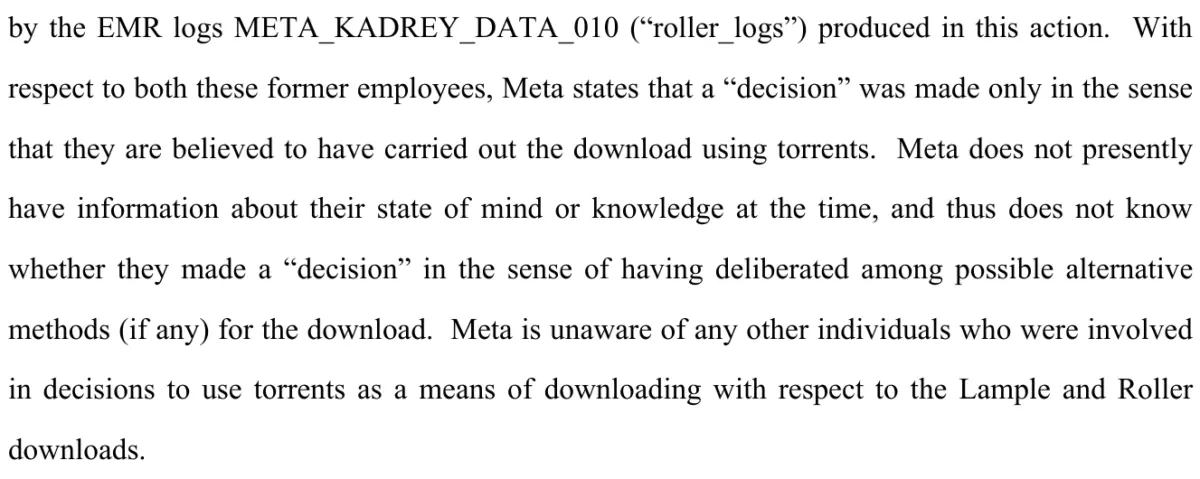
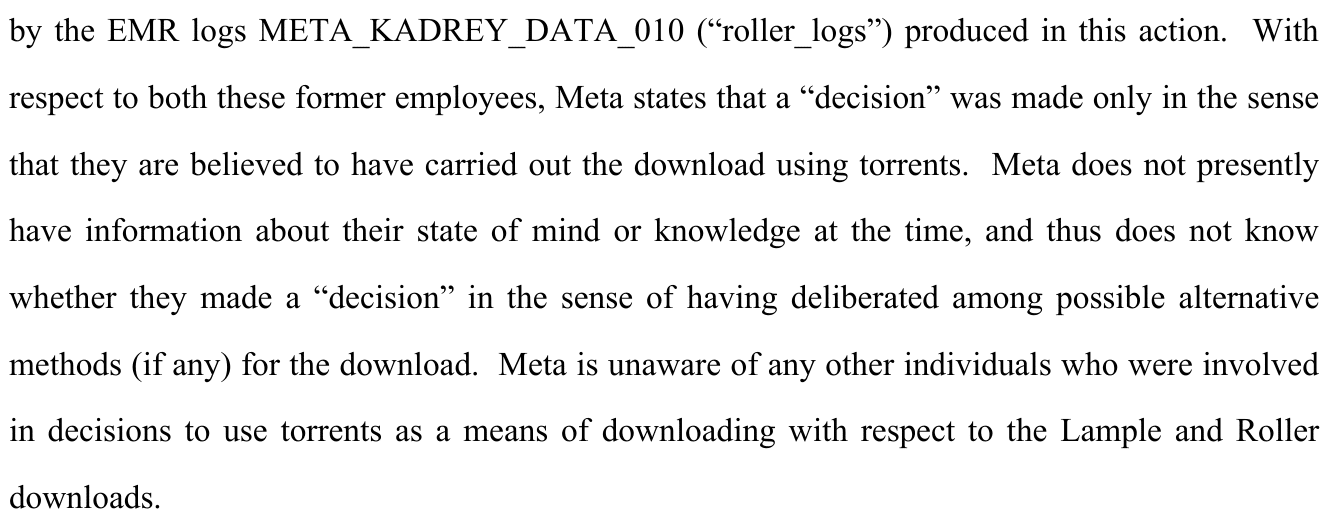
The core of the recent dispute centers on accountability. Entrepreneur Media previously asked Meta to identify every individual who "made, authorized, or approved" the decisions to obtain shadow library datasets using BitTorrent protocols. In response, Meta pointed to various employees involved in data operations, describing their actions as technical choices. Furthermore, the company maintained that it could not identify anyone who "formally" made or approved decisions to acquire or use books for its first two Llama models, attributing those choices to organic team consensus.
Meta also noted that its acquisition of data from Anna’s Archive underwent an internal legal review in early 2024 involving in-house counsel. However, the company consistently avoided naming individuals higher up in the corporate hierarchy who gave the green light to utilize peer-to-peer networks.
This stance frustrated the plaintiffs. Entrepreneur Media countered that under Meta’s construction of events, no one at the company actually decided to torrent anything, despite overwhelming evidence that Meta routinely downloaded shadow libraries from 2022 through 2024.
The question of oversight is far from academic. Internal documentation uncovered during discovery reveals that Meta’s engineering teams were acutely aware of the legal perils associated with peer-to-peer file sharing.
"Legally Not Okay"
The tension between technical execution and legal awareness is vividly illustrated in internal records. One engineer who participated in downloading data from Library Genesis (LibGen) previously testified that the distinct issue of seeding—uploading files to other users on the network—was raised, discussed, and deliberately addressed internally with steps intended to limit exposure.
An internal Meta logbook reviewed by an employee prior to initiating a download from Anna’s Archive explicitly warned against utilizing torrent networks. According to Entrepreneur Media’s court filings, the logbook entry reads: "Decided to go with direct file uploads without using torrents for the following reasons: Using torrents would entail seeding the file such as sharing content outside. This would be legally not okay."
Despite these internal warnings, Meta does not dispute that it ultimately utilized BitTorrent to download the LibGen Scimag collection as well as datasets from Anna’s Archive. However, the company has maintained that it is unaware of anyone who formally approved uploading or distributing the data, pointing instead to technical workarounds and measures implemented to mitigate seeding.
The exact volume of data shared by Meta with external network peers remains a point of contention. An expert retained by Meta previously estimated that uploads from its Amazon Web Services (AWS) servers accounted for roughly 30 percent of the total data volume downloaded during torrent operations between April and July 2024.
Everyone in the Group Must Be Named
Ruling on the discovery dispute, Magistrate Judge Hixson rejected Meta’s evasive posture. Addressing Meta’s claims that it lacked specific decision-makers to name, the judge noted that the plaintiffs’ interrogatory was not restricted solely to formal decisions, and that Meta’s previous responses largely focused on using the data rather than acquiring or downloading it.

Judge Hixson also dismissed the argument that collaborative team dynamics absolve the company from identifying responsible parties. The court clarified that because the interrogatory asks for all decision-makers, if a decision was reached by a collective group or team, every individual involved must be identified by name.
Under the terms of the new order, Meta must specifically identify everyone who participated in the discussions preceding the 2023 LibGen torrent download. The company must also name the individuals who approved the shift to BitTorrent, as well as those who greenlit the April 2024 download from Anna’s Archive. Crucially, the directive encompasses anyone who weighed in on "whether or how to seed, or to mitigate seeding" during the acquisition of the pirated libraries.
For Entrepreneur Media and other rightsholders, securing these names is essential for establishing willfulness on the part of the tech giant, which directly impacts claims of contributory copyright infringement and unauthorized distribution. While the broader legal ecosystem continues to grapple with the complexities of fair use in the age of generative artificial intelligence, this latest judicial intervention ensures that accountability for the underlying file-sharing mechanics will rest squarely on the individuals who steered the process.