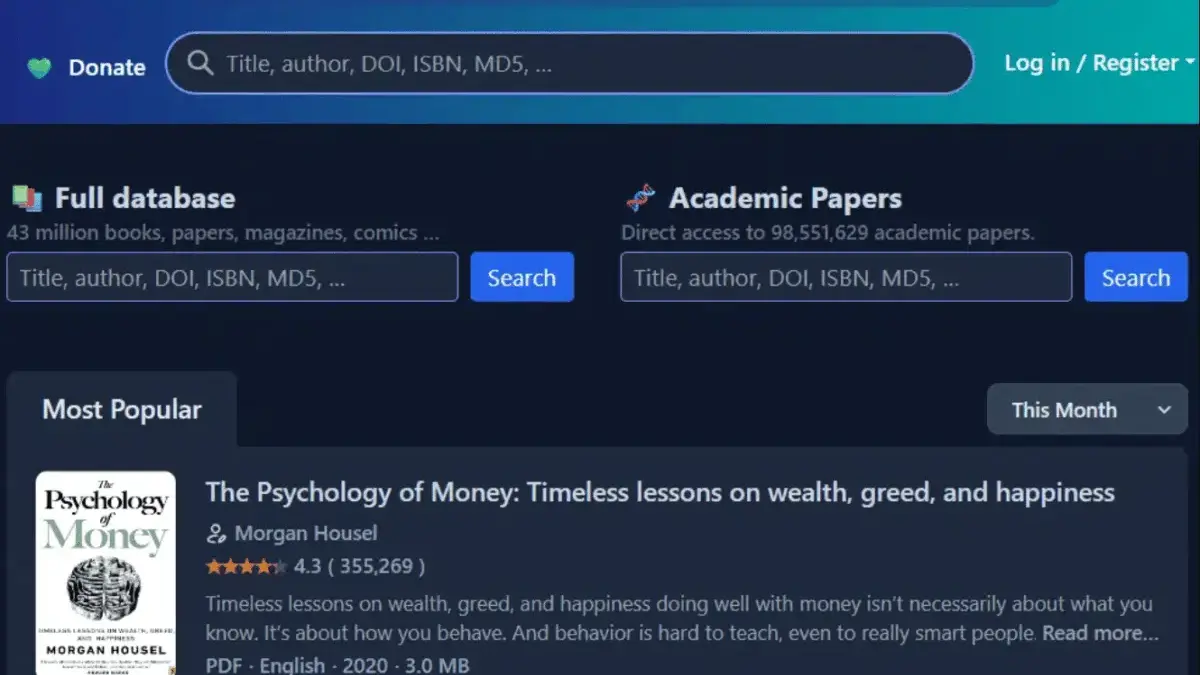
A coalition of major publishing giants has formally asked a New York federal court to enter a $19.5 million default judgment against WeLib, an anonymous pirate library that allegedly built its platform by copying both the code and the vast collection of another prominent shadow library, Anna’s Archive.
The legal move, filed on Monday in a U.S. federal court, represents the latest escalation in the ongoing intellectual property crackdown targeting large-scale digital piracy networks. The plaintiffs—including industry heavyweights such as Penguin Random House, Elsevier, HarperCollins, and Macmillan—are asking U.S. District Judge Victor Marrero to hold the anonymous operators of WeLib fully accountable for widespread copyright infringement.
The lawsuit highlights the complex and often derivative nature of the underground digital library ecosystem, while also revealing an unusual administrative slip-up by the legal team representing the publishers.
Last year, the operators of Anna’s Archive issued a public warning to their own users regarding WeLib, describing it as a newcomer within the shadow library landscape. According to Anna’s Archive, the site had mirrored the majority of their extensive library collection and utilized a fork of their underlying codebase. Because WeLib’s operators were reportedly taking everything without contributing back any newly acquired collections or software improvements, Anna’s Archive publicly advised its user base to steer clear of the site, writing at the time that they recommended against using it.

In June, a coalition of major book publishers arrived at a remarkably similar conclusion regarding WeLib’s origins, albeit through the lens of copyright law. The publishers filed a lawsuit in a New York federal court, alleging that WeLib was created after its anonymous operators copied both the source code and the vast majority of the contents hosted by Anna’s Archive.
Despite being formally served with the allegations of copyright infringement, WeLib’s anonymous operators chose not to respond or mount a legal defense. This lack of engagement prompted the publishers to press forward, resulting in the court clerk entering a formal default against the site in August. That procedural milestone cleared the path for the publishers to request a final default judgment and permanent injunctive relief.
On Monday, the legal team representing the publishing houses officially asked Judge Victor Marrero to issue the default judgment against WeLib and its unidentified administrators. In their legal memorandum, the plaintiffs emphasize the commercial nature of the enterprise, describing WeLib as a pirate platform whose sole business model involves distributing protected copyrighted content in direct violation of the rights of publishers and other copyright owners.
To calculate the financial penalty, the publishers requested the maximum statutory damages allowed under copyright law: $150,000 for each of the 130 specific works cited in the complaint, equating to ten works per publisher. This calculation brings the total requested penalty to $19.5 million. Notably, this is the exact same financial penalty that U.S. District Judge Jed Rakoff awarded to publishers earlier in the separate legal case targeting Anna’s Archive.
The individual allocations break down evenly across the thirteen participating publishing entities. Under the proposed judgment, each plaintiff—including Apress Media, Cengage Learning, Elsevier, Hachette Book Group, HarperCollins, John Wiley & Sons, Macmillan Learning, Macmillan Publishing Group, McGraw Hill, Pearson Education, Penguin Random House, Simon and Schuster, and Taylor & Francis Group—would be awarded $1.5 million, culminating in the aggregate total of $19.5 million.

The publishers’ legal filing also sheds light on WeLib’s monetization strategy. While the platform allows users to access its database for free, it aggressively prompts visitors for financial contributions reaching up to $90 a month. According to the lawsuit, these requested contributions are not mere donations, but rather functioning payments designed to grant users access to faster download speeds.
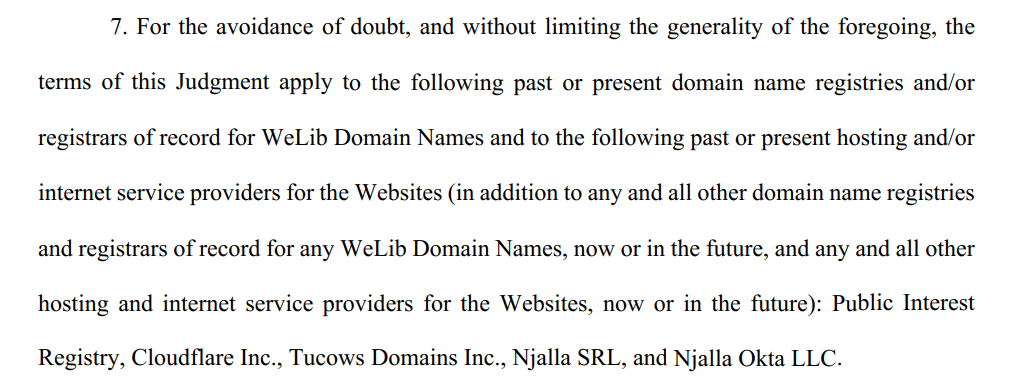
Alongside the multi-million-dollar damages award, the publishers are seeking a permanent injunction designed to severely disrupt WeLib’s infrastructure. If granted, the order would compel domain registries and registrars to disable domains associated with the service, including welib.org, welib.st, and welib-public.org, while also blocking the transfer of these domains to any entity other than the publishers themselves. Furthermore, hosting providers would be legally required to cease servicing the sites entirely.
While the injunction would apply broadly to all applicable technical intermediaries, the proposed court order specifically names five key organizations: the Public Interest Registry, Cloudflare, Tucows, and two separate entities tied to Njalla. This list is notably shorter than the one featured in the Anna’s Archive judgment, which named more than twenty distinct intermediaries.
A Paper Victory?
As the legal proceedings continue, an unusual drafting error in the publishers’ legal brief has drawn attention. Large portions of the memorandum filed against WeLib closely mirror the legal arguments submitted by the law firm Oppenheim + Zebrak against Anna’s Archive in May on behalf of the same group of publishers.

However, because the briefs were nearly identical, certain arguments failed to match WeLib’s actual operational methods. For instance, the brief argues that WeLib diverts revenue from publishers at a scale made worse by the platform’s use of the viral BitTorrent protocol. Investigative reviews of WeLib have yielded no evidence that the site utilizes BitTorrent, nor does the original WeLib complaint mention it. Instead, the cited paragraphs appear to have been directly carried over from the Anna’s Archive filing, where they were originally included because Anna’s Archive maintains a dedicated page offering bulk torrent files for download.
By contrast, WeLib’s own complaint details an entirely different mechanism for file delivery, operating directly from its own servers through tiered slow and paid fast download options.
Additional remnants of the reused text appear elsewhere in the document. The brief asserts that WeLib’s infringement continued despite several prior legal actions against the operators. While Anna’s Archive has faced multiple lawsuits, legal observers note that no other public lawsuits appear to have been filed against WeLib’s operators. Even a typographical error and a garbled sentence containing a double negative were carried over from the earlier document, including identical phrasing regarding whether the court is satisfied that default standards have been met and whether defendants can establish a lack of meritorious defenses.
Ultimately, it remains up to Judge Marrero to review the request and determine the appropriate outcome. Regardless of the final ruling, legal analysts suggest that the publishers are unlikely to recover any significant financial compensation, given that WeLib’s operators continue to operate anonymously behind privacy-shielded infrastructure.
Previous enforcement efforts against similar shadow libraries demonstrate the resilience of such networks. Following an earlier injunction secured by music industry plaintiffs, Anna’s Archive lost several domains but managed to remain accessible online through alternative top-level domains tied to international registries outside the United States jurisdiction.
Whether an injunction will permanently shutter WeLib or simply prompt a migration to new web domains remains to be seen, leaving the ultimate impact of the multi-million-dollar judgment largely symbolic.