Major technology companies, cloud storage providers, and internet infrastructure firms have officially responded to allegations made by copyright holders regarding online piracy, submitting detailed rebuttals to the Office of the United States Trade Representative (USTR).
Earlier this month, prominent rightsholder groups—including the Motion Picture Association (MPA) and the Recording Industry Association of America (RIAA)—submitted their annual overviews identifying global platforms they deem "notorious markets" for copyright infringement. While these lists traditionally target dedicated pirate streaming sites and torrent indexes, they increasingly capture mainstream online platforms, social media networks, and foundational internet infrastructure providers.
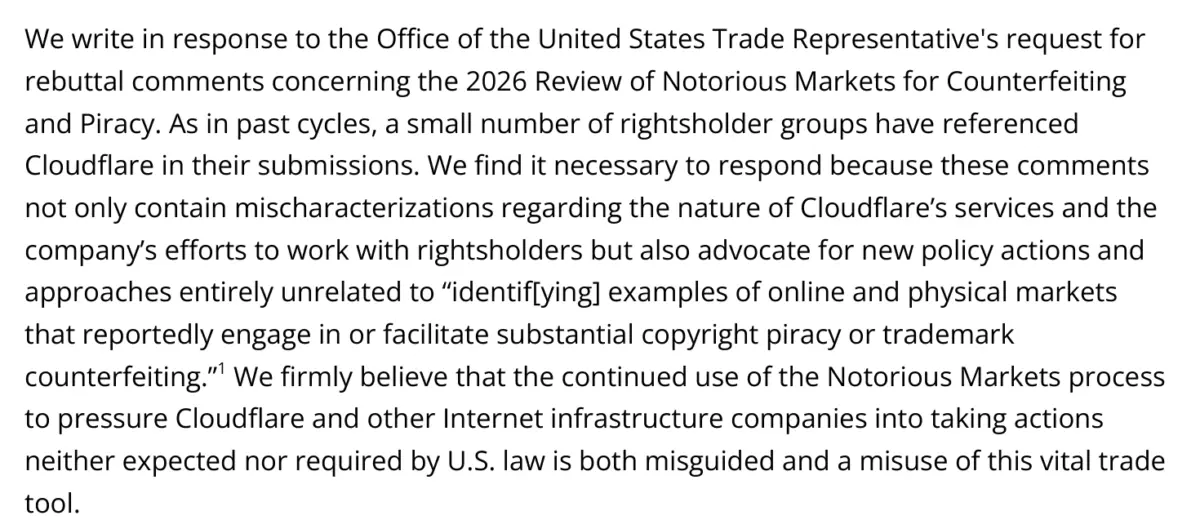
In response, companies such as Meta, Mega, and Cloudflare have filed formal rebuttals defending their anti-piracy measures, highlighting technical challenges, and pushing back against what they view as a misapplication of trade policy tools to pressure private companies.
Meta Highlights AI-Driven Live Stream Enforcement
Meta’s submission to the USTR largely focuses on addressing counterfeiting concerns, but unlike previous years, the tech giant dedicated a substantial section of its rebuttal to the issue of digital piracy, particularly unauthorized live-streaming broadcasts across Facebook and Instagram.

Outlining its multi-pronged approach to intellectual property protection, Meta explained that its strategy is built around three core pillars: preventing infringing content from being uploaded in the first place, rapidly removing content that slips through initial filters, and making any remaining unauthorized material significantly harder to find. According to the company, recent developments in live-streaming enforcement demonstrate that this methodology is yielding tangible results.
The centerpiece of Meta’s updated anti-piracy arsenal is a newly deployed artificial intelligence tool specifically designed to target live sports broadcasting piracy.
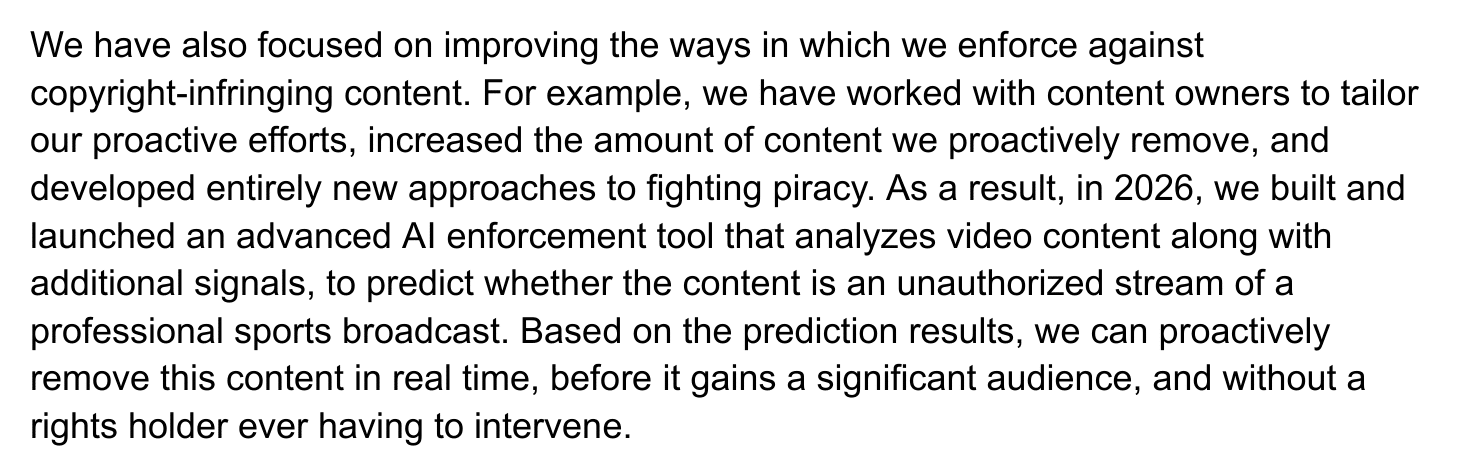
"In 2026, we built and launched an advanced AI enforcement tool that analyzes video content along with additional signals, to predict whether the content is an unauthorized stream of a professional sports broadcast," Meta stated in its USTR filing.
The company added that the predictive capabilities of the system allow automated moderation tools to proactively intercept and eliminate infringing streams in real time. This intervention happens before the broadcasts can amass a significant audience, and crucially, operates without requiring manual takedown notices or intervention from the affected rights holders.
While Meta did not disclose specific operational metrics regarding the volume of streams removed or the precise professional sports leagues targeted by the AI tool, the disclosure underscores a growing industry reliance on automated, proactive machine-learning models to combat real-time media theft.

Restricting Facebook Live and Targeting IPTV Devices
Alongside the introduction of real-time AI prediction models, Meta has implemented sweeping structural changes to the functionality of Facebook Live to curb the proliferation of unauthorized streams. Under current platform restrictions, newly registered accounts are entirely prohibited from utilizing the Live broadcasting feature. Furthermore, established users face strict numerical caps limiting the number of concurrent live streams they can host.
Meta has also instituted punitive functional limitations on accounts that have previously had live-streaming content blocked for copyright violations, alongside introducing algorithmic distribution delays designed to give automated safety filters sufficient time to catch and neutralize infringing broadcasts before they become publicly accessible.
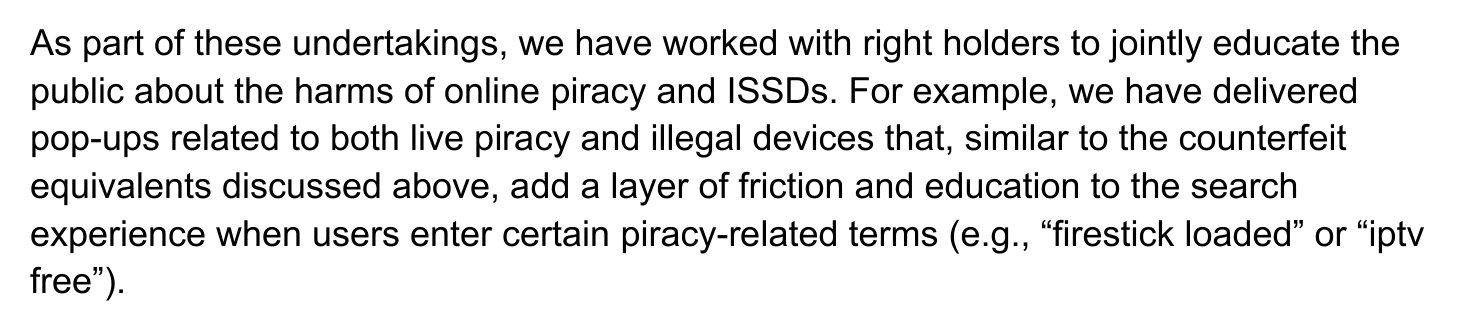
Beyond live video streams, Meta reported that the vast majority of content removals associated with the promotion of illegal streaming devices and services are now executed proactively by the platform rather than reactively via external reports. When users attempt to search for popular keywords associated with hardware modification and unauthorized subscription services—such as "firestick loaded" or "iptv free"—the platforms now trigger automated warning pop-ups to discourage engagement with illicit networks. These proactive search warnings mirror similar anti-piracy interventions first observed on Instagram and Facebook several years ago.
While Meta’s rebuttal emphasizes technological advancements and proactive enforcement, other platforms caught in the crosshairs of the USTR review process are dealing with different operational challenges.
Cloud Storage Provider Mega Acknowledges Major System Outage
Cloud storage and file-hosting platform Mega found itself newly targeted in this year’s submissions, with the RIAA filing formal complaints designating the company as a cyberlocker. The RIAA alleged that Mega fails to adequately prevent the re-upload of infringing material or effectively deter repeat copyright infringements on its platform.
Mega fired back with a formal rebuttal filed on October 20, forcefully rejecting the "cyberlocker" classification and insisting that it operates as a legitimate cloud storage provider. To substantiate its commitment to intellectual property compliance, Mega pointed to its established repeat infringer policy, which dictates that user accounts accumulating three copyright strikes within a rolling six-month period face formal suspension.
However, Mega’s filing also included a notable and candid disclosure regarding a critical failure in its moderation infrastructure.
"Because of a technical error, the suspension system did not operate fully in Q4 2024 or at all in Q1 2025," Mega acknowledged in the official document.
While the admission caught the attention of rightsholders reviewing the USTR submissions, the outage itself was not entirely unprecedented. The technical glitch had previously been disclosed in footnotes within Mega’s published transparency reports, which confirmed that the underlying engineering failure was fully resolved in early April 2025.
In its defense, Mega noted that rights holders who successfully report a file have the option to request the complete removal of every duplicate copy stored across all user accounts on the platform. The company urged the RIAA and its member record labels to actively utilize these backend removal tools rather than relying solely on public trade submissions.
Cloudflare Decries the ‘Notorious Markets’ Review Process
While cloud storage providers and social media companies frequently update their enforcement mechanisms and policy frameworks, internet infrastructure providers have remained locked in a multi-year stalemate with the entertainment industry.
Cloudflare has responded to recurring allegations from rightsholder groups in the USTR notorious markets review for a decade. The ongoing cycle of accusations and identical defenses has previously been described as an anti-piracy version of "Groundhog Day," characterized by recycled arguments and entrenched positions.
Demonstrating the repetitive nature of the dispute, Cloudflare utilized the exact same core statement in its latest rebuttal that it relied upon during the previous year’s review cycle.
"We firmly believe that the continued use of the Notorious Markets process to pressure Cloudflare and other Internet infrastructure companies into taking actions neither expected nor required by U.S. law is both misguided and a misuse of this vital trade tool," Cloudflare asserted in its filing.
The persistence of nearly identical arguments across multiple filing cycles highlights how deeply divided stakeholders remain regarding the legal responsibilities of core internet infrastructure providers in combating online piracy.

With the submission window closed, the USTR will evaluate the initial claims made by copyright holders alongside the extensive rebuttals filed by technology platforms, infrastructure providers, and cloud storage operators. The agency’s final notorious markets list is anticipated to be published early next year.