By Staff Reporters
If you have been visiting Opensource.com recently, you may have noticed that things have been remarkably quiet across the platform. For regular readers accustomed to a steady stream of daily insights, tutorials, and community perspectives on open source software, the sudden lull has not gone unnoticed. Behind that quiet facade, however, a great deal of activity is taking place. The vibrant community that has sustained the platform for over a decade is hard at work on something entirely new.
While specific details and concrete announcements about the upcoming project are still under wraps, there is already plenty to discuss regarding the direction of the initiative. To understand where the platform is heading and why this transition matters, it helps to look at the broader picture—starting with the very infrastructure of the internet itself, the evolution of top-level domains, and the fundamental nature of open source as a deeply interconnected human network.
The Internet, and Top-Level Domains
To appreciate the scale of what a digital community represents, it is useful to examine the foundation upon which it is built. Many internet users know that the internet is, fundamentally, a network. By definition, a network is a group of distinct connections linked together to share information. In fact, the very word "internet" is a portmanteau derived from "interconnected" and "network."

In its earliest conceptualization and implementation, the internet was composed of just two primary networks: a military network designed for resilient communications and an academic network meant to connect researchers across institutions. As the digital age progressed and the technology grew in popularity far beyond those initial specialized groups, it quickly became apparent that different designations were necessary. A method was required to easily differentiate a commercial enterprise from a charitable organization, an institution of higher education, or a governmental department.
These critical designations are known as top-level domains, or TLDs. Today, internet users can choose from a vast and diverse array of TLDs reflecting every conceivable niche, geography, and industry. However, for a very long time, there were only a handful of original designations available to navigate the nascent web. These original TLDs remain remarkably popular and culturally embedded in the internet experience. Most web users instantly recognize that when they navigate to an address ending in .com, they are visiting a commercial site, whereas a visit to a .org address generally signifies a non-profit organization dedicated to a public mission. These suffixes were never merely technical routing tools; they established a shorthand for the underlying intent and governance of the digital entities behind them.
Open Source Is a Network
Open source, much like the broader internet, can manifest in many different forms and fulfill many different roles. It can be thoroughly commercial, driving enterprise software and global cloud infrastructure. It can be non-profit, stewarded by foundations dedicated to protecting the public good and ensuring software freedom. It can be academic, serving as the experimental bedrock for computer science research and collaborative student innovation. It can even be cultural, shaping how artists, writers, and creators share their works with the world.
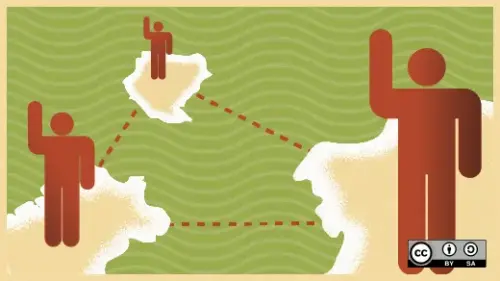
No matter what form it ultimately takes or what industry it serves, open source is always, at its core, a network. Sometimes—though certainly not always—that network is composed of physical computers, servers, and repositories sharing code across continents. More importantly, however, it is a network of people.

Whether these individuals are gathering in person at massive international conferences, chatting over drinks at a local pub, or collaborating asynchronously in online chat rooms, open source is defined above all else by its community of human participants. Technology does not build itself; software is written, reviewed, maintained, and shared by living, breathing people who share a common vision of cooperation and openness.
For the past twelve years, the website Opensource.com has been supported and sustained by a commercial entity. Corporate backing has allowed the platform to grow, host thousands of articles, and serve as a central gathering place for advocates of open source solutions. Yet, a fundamental distinction remains between corporate structures and human communities. The people—representing every reader, contributor, advocate, and enthusiast—who make up the Opensource.com community are not commercial entities; they are human beings united by a shared ethos.
Now, after more than a decade of publication under its previous model, that dynamic is shifting. In one month, Opensource.com is set to resolve that imbalance and step into a new era. The community is mobilizing, preparations are underway, and the next chapter for the platform is almost ready to unfold. Stay tuned as more details emerge about what is next for the network.