For years, Markdown has been celebrated by developers, technical writers, and content creators as a clean, lightweight, and distraction-free way to write text. However, publishing Markdown content online has traditionally required a dedicated website setup, static site generators, or complex build processes. A new open-source project called Docsify-This is aiming to change that paradigm by allowing users to transform raw Markdown files into responsive, standalone web pages instantly, without requiring any hosting infrastructure or server-side builds.
Built on top of the popular open-source project Docsify.js, Docsify-This provides a streamlined utility to publish, share, and reuse Markdown content across a wide variety of digital platforms. Whether creators need to syndicate text across different content management systems or embed constraint-free documentation into learning management systems, Docsify-This bridges the gap between raw text files stored in version control repositories and fully rendered, highly customizable web pages.
What is Docsify-This?
At its core, Docsify-This takes any publicly available Markdown file and instantly converts it into a responsive, standalone web page complete with a shareable URL. Beyond single-page documents, users can link multiple Markdown files together to establish a straightforward, multi-page website structure without managing traditional web hosting.

The project was designed with flexibility and design control in mind. Creators and designers can alter the visual appearance of their displayed pages using a straightforward point-and-click Web Page Builder interface or by appending specific URL parameters. Furthermore, the project supplies a dedicated set of Markdown CSS classes that developers can leverage when authoring content. For those who store their documentation repositories on popular Git hosting platforms like Codeberg or GitHub, Docsify-This can automatically generate an "Edit this Page" link for every rendered document, fostering smooth collaborative authoring environments.
Because Docsify-This is fully open-source software, organizations and individuals are not locked into a single proprietary service. Users can easily host their own independent instances of Docsify-This under custom domains, retaining full control over their publishing pipelines and data.
Use the Docsify-This Web Page Builder
The primary entry point for creators looking to test or utilize the platform is the Docsify-This Web Page Builder interface, accessible via the official project website or a locally hosted instance. To generate a web page, an author simply inputs the direct URL of a Markdown file residing within a public repository on GitHub or Codeberg—though other Git hosts can be integrated using advanced URL parameters—and clicks a button to publish the content as a standalone web page.
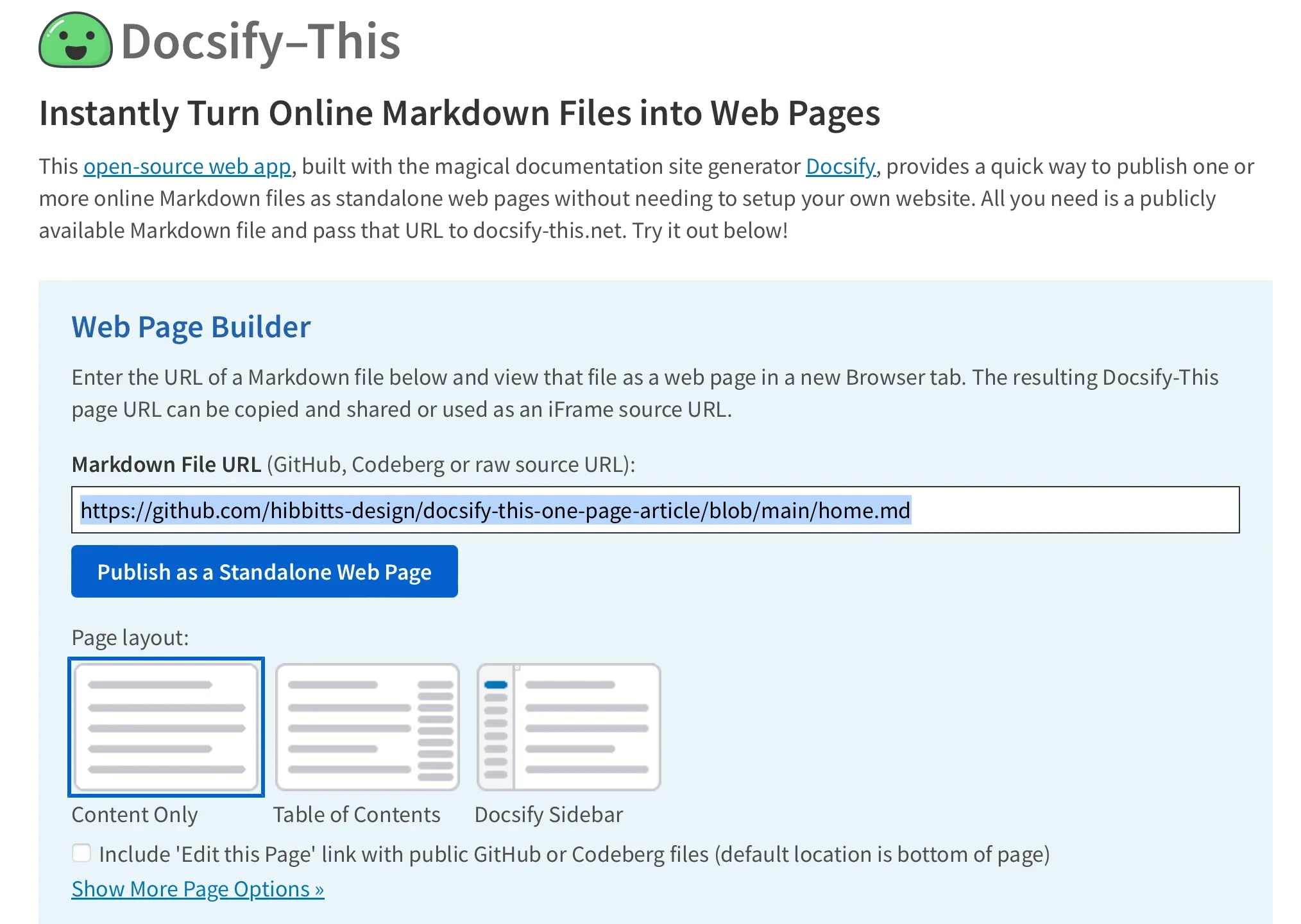
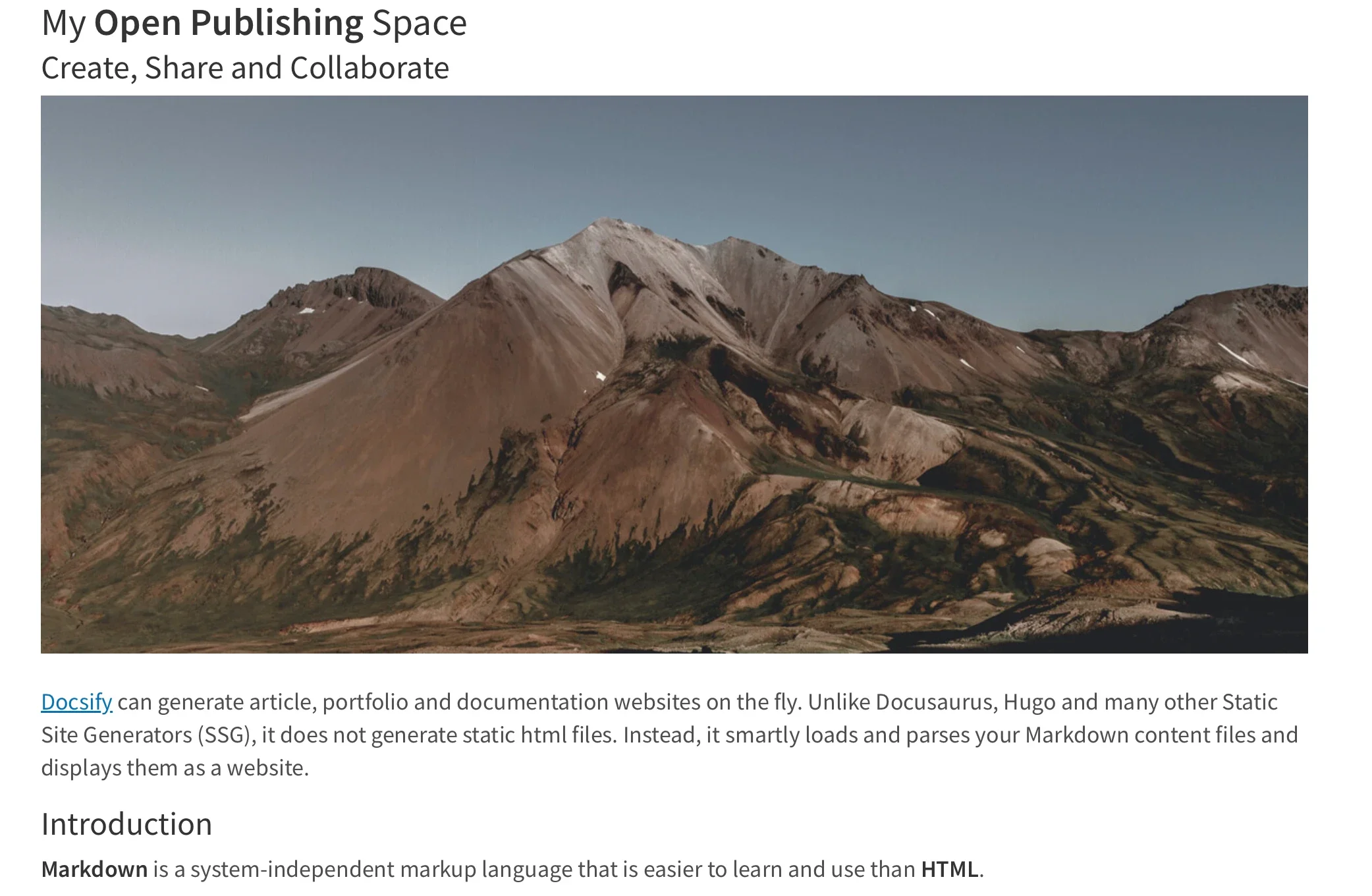
Upon publication, Docsify-This outputs a clean web address pointing directly to the rendered document. This URL can be freely copied, shared via email, distributed on social media, or embedded into other web properties. The resulting pages are dynamically responsive, adapting seamlessly to desktop displays, tablets, and mobile phones.
Render Other Files in the Same Repository
Managing multi-document projects or updating existing content collections is similarly streamlined through URL manipulation. Authors do not need to generate entirely new publishing configurations for every individual file within a project. Instead, they can render alternate Markdown files housed within the same remote repository by directly modifying the homepage parameter in the Docsify-This URL structure. This allows teams to maintain a centralized repository of documentation, lecture notes, or articles while dynamically switching which specific file is actively displayed to the end reader.
Modify the Web Page’s Appearance
Customizability is a cornerstone of the Docsify-This publishing model. Rather than forcing content into a rigid, uniform template, the platform allows publishers to alter the visual presentation of any rendered Markdown file by applying standard URL parameters. Common cascading style sheet attributes such as font-family, font-size, link-color, and line-height can be passed directly through the web address to match external brand guidelines or aesthetic preferences.
In addition to global layout parameters, authors can inject specialized Markdown CSS classes into their source files. For instance, appending a class designation to a standard link transforms ordinary text into a styled button element automatically. Beyond the predefined classes supplied by the platform, technical authors have the freedom to embed custom CSS blocks directly within their Markdown files. This enables the creation of unique user interface components, such as specialized callout boxes, custom buttons, and tailored typographic layouts, all while maintaining the simplicity of writing in raw Markdown.
Include HTML Snippets and Advanced Layouts
While Markdown is prized for its minimalist syntax, complex web publishing often demands richer structural layouts. Docsify-This supports standard HTML snippets embedded directly within the source text, enabling authors to construct multi-column layouts, grid systems, and other structural arrangements without breaking the publishing workflow. This capability allows technical writers and educators to combine the writing speed of Markdown with the structural flexibility of HTML when designing resource pages, syllabi, or project documentation.
Embed Docsify-This as an iFrame
One of the most powerful use cases for Docsify-This is content syndication. Because the generated web pages are lightweight and responsive, they can be embedded seamlessly into almost any third-party platform using an HTML iFrame. Publishers can utilize URL parameters to fine-tune the appearance of the embedded content, ensuring that fonts, scaling, and interface elements harmonize smoothly with the host platform’s native design. This approach eliminates the tedious chore of duplicating content across multiple systems, allowing a single Markdown file maintained in a Git repository to serve as the single source of truth for updates distributed across external websites and portals.

Embed Docsify-This with an External URL
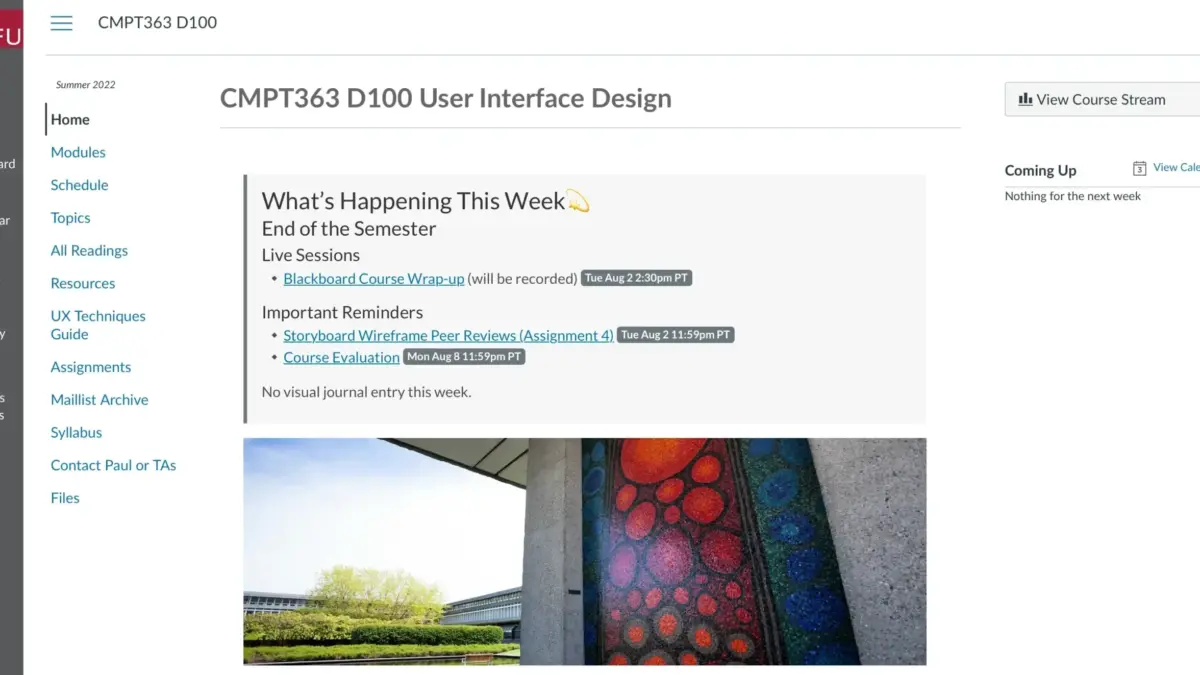
For educators and administrators working within institutional learning management systems, embedding content via iFrames is only one option. Popular learning platforms—including open-source solutions like Moodle and proprietary environments like Canvas—frequently support external URL integrations. Administrators can configure course navigation menus to link directly to external web applications, or utilize dedicated extensions such as the Canvas Redirect Tool to pull Docsify-This pages directly into a student dashboard. By leveraging these integrations, instructors can maintain their course readings, schedules, and resource libraries in version-controlled Markdown repositories while delivering a native-feeling experience directly inside their institutional learning management system.
Integrate Docsify-This and Git
To fully unlock the advantages of collaborative authoring, version tracking, and automated publishing, Docsify-This is designed to integrate cleanly with Git-based workflows. By storing documentation files in repositories on platforms like GitHub or Codeberg, authors gain access to comprehensive revision histories, pull requests, and issue tracking.
A variety of software tools support this ecosystem, ranging from visual Git clients like GitHub Desktop, Git-Cola, and SparkleShare, to advanced text editors with built-in version control integration such as Visual Studio Code and Pulsar Edit. This integration ensures that technical writers, developers, and educators can continue utilizing their preferred local development environments and version-control best practices while instantly publishing their work to the web via Docsify-This.

Conclusion
The barriers that once separated raw text authoring from professional web publishing continue to dissolve. Through the combination of Docsify.js and the flexible publishing utilities provided by Docsify-This, content creators, educators, and developers have gained a robust, open-source pathway to share and syndicate Markdown documents anywhere on the web. By removing complex build processes and infrastructure requirements, Docsify-This makes modern, version-controlled publishing accessible to a broader audience than ever before.