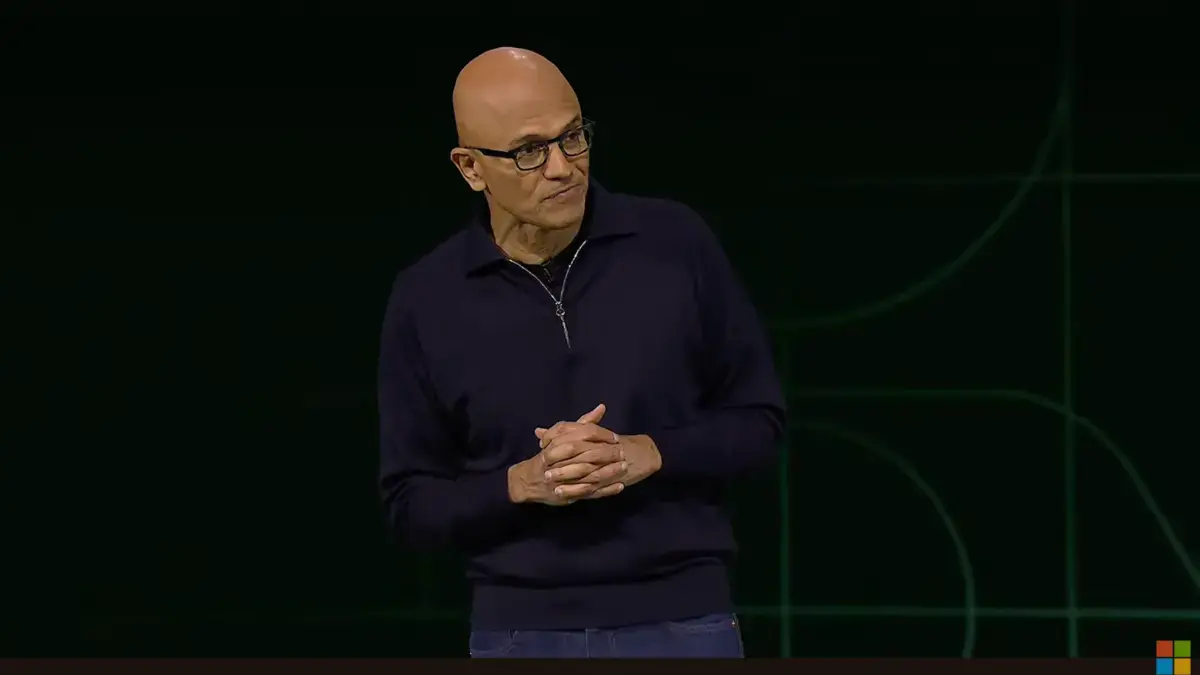
SAN FRANCISCO — During a wide-ranging roundtable discussion following his keynote address at Microsoft Ignite at the Chase Center, Microsoft CEO Satya Nadella offered a sobering perspective on the future of artificial intelligence, stating that he is “AGI-pilled” when considering the profound structural transformations the technology could inflict on the global economy and democratic political systems.
Rather than focusing on science-fiction tropes of machine sentience, Nadella’s concerns center squarely on the political economy. When asked about how he conceptualizes artificial intelligence, the Microsoft chief executive directed attention away from narrow corporate rivalries and toward macro-level societal impacts.
“I am AGI pilled in the sense that at an economy level, what is the political economy’s organization around AGI?” Nadella asked reporters.
The discussion followed Nadella’s response to questions regarding competitor announcements, specifically Anthropic’s release of expanded enterprise products, including its own AI-powered office suite. While software releases of this nature are typically discussed in the context of market share and productivity gains, Nadella’s assessment quickly scaled to existential economic and political stakes. He warned of potential macroeconomic collapse and the erosion of democratic governance if the burgeoning AI ecosystem is allowed to consolidate into a monopoly.
“If the Marxist sort of view is that there’s only one firm, then it’s over, right? For all of us,” Nadella said. Expanding on this theme, he cautioned that a consolidated AI landscape would leave no independent economic actors, quipping that even individual professionals would ultimately become mere corporate affiliates of a singular dominant entity like Anthropic.
Nadella emphasized that viewing artificial intelligence merely as a traditional tech industry race for market capitalization fundamentally misunderstands the technology’s unbounded nature. Unlike legacy software or hardware platforms that operate within specific verticals, advanced AI models possess the generalized capability to permeate every sector of commerce and governance.
“Most people think about this as a competition between tech firms, of course it will be,” Nadella noted. “Pero remember, the model has no limits. It’ll be a healthcare company. It can be a financial services company. It can be anything if it wants to be. It can take over the government. Thinking of this as some narrow competition between tech firms, of who is going to get to the next trillion dollars of market cap, is one of the strangest, narrowest ways to think about it.”
This expansive capability, Nadella argued, threatens to fundamentally disrupt the traditional definition and purpose of a corporate entity. As models grow increasingly sophisticated, capable of absorbing vast amounts of data and performing complex cognitive labor, the traditional relationship between human capital and corporate structure faces unprecedented pressure.
“If intelligence has network effects, what is the future of a firm?” he asked. “If the model sees anything and learns it, and essentially all of human capital collapses into token capital, what is the role of a firm and the human capital in a firm? That’s the debate.”
This restructuring of labor and capital carries profound implications for democratic stability, according to the Microsoft CEO. In a functioning democracy, political legitimacy relies on an economic foundation where labor retains value and wealth circulates broadly. If advanced automation leads to a scenario where capital is hyper-concentrated within a handful of models or firms while human labor is marginalized, the viability of democratic governance itself comes into question.
“I think the political economy is going to get more and more interesting in that context,” Nadella said. “No one — at least in a democracy — can even win an election if this just goes that way, if there’s only capital and there’s no labor. I mean, I don’t know, that’s not an economy.”
Despite his stark warnings regarding the political economy of artificial intelligence, Nadella remains skeptical about the near-term likelihood of conscious or sentient frontier models. When addressing the philosophical and ethical dimensions of AI development, he contrasted his views with those held by competitors like Anthropic.
Anthropic, as a matter of institutional principle, has treated certain models with a level of moral status, a practice that has drawn sharp criticism from within the leadership ranks at Microsoft. Microsoft AI CEO Mustafa Suleyman has previously expressed concern over this approach, telling interviewers that he believes Anthropic’s team has “wireheaded” themselves by attributing rights or consciousness to AI systems, calling the methodology dangerous.
Nadella took a slightly more measured stance on the debate while aligning with the core premise that models are not conscious entities. “I don’t think so,” Nadella said when asked if models like Claude possess consciousness. He added that while he is not overly dogmatic about the philosophical intricacies, the immediate socio-technical challenges lie elsewhere. “It’s a good debate. I’m not sort of dogmatic about it. What I’m saying is the most important social technical issue we have to deal with is how do you ensure that an economy can diffuse this technology broadly?”
This
emphasis on broad diffusion directly informs Microsoft’s commercial strategy, which Nadella actively promoted throughout the Ignite event. Rather than championing a centralized, monolithic AI model that controls all facets of enterprise operations, Microsoft’s enterprise offerings are designed to provide corporate clients with the flexibility to select cost-effective models tailored to specific tasks, deploy proprietary models, and maintain strict control over their own data assets.
Nadella framed this decentralized approach as an essential safeguard against monopolistic consolidation. By ensuring that organizations retain data sovereignty and the ability to choose from a diverse marketplace of models, the tech ecosystem can resist the gravitational pull toward corporate centralization.
“I think that if you believe that the world, the economy needs more than one firm or two firms, then by definition there need to be as many models as firms of some sort,” Nadella concluded.