
As the development community transitions into a new season, the web platform continues to evolve at a rapid pace, bringing forth innovative features, experimental specifications, and creative workarounds for longstanding front-end challenges. The latest edition of the web development roundup captures a wealth of cutting-edge ideas, community debates, and technical breakthroughs produced by CSS developers and browser engineers over the past couple of weeks. From refining user interface interactions to rethinking how we handle syntax highlighting, grid layouts, and advanced selectors, this period has been particularly rich in technical discussion.
One of the foundational user experience problems tackled recently involves the behavior of tooltips. For years, developers have struggled to strike the right balance between responsiveness and annoyance when displaying contextual information on hover. Abhishek Jakhar recently explored why tooltips should feature an initial delay followed by an instant response. By introducing a short pause before a tooltip appears, users are protected from accidental triggers as their cursors sweep across a crowded interface. Once the tooltip is active, however, moving away should ideally cause it to disappear immediately without lingering frustratingly on the screen. Jakhar detailed how to implement this pattern effectively, while noting an important caveat: if the hoverable target region is too small, a hasty mouse movement can inadvertently de-trigger the tooltip, making the delay a necessary safeguard in certain layouts.
Building on this concept, Chris Coyier demonstrated a modern implementation leveraging interest invokers, a forward-looking feature centered around two specific CSS properties: interest-delay-start and interest-delay-end. While support for interest invokers is currently restricted to Chrome, the technique serves as a textbook example of progressive enhancement, allowing developers to adopt modern browser capabilities today while maintaining a resilient experience across all user agents.
<geolocation> and How to Use It Today
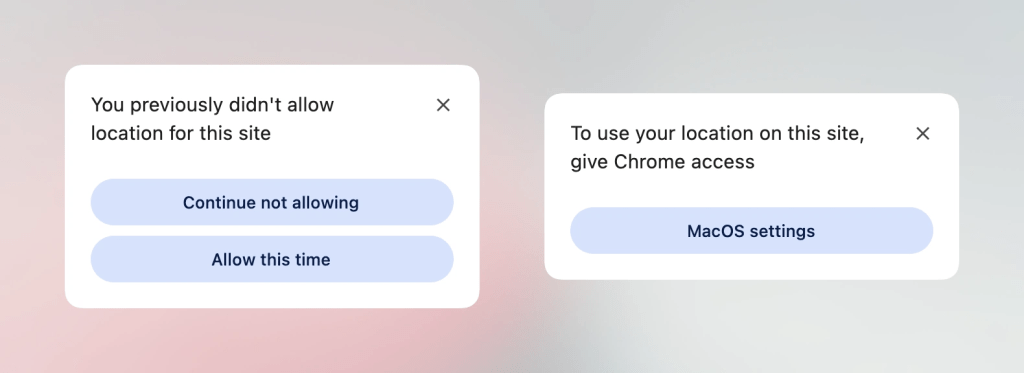
Progressive enhancement remains a central theme in modern web development, especially as browser vendors attempt to simplify historically cumbersome browser APIs. The Geolocation API has traditionally been a source of frustration due to its reliance on external hardware components like GPS satellites, Wi-Fi triangulation networks, and cellular towers, alongside the persistent complexities of managing permission states once they have been granted or denied.
To address these pain points, the emerging <geolocation> element aims to streamline location requests, though it brings its own set of unique quirks—most notably, strict styling restrictions imposed by the browser. Because native support is currently limited to Chrome, developers looking to adopt the element must deploy it alongside the traditional Geolocation API as a fallback. This hybrid approach ensures that applications can leverage the cleaner declarative syntax where supported while gracefully falling back to established scripting methods for broader compatibility.
MicroLighter: A Highlight-Based Syntax Highlighter
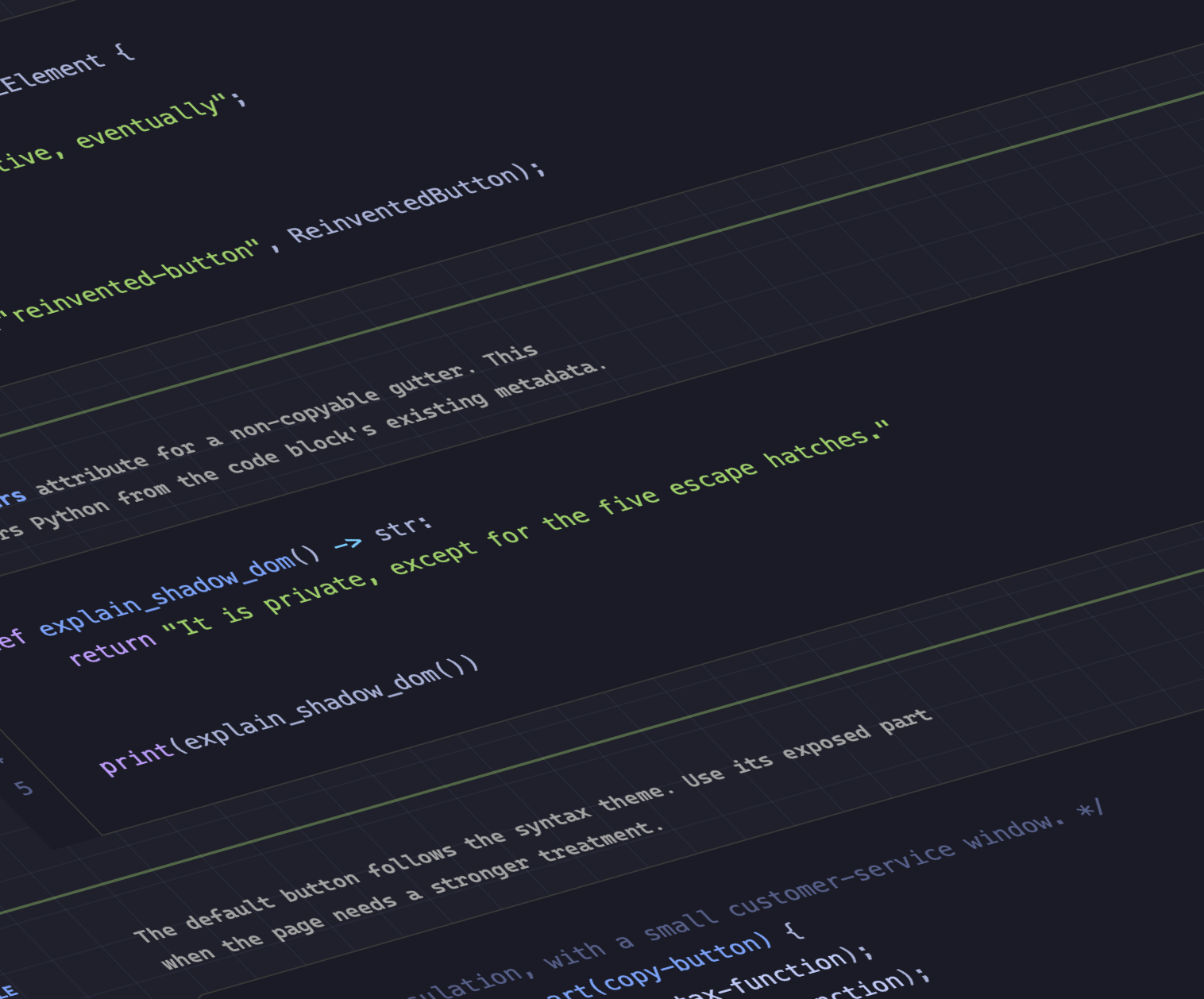
The ongoing expansion of native browser styling capabilities has also given rise to novel utilities like MicroLighter, a compact syntax highlighter built by Dave Rupert using the Custom Highlight API and the ::highlight() pseudo-element. Traditional syntax highlighters often require heavy DOM manipulation, wrapping individual tokens in custom spans that bloat the document tree. By leveraging the Custom Highlight API, developers can apply styles directly to text ranges without altering the underlying HTML structure. Rupert published a detailed breakdown of how MicroLighter functions, while Geoff and other community voices highlighted its potential to make client-side syntax highlighting significantly lighter and more efficient.
How to Get CSS Grid Information Into CSS Variables
In the realm of layout engineering, Temani Afif shared a powerful technique for bridging the gap between layout geometry and styling logic by passing CSS grid information directly into CSS custom properties. Afif demonstrated how developers can extract the total number of rows and columns, as well as the exact x and y coordinate indexes for individual cells, provided that the columns maintain equal widths.
This capability opens up exciting possibilities for advanced interaction design. Afif illustrated one such use case by applying grid variables to calculate hover proximity, allowing elements to react dynamically based on their spatial relationship to the user’s cursor within a grid structure—a technique that showcases the increasing computational power of modern CSS.
Dark Mode: Two-State or Tri-State?
User interface preferences continue to spark healthy debates within the community, particularly regarding dark mode toggles. A recent philosophical divide emerged between Lea Verou, who advocates for a streamlined two-state toggle, and Bramus, who makes a strong case for a tri-state approach that explicitly separates light, dark, and system-default settings. Meanwhile, other developers have championed variations like the auto-until-overridden two-state model, highlighting the ongoing effort to balance user autonomy with seamless automated theme switching based on operating system preferences.
An Introduction to the Class Prefix Selector
Bramus also proposed several forward-looking additions to the CSS specification, beginning with the class prefix selector. Designed to streamline styling rules that target classes sharing a common naming convention, this selector offers a cleaner and significantly more performant alternative to traditional attribute selectors. Instead of relying on complex substring matching rules that inspect class attribute strings, the proposed prefix syntax provides a native, straightforward way to group styles. Although browser support is not yet available, the simplicity and utility of the proposal suggest that it could see relatively fast adoption as specifications progress.
In tandem with the class prefix selector, Bramus introduced the @supports named-feature() function, supported currently in Chrome. This feature-detection mechanism allows developers to query granular browser capabilities that were previously impossible to detect via standard @supports queries—such as whether a browser correctly respects CSS transforms when positioning anchor elements. By expanding the scope of feature detection, the function aims to help developers write more resilient, adaptive stylesheets without resorting to brittle browser sniffing.
How to Balance Wrapped Flex Items Across Rows or Columns
Rounding out the recent wave of layout enhancements, Chrome has introduced support for flex-wrap: balance. Functionally similar to the popular text-wrap: balance property used for typography, this new flexbox capability automatically distributes items evenly across multiple rows or columns to prevent awkward orphan items at the end of a grid. Ahmad Shadeed published a comprehensive exploration of the property, detailing how developers can utilize it to create more visually harmonious layouts without relying on complex JavaScript calculations. As the web platform continues to mature through these varied updates, developers are equipped with an increasingly powerful toolkit to build robust, elegant, and responsive user interfaces.



Leave a Reply