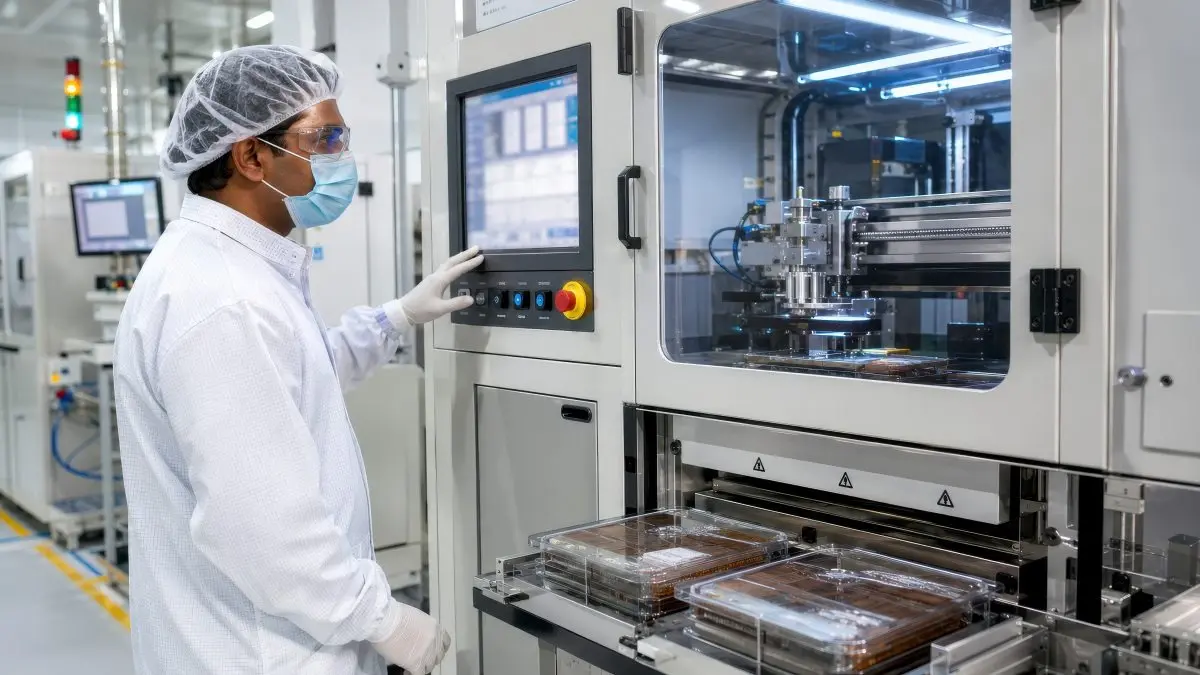
A prime example of this emerging entry point is Sahasra Semiconductors’ operating facility located in Bhiwadi, Rajasthan. Backed by an investment exceeding ₹1.5 billion—roughly equivalent to $15.8 million—according to a May 2026 government announcement, the facility highlights how smaller players can enter the semiconductor value chain. Yet, this development brings a broader structural question to the forefront of the industry: Can smaller, agile facilities successfully build commercially viable businesses by deliberately focusing on mature packaging technologies and specific, underserved product segments?
To better understand the economic realities behind these specialized ventures, EE Times spoke with Nitin Dodia, an independent semiconductor consultant and the founder-director of Smart Fab Systems. Dodia estimated that establishing a facility centered strictly on mature packaging technologies requires an initial capital expenditure ranging between ₹1.5 billion ($15.8 million) and ₹2 billion ($21 million). He noted that the exact financial figure naturally fluctuates depending on the specific product mix, specialized equipment requirements, and ongoing operating expenditures.
Dodia’s financial and operational estimates apply primarily to mature, non-advanced products that rely on simpler, well-understood manufacturing processes. Simple wire bonding or traditional leadframe-based packaging frameworks are inherently less capital-intensive than cutting-edge packaging methods, allowing market entrants to establish operations without committing astronomical sums.
Furthermore, production volume heavily dictates capital expenditure requirements, Dodia explained. Industry giants like Micron process tens of millions of chips every month, necessitating massive equipment investments tailored explicitly for those extreme volumes. In contrast, OSATs handling specialized products through mature technologies can comfortably launch operations with significantly lower capex thresholds.
Sahasra’s semiconductor packaging facility, established under the Ministry of Electronics and Information Technology’s Scheme for Promotion of Manufacturing of Electronic Components and Semiconductors (SPECS), occupies 5,295 square meters—about 57,000 square feet—and boasts a stated annual packaging capacity of 60 million units. The facility handles a diverse portfolio, packaging memory chips for microSD cards and flash storage, LED driver ICs, embedded SIMs (eSIMs), and RFID products. Government officials have recognized Sahasra as India’s first small and medium enterprise (SME) to successfully embark on commercial production of semiconductor chips.
Similarly, RRP Electronics operates a specialized OSAT facility located in Mahape, Navi Mumbai, Maharashtra, catering directly to customers across the automotive, industrial, and telecommunication sectors.
These agile facilities contrast sharply with the scale of India’s larger OSAT initiatives. Tata Electronics, for instance, is spearheading a massive ₹270 billion—roughly $3.25 billion—OSAT facility in Assam with an approved capacity reaching 48 million units per day. Meanwhile, CG Power is developing a ₹76 billion—approximately $910 million—facility in Sanand, Gujarat, designed with a planned capacity of 15 million units a day. Kaynes Technology is also building a ₹33.07 billion—roughly $395 million—facility in Sanand, engineered to handle more than 6.33 million units daily. By comparison, Sahasra’s stated annual capacity of 60 million units translates to a daily average of roughly 164,000 units, underscoring the stark operational differences between high-volume mega-plants and specialized SME operations.
Customers before capital
Despite the vast differences in scale, industry experts emphasize that financial investment alone does not guarantee long-term viability. Dodia stressed that whether a company is establishing a smaller operation or a massive enterprise, securing an anchor customer is an absolute prerequisite. He also pointed to crucial operational metrics such as capacity utilization, the availability of experienced personnel, and rigorous product qualification processes as determining factors for sustained success.

Dodia advised that a newly established OSAT should secure at least one primary customer legally and commercially committed to purchasing its manufactured products over a sustained period of three to five years. This foundational requirement becomes even more critical when a company operates under a tight, lower initial investment budget.
Established pioneers like Sahasra and RRP Electronics hold a distinct structural advantage because they entered the domestic market earlier and have already cultivated active customer bases purchasing their commercial output. Dodia emphasized that securing paying buyers matters far more than simply deploying capital into infrastructure. An investor could easily allocate ₹1 billion to ₹2 billion on advanced equipment, but if that machinery sits idle because no buyers are lined up, the investment will inevitably fail to deliver the expected financial returns.
Larger market players, including CG Semi and Kaynes Semicon, deliberately follow this exact business model by establishing tight partnerships with both anchor customers and established technology partners. For example, Renesas acts as both a crucial technology partner and an anchor customer for CG Semi, whose initial production runs are dedicated directly to fulfilling Renesas’s specific packaging requirements. Without such guaranteed arrangements in place, Dodia noted that proceeding with a manufacturing setup carries unnecessary commercial risk.
A major global buyer like Apple or Samsung might theoretically need to collaborate with ten smaller OSATs, each tethered to an investment bracket of ₹1 billion to ₹2 billion, just to satisfy their aggregate production requirements. Dodia noted that this fragmented approach creates significant administrative and management overhead for the customer as well.
Ultimately, capacity utilization remains far more important than initial capital expenditure. Equipment carries a heavy financial cost regardless of whether a company invests ₹1 billion or ₹10 billion. Idle machinery continuously ties up capital while the business absorbs ongoing interest payments. Therefore, maximizing the operational potential of existing equipment and product lines is paramount, Dodia explained.
Investors entering this complex sector must also exercise considerable patience. Dodia pointed out that financial returns are typically nonexistent during the first year of operation, and stakeholders should realistically expect zero returns through the initial two to three years of commercial activity.
Experienced engineers are scarce
Beyond financial capital and customer acquisition, human capital presents one of the most critical challenges facing the burgeoning Indian semiconductor ecosystem. Dodia highlighted that the workforce, particularly experienced technical personnel, represents the most heavily underestimated requirement in the industry.
While equipment suppliers and material vendors readily provide clear cost quotes, experienced engineering talent remains globally scarce. Indian OSATs find themselves locked in intense competition for skilled labor not only domestically but also with the United States and other nations rapidly expanding their own domestic chip manufacturing footprints to minimize supply chain vulnerabilities.
Dodia warned that the pool of seasoned personnel risks running dry. Much of the intricate knowledge required in semiconductor manufacturing remains undocumented. For instance, two identical manufacturing tools sourced from the exact same vendor can begin behaving differently over time due to microscopic residue accumulation inside their process chambers. An experienced process engineer can analyze statistical process control charts to rapidly identify and resolve the root cause. Artificial intelligence cannot solve these nuanced operational problems without comprehensive underlying data. Consequently, most critical manufacturing knowledge still exists strictly inside experienced engineers’ heads.

Echoing these concerns in an earlier interview with EE Times, Wasi Uddin, senior manager of R&D and training at Kaynes Semicon and a former OSAT and ATMP consultant at MeitY, noted that the immediate operational gap is neither raw materials nor specialized equipment, but rather the deep expertise required to run semiconductor-grade facilities. Uddin explained that much of this foundational expertise currently flows in from the Philippines and Malaysia, or stems from Indian engineers who previously worked abroad and have recently returned home. Furthermore, domestic semiconductor manufacturers are forced to compete directly with India’s booming IT sector when offering competitive engineer salaries.
A long road to qualification
Product qualification serves as another formidable operational hurdle for emerging facilities. Dodia explained that qualification cycles routinely span anywhere from 12 to 24 months, meaning a newly established OSAT cannot immediately supply commercial customers the moment its equipment is installed and powered on.
Prospective customers typically demand anywhere from six to twelve consecutive, flawless production batches before officially qualifying a new manufacturing supplier. Even after successfully passing this rigorous vetting process, the new OSAT may initially serve only as a secondary or backup supplier. Additionally, upstream material suppliers themselves often spend up to a full year qualifying their components with a new OSAT facility.
Clusters versus a spread-out map
Geographic clustering is another vital factor influencing the maturation of India’s semiconductor supply chain. Dodia argued that smaller OSATs should ideally operate within concentrated regional clusters to maximize logistical efficiency. However, individual Indian states are actively competing for high-tech investments, leading to semiconductor plants spreading widely across the country.
With the Indian government approving 12 distinct projects under the India Semiconductor Mission (ISM), specialized suppliers—such as chemical providers and firms like RRP Electronics—may find themselves forced to establish local warehouses across eight to ten different geographic locations. Certain essential manufacturing materials, such as specific leadframes destined for relatively advanced packages, must be sourced from suppliers located within a few hundred kilometers of the OSAT because extended transportation can negatively impact material integrity.
Illustrating this logistical challenge, Tata operates one plant in Dholera, Gujarat, and another facility in Assam, requiring supply chain partners to manage complex logistics stretching from the western coast to the eastern edge of the country. Dodia acknowledged that individual states naturally want a fair share of the burgeoning high-tech industry, but cautioned that this geographic dispersion means domestic supply chains will take significantly longer to fully mature. A development timeline that might have taken three years in a concentrated cluster could now stretch to five years.
The industrial hub of Sanand in Gujarat presents a contrasting, highly efficient model. Dodia pointed out that Gujarat successfully houses three OSAT operations directly in Sanand alongside three additional facilities in the immediate surrounding area, allowing a single localized supplier facility to efficiently serve multiple independent manufacturing companies.
Uddin offered a pragmatic perspective on the supply chain evolution, noting that new OSATs can comfortably rely on imported materials for their first three to five years while local component ecosystems gradually develop. Addressing the historical absence of domestic suppliers, Uddin asked rhetorically why India lacked a domestic leadframe supplier until recently, answering that because there were previously no domestic OSATs, there simply was no viable local market.
Highlighting cooperative industry efforts, Uddin noted that major domestic players including Micron, CG Semi, and Kaynes formed a collaborative consortium, holding regular monthly supplier meetings so component manufacturers could clearly visualize their combined market demand.

Room in legacy packaging
While commodity packaging forces smaller OSATs into intense competition with global suppliers worldwide, large-scale OSAT enterprises are rapidly shifting their primary growth focus toward advanced packaging technologies. Amkor, for instance, reported that its advanced packaging revenue climbed to $5.56 billion in 2025, while its mainstream wirebond business remained relatively flat at $1.15 billion.
Concurrently, large OSATs routinely phase out and retire older legacy packaging lines. In 2022, ASE’s Chung-Li plant in Taiwan decommissioned its punch quad flat no-lead (QFN) manufacturing line, forcing major chipmaker NXP to officially withdraw two long-standing parts from active production.
Dodia sees a lucrative commercial opening for smaller, agile OSATs willing to step into these discontinued legacy product lines. Many mature products feature deeply entrenched, long-term applications where market demand remains steady for 10 to 20 years, with the automotive sector serving as a prime example. NXP has publicly committed to supplying several automotive microcontroller families for well over 15 years, while Rohm Semiconductor specifies extended supply commitment periods of 10 to 20 years for various components, including automotive MOSFETs.
However, Dodia cautioned against market overcrowding. If a cluster of five or ten smaller OSATs all independently target the exact same automotive market segment, they will find themselves locked in a destructive race to the bottom. Ideally, these agile enterprises should coordinate their strategic efforts, with individual companies targeting distinct product segments. Some specialized players could even pursue advanced packaging if they secure the right forward-thinking customers, as industry startups and dedicated research and development teams frequently demand newer, cutting-edge packaging technologies.
Uddin noted that major OSAT market players have already successfully partitioned themselves by operational segment. Micron focuses heavily on memory packaging; CG Semi concentrates on legacy packages such as QFN and thin shrink small outline packages (TSSOP); Kaynes specializes in power packaging; and Alpha and Omega Semiconductor has already booked 28% of its available capacity. While competition is guaranteed, Uddin emphasized that it will not devolve into a destructive, throat-cutting environment.
Who will buy from smaller OSATs
Exploring potential customer bases, Dodia explained that certain specialized buyers are fully willing to pay a premium price in exchange for dedicated manufacturing capacity. Defense and aerospace customers, for instance, are highly sensitive about exposing their sensitive hardware elsewhere and will gladly pay extra for a dedicated, secure production line. Similarly, corporate R&D teams and nimble startups require low-volume prototype batches delivered on compressed timelines. When a massive semiconductor manufacturer receives a multi-million-dollar production order, a minor $10,000 research order can easily sit idle for months. In all such specialized scenarios, rapid turnaround time often matters far more than low unit costs.
Fabless semiconductor startups represent ideal, natural customers for newly established Indian OSAT operations. Serving these innovative startups demands a highly flexible operational model capable of supporting dozens of diverse manufacturing processes, as their initial production volumes are low and their technical requirements shift rapidly. Furthermore, integrated device manufacturers (IDMs) and electronics manufacturing services (EMS) providers represent strong prospective customer segments.
Global corporations like Renesas have compelling strategic reasons to qualify a smaller Indian OSAT, Dodia noted. Government production incentives can assist these smaller facilities in offering attractive pricing structures, while partnering with a dedicated regional provider guarantees planned production capacity for a three-to-five-year horizon without forcing them to compete for resources against the hundreds of massive clients served by global giants like ASE or Amkor.
Ultimately, Dodia concluded that India requires a balanced, tiered industrial ecosystem. Large-scale OSATs can efficiently handle ultra-high-volume commodity production, while smaller, specialized facilities can cater to clients demanding rapid turnaround times, enhanced security, or niche technical services. Several mature international markets already successfully operate under this collaborative framework. If the domestic ecosystem restricts itself strictly to high-volume customers, critical market segments like startups, defense agencies, and advanced research labs will be left underserved. Fostering both operating models ensures that mature products and foundational packaging technologies can effectively meet India’s diverse domestic and international requirements.