What began as a straightforward digital copyright infringement lawsuit has devolved into a labyrinthine legal battle over identity, jurisdiction, and verification. Last year, legal action brought against several prominent private torrent trackers—including PassThePopcorn, BroadcasTheNet, Karagarga, HDBits, and Beyond-HD—captured the attention of the digital rights community. A filmmaker identifying as Matthew Schneider obtained a DMCA subpoena through a California federal court, targeting Cloudflare for information on these elite, invite-only communities that allegedly shared his creative works without authorization.
The legal friction intensified months later when the litigation shifted to an Illinois federal court. Proceedings took a dramatic turn when defense attorneys introduced evidence suggesting that the individual litigating under the name Matthew Schneider might be an impostor. Faced with mounting scrutiny, the person driving the lawsuit dropped the action last month. However, the matter is far from over. Judge Andrea R. Wood maintained jurisdiction specifically to address a pending sanctions request from the defense, setting the stage for a contentious phase focused entirely on uncovering who the plaintiff actually is before any penalties can be weighed.
Passport, License, and Copyright Application
During a September hearing, the man maintained that Matthew Schneider is his legal name and that he currently resides in London. Unconvinced by verbal assertions alone, the court instructed him to provide official documentation to substantiate his identity.
Judge Wood scheduled an October 2 status hearing to be conducted via videoconference, but the plaintiff ultimately joined by phone, citing technical difficulties. At that hearing, the judge directed him to email copies of his driver’s license, passport, and official documentation regarding his application to the U.S. Copyright Office to the courtroom deputy by October 9. The court intended to file these documents under seal and share them with opposing parties strictly under a protective order.

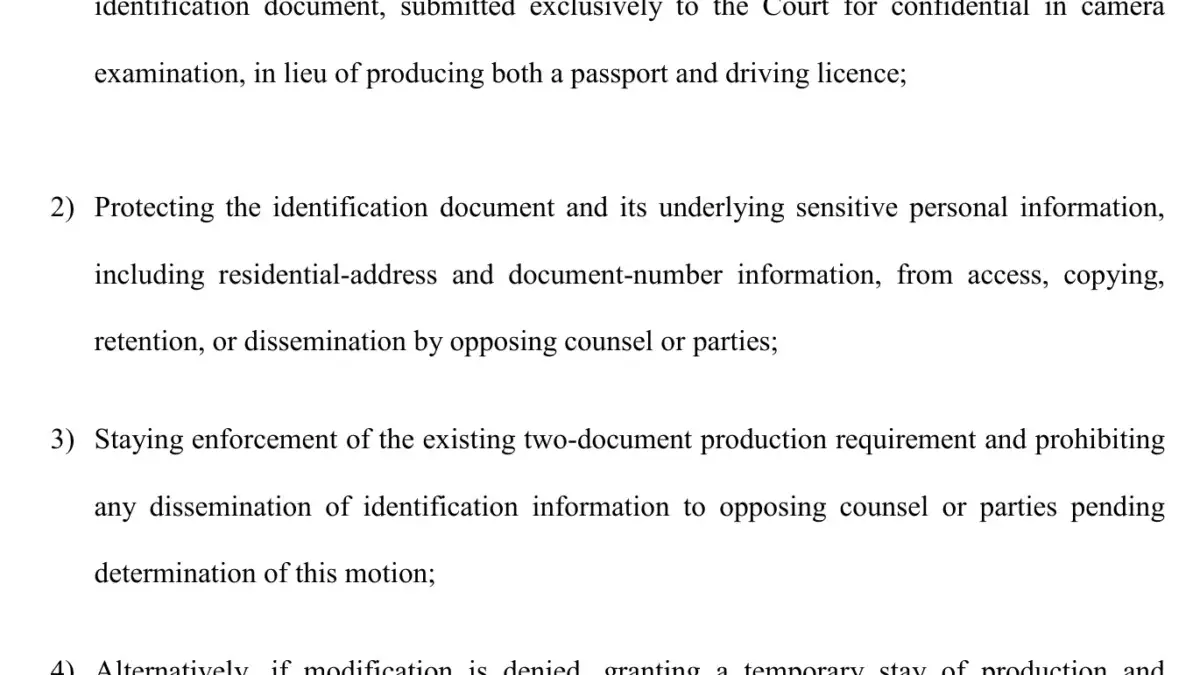
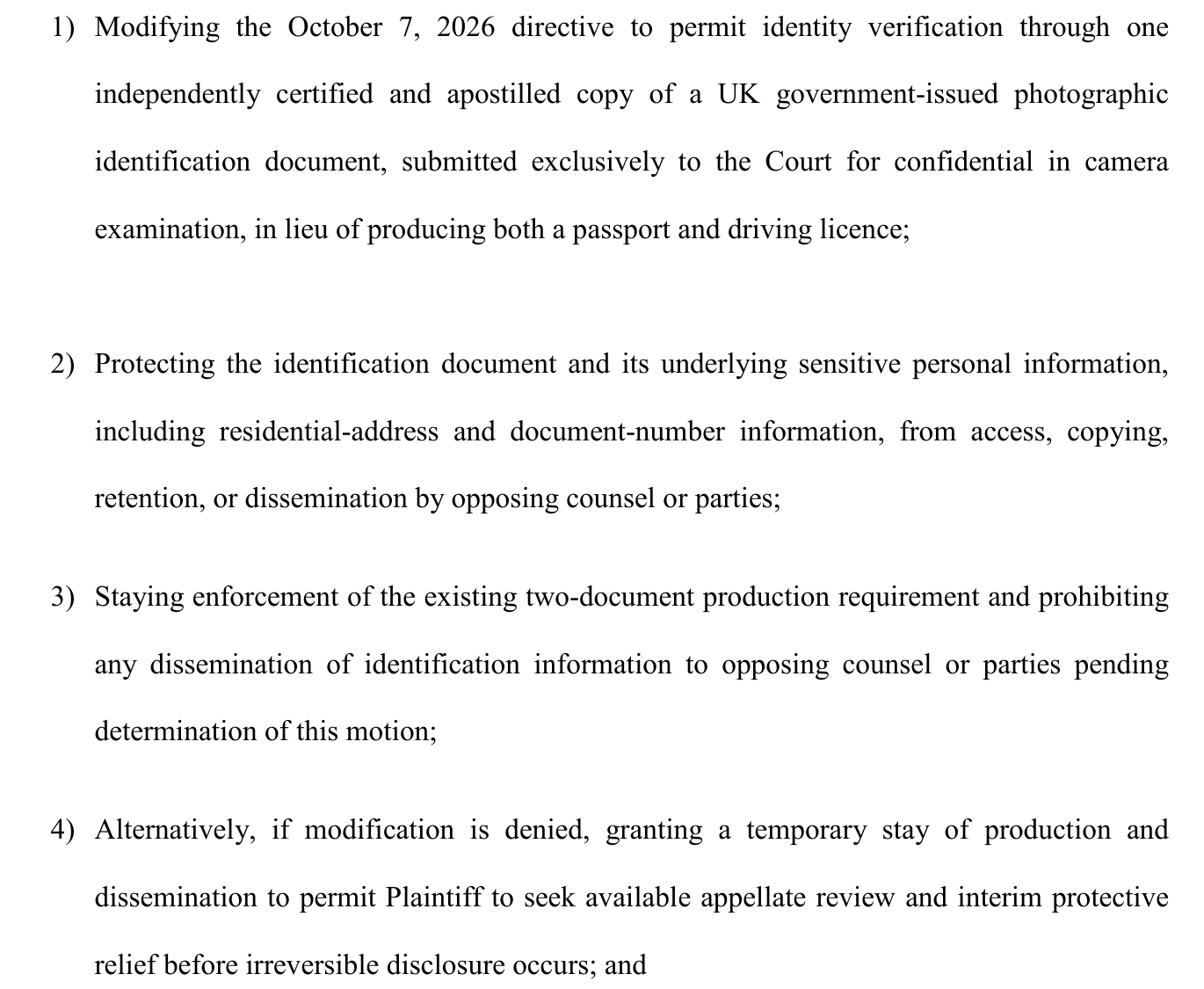
Yet, the October 9 deadline passed without compliance. On October 14, the plaintiff submitted a request asking the court for permission to share a single, independently certified and apostilled UK government photo ID instead. Under his proposal, this identification would be examined exclusively by the judge, with zero access granted to the defense.
The plaintiff argued that strict privacy restrictions are fully warranted under UK data protection law, asserting that once his government-issued identification is exposed, the breach of privacy cannot be undone. In his motion, he emphasized that once opposing counsel receives his sensitive government-issued identification and residential information, the resulting loss of confidentiality cannot meaningfully be reversed. He further requested that if the court refuses to restrict disclosure, it should grant a temporary stay to allow him time to seek appellate review. Notably, the motion omitted any mention of the required U.S. Copyright Office records, which remain unshared.
“This Is Plaintiff’s Design”
The plaintiff’s hesitation to comply quickly drew a sharp response from the defense. Two days after the filing, Erin Russell, counsel representing Doe 1, petitioned Judge Wood to order the plaintiff to show cause as to why he should not be held in civil contempt, noting that he had previously agreed on the record to hand over the required documents.
While Russell is not yet asking for severe punitive measures, she requested a sworn statement detailing what was sent and when, followed by an in-person hearing. Establishing a verifiable identity is much more than a routine procedural formality. As Russell previously explained to the court, any future sanctions award would remain entirely uncollectible unless the court first definitively establishes who the plaintiff actually is.
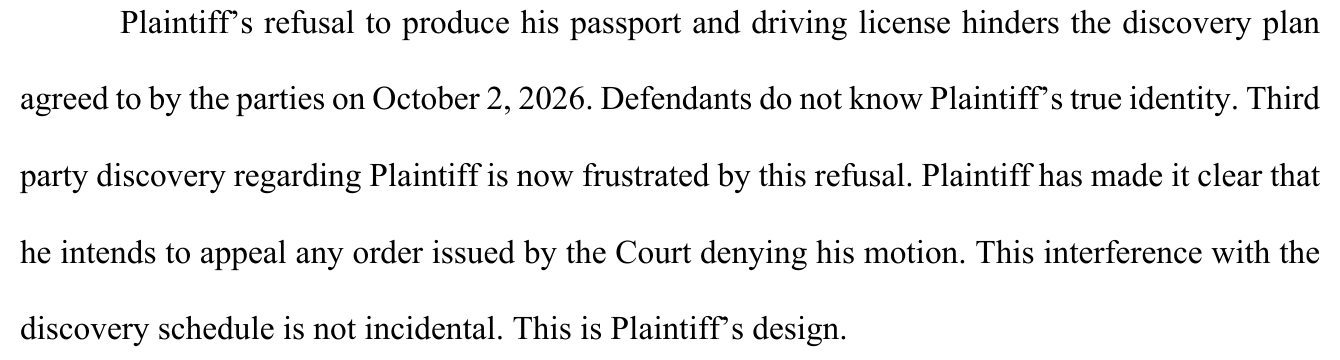
In a subsequent filing last week, Doe 1 escalated its position, arguing that the plaintiff’s ongoing refusal to produce his passport and driving license directly disrupts the discovery schedule agreed upon by the parties. Because the defense still does not know the plaintiff’s true identity, they contend that the obstruction is entirely intentional. Pointing to the plaintiff’s explicit warning that he will appeal any unfavorable ruling—a move that would prolong the litigation indefinitely—Doe 1’s filing concluded that the interference with the discovery schedule is not incidental, characterizing it as the plaintiff’s deliberate design.
Blanks to Fill
The lack of verified identity documentation has left the defense scrambling to adjust their legal strategy. In filings submitted last week, both Doe 1 and Doe #10—the latter identified as Usenet indexer omgwtfnzbs.org—outlined their proposed discovery requests and subpoenas. Because they lack the necessary identity paperwork, both defendants were forced to utilize creative placeholders within their filings, such as requesting the plaintiff to admit that his legal name matches the specific name listed on his passport.
The proposed subpoenas target major entities, including Google for records related to the plaintiff’s Gmail account, his telecommunications carrier for phone number records, and the mailbox provider or landlord associated with his residential address in Sanborn, New York. From the Sanborn address provider, Doe 1 is seeking billing records, payment methods, and historical details regarding where his mail was allegedly forwarded. Additionally, Doe 1 has requested that the PACER Service Center hand over the specific IP addresses the plaintiff used to access the federal court’s website.
The defense is also working to measure its own exposure by demanding all documents, data, and materials the plaintiff received from companies he previously subpoenaed since August 2025. This request encompasses materials that Cloudflare produced in response to the initial California DMCA subpoena, an exhibit that the plaintiff filed in February and which remains under seal.
Throughout the proceedings, Doe 1’s attorney has suggested that the person orchestrating the lawsuit may have previously been banned from the targeted private trackers and harbors personal ill will over the ban, pointing toward a retaliatory motive behind the litigation.
Was “Do Us Part” Made With AI?
Another major focal point of the ongoing dispute centers on "Do Us Part," one of three films the plaintiff claims to have produced in the UK. After receiving a direct court order, the plaintiff submitted his version of the film in September, arguing in his motion that the evidence directly refuted claims that his work was actually a separate Canadian production.
Although the plaintiff asserts his film was created more than 14 years ago, the defense remains deeply skeptical of its origin and authenticity. Consequently, the defense has asked the plaintiff to formally admit whether the submitted film was generated, either in whole or in part, using generative artificial intelligence tools.
To resolve the authenticity question, the defense is demanding the original file, all raw footage, and a comprehensive collection of prompts, outputs, project files, account records, and activity logs associated with any use of AI during the film’s creation.
All parties retain the opportunity to file formal objections to these sweeping discovery requests ahead of their next scheduled video hearing on November 17. To prevent the technical complications that plagued previous appearances, the court has specifically directed the plaintiff to thoroughly test his video capabilities before the proceedings commence.