Elegoo, a brand widely recognized and respected for its contributions to the desktop 3D printing community, is officially making its debut in the 3D scanner market with the introduction of the M1 Ultra. Known primarily for its accessible and reliable resin and filament 3D printers, the company is now expanding its hardware ecosystem to include 3D capture technology. The new M1 Ultra arrives as a heavily featured device aimed at creators, hobbyists, and professionals looking to digitize physical objects, bringing a versatile array of scanning capabilities to the table in its very first iteration.
At first glance, the M1 Ultra distinguishes itself through an impressive configuration of scanning modes. The device packs a total of five distinct scanning modes, offering users a high degree of flexibility depending on the object they are trying to capture. Among these are four blue light laser modes, which are typically favored for capturing fine details, sharp edges, and reflective or dark surfaces with high precision. In addition to the laser modes, the scanner incorporates a near-infrared (NIR) binocular structured light mode, broadening the range of textures, ambient lighting conditions, and surface types the hardware can successfully process.
Beyond its optical modes, the hardware design includes several practical features aimed at improving usability in the field or around the workshop. The M1 Ultra is equipped with a 3-inch color touch screen, allowing users to interact with the device directly and monitor their scanning progress without constantly looking away at a secondary monitor. Furthermore, Elegoo has prioritized mobility and extended operational times by outfitting the scanner with a long-lasting battery. In a move that will likely appeal to users who plan to take the device on location, the package even includes a spare rechargeable battery, ensuring that operators are always prepared for extended scanning sessions without being constantly tethered to a wall outlet.
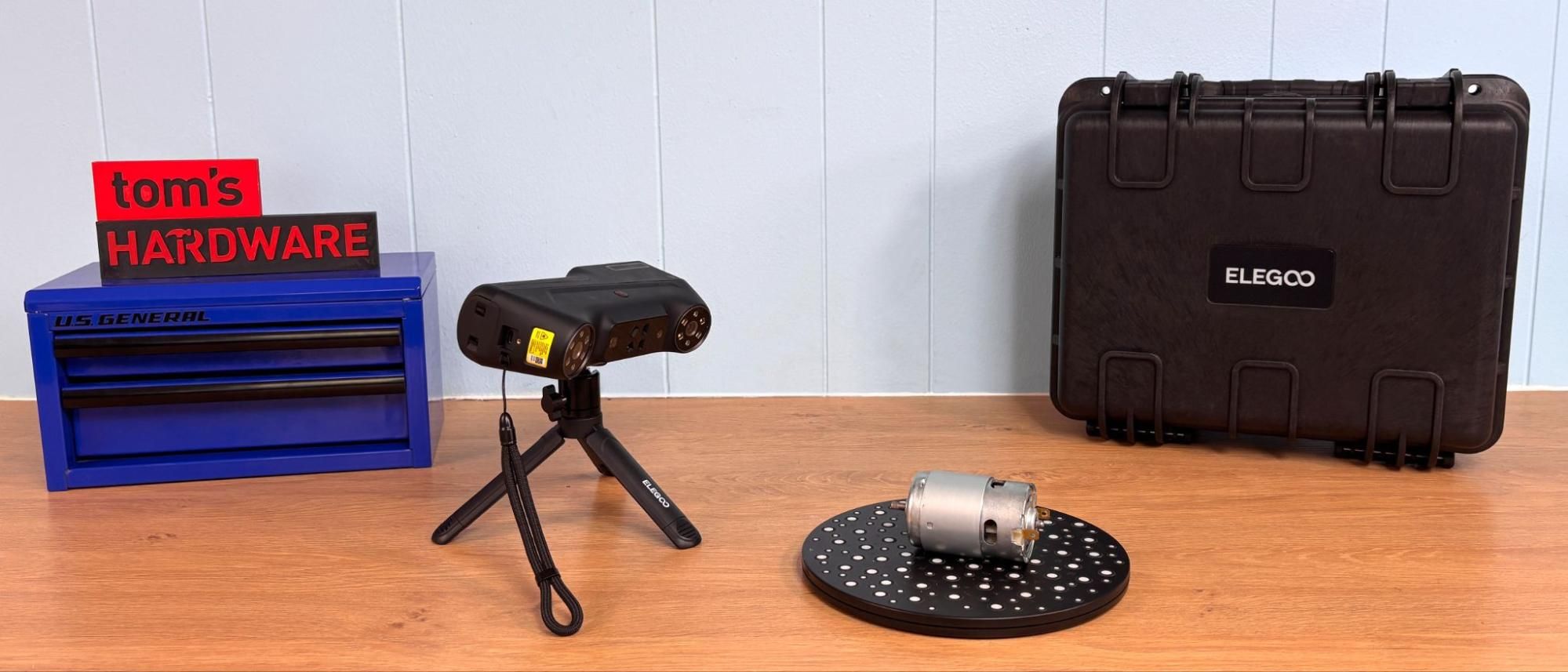
Despite these advanced standalone physical attributes, the Elegoo M1 Ultra is not a completely independent, self-contained processing system. While the device handles the complex task of capturing visual and spatial data, it relies heavily on external computing power to transform that raw data into a usable 3D model. To achieve this, users must pair the scanner with a powerful laptop or computer equipped with a high-end CPU and GPU combination capable of handling intensive data processing tasks. Whether running on a high-end PC or a Mac, the processing workstation is a mandatory component of the workflow.
When it comes to connecting the M1 Ultra to a processing computer, users have multiple options depending on their workspace setup and environment. The scanner can be linked directly via a USB-C cable, which offers the fastest possible data transfer speeds and ensures a stable, uninterrupted workflow. For those who prefer a cable-free experience or need to maneuver more freely around a bulky or stationary subject, the device can also be tethered wirelessly via Wi-Fi.
During practical testing in demanding RF environments, the wireless connection proved functional over short distances, allowing the reviewer to operate approximately five feet away from the subject. While this range was sufficient for immediate testing needs, the full maximum wireless range remains to be thoroughly pushed beyond that five-foot threshold. Nevertheless, given the massive amounts of data generated during high-precision 3D scanning sessions, the wired USB-C connection consistently provides the fastest and most reliable connectivity, making the physical tether well worth any minor inconveniences associated with managing a cable.
By blending multiple blue light laser modes, structured light capabilities, a convenient color touch screen, and a thoughtful dual-battery setup, Elegoo’s inaugural 3D scanner positions itself as a competitive option in the digital capture space. While it requires a powerful companion PC or Mac to process scans into final, workable assets, its flexible connectivity options and robust hardware feature set mark a significant entry for Elegoo as the company branches out beyond traditional additive manufacturing hardware.