Efforts by Chilean authorities to clamp down on unauthorized digital broadcasting are accelerating significantly, as fresh data from the national telecommunications regulator reveals that the campaign has expanded far beyond its initial targets. What began earlier this year as a targeted legal victory for major entertainment conglomerates has now blossomed into a massive, systematic operation involving multiple major internet service providers and continuous tracking of illicit online domains.
The genesis of this sweeping enforcement traces back to earlier this year when a Santiago court firmly sided with Warner Bros. in a high-stakes legal battle against several prominent Latin American pirate streaming brands, most notably MagisTV, FlujoTV, and XuperTV. Following that ruling, the 19th Civil Court of Santiago issued a sweeping directive instructing all variants of these services to be blocked nationwide. The court formally tasked the country’s telecommunications regulator, Subtel, with ordering local internet service providers to implement the restrictions. Subtel duly dispatched these blocking instructions in January, setting off a chain reaction that later included Warner Bros. filing a criminal complaint against a local IPTV operator amid concerns over the rapid growth of unauthorized distribution networks.
New information published this week by Subtel demonstrates that those initial blocking measures were merely the opening salvo in a much broader campaign. According to the regulator, a coalition of major domestic internet service providers—including GTD, DirecTV, Entel, WOM, Mundo, ClaroVTR, Netline, and Movistar—has now blocked a cumulative total of 1,954 URLs linked to illegal IPTV operations. These enforcement actions are not executed in a single static sweep but are instead rolled out in regular batches that have steadily grown in volume as the year has progressed.
Monthly data released by Subtel highlights the accelerating pace of the campaign. The figures show that authorities blocked 221 URLs in June, followed by 180 in July. The enforcement tempo picked up substantially toward the end of the year, with 469 URLs blocked in August, 319 in September, and a staggering 765 URLs blocked during the month of October alone.

Crucially, the domains being scrubbed from the accessible web are no longer restricted to the three brands named in the original lawsuit. Subtel’s expanded blocklist explicitly encompasses a wide array of other well-known unauthorized streaming and file-sharing destinations, including Cuevana, Oleada TV, Stella TV, TeleLatino, PelisPlus, Cinecalidad, and Fútbol Libre, alongside their various mirror sites, subdomains, and alternative operational variants.
This coordinated digital enforcement coincides with physical law enforcement actions. Subtel’s latest announcement followed closely on the heels of an operation by Chilean police that resulted in the arrest of sixteen individuals allegedly connected to separate pirate IPTV services known as UltraIPTV and MegaIPTV, illustrating a two-pronged strategy involving both civil network-level blocking and criminal prosecution.
A Matter of Data Protection
While the legal foundation of these actions is firmly rooted in copyright enforcement and intellectual property protection, Subtel has notably framed its public communications around digital security, privacy, and consumer protection. In its official announcements, the regulator places data safety at the forefront of the campaign, arguing that the primary victims of these illicit platforms are often the unwary consumers who use them.
Subtel warns that unauthorized streaming platforms and informal applications frequently harvest sensitive user data, leaving citizens dangerously exposed to a wide range of cybercrimes, including identity theft, malicious hacking, and sophisticated financial fraud.

Undersecretary of Telecommunications Romina Garrido emphasized these risks in official statements, noting that individuals who download and install these informal applications are effectively opening the door to malicious actors. According to Garrido, users routinely expose their personal banking credentials, private personal information, and connected devices to scams and hacks without any form of institutional support, consumer recourse, or technical protection. When consumers utilize a pirate application or website, they are essentially handing over the keys to their personal data to unknown and unregulated criminal organizations.
This consumer safety narrative is not entirely new to the legal arena. During the initial legal proceedings brought forward by Warner Bros., attorneys similarly argued that these pirate platforms posed a severe and tangible risk to the personal data of ordinary users, a point heavily covered by local media outlets earlier in the year.
Furthermore, Subtel leverages the enforcement campaign to steer citizens toward legitimate, licensed alternatives within the market. By executing these systemic blocks, the regulator aims to dismantle the infrastructure of cybercrime while simultaneously promoting a formal telecommunications ecosystem that guarantees robust data protection, consumer privacy, and reliable technical support.
MagisTV and Beyond
Although the foundational court order specifically named MagisTV, FlujoTV, and XuperTV, the sheer breadth of the current blocklist required a flexible legal and administrative framework. According to reports from local media, the expansion of the blacklist beyond the original three brands was achieved through a cooperative interpretation of the initial ruling, facilitated by a newly established protocol agreed upon by Subtel, the Public Prosecutor’s Office, Warner Bros., and the Alliance Against Digital Piracy.
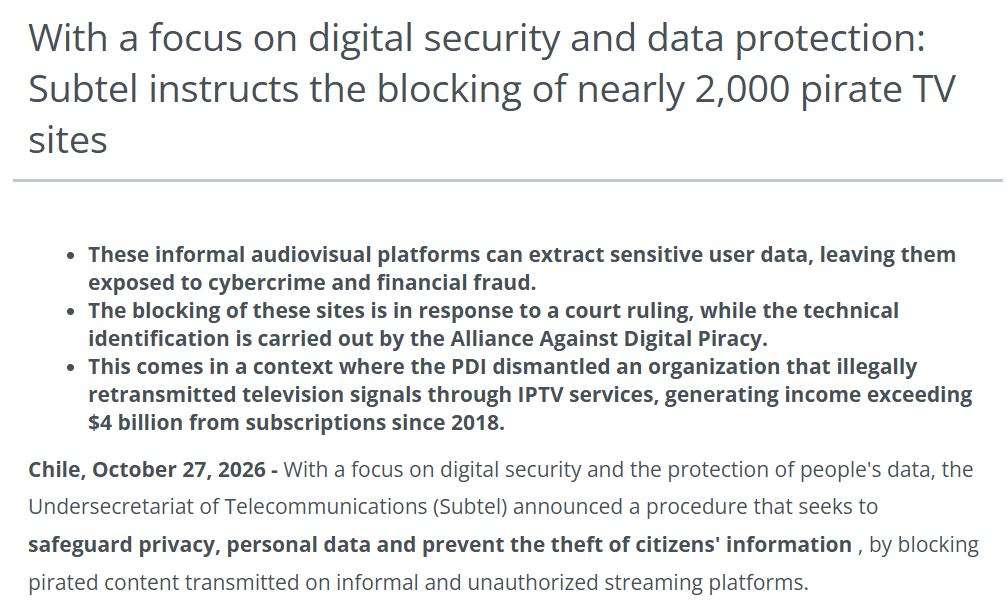
The operational pipeline relies heavily on the anti-piracy Alliance, which compiles comprehensive lists of offending URLs, specific IP addresses, and active domains. Once curated, these intelligence lists are handed over to Subtel, which then formally instructs national internet service providers to implement the technical blocks across their networks.
The judicial and administrative orders themselves are notably comprehensive in scope. According to legal documentation and reporting from local outlets, the blocking instructions cover all variants of the targeted brands, capturing any domain, subdomain, IP address, URL link, redirection mechanism, or mirror site designed to reproduce audiovisual content without explicit authorization, either in whole or in part.
Despite the impressive scale of the operation—surpassing nearly two thousand blocked endpoints—industry observers and investigative reports indicate that traditional enforcement methods face persistent hurdles. Local journalism outlets examining the state of digital piracy in the region have discovered that several of the specific websites targeted by government orders have managed to circumvent the prohibitions, quickly shifting to new web addresses or deploying alternative operational structures. Independent searches for popular brands like Cuevana, Fútbol Libre, and MagisTV reveal that copycats, alternative domains, and workarounds remain readily accessible to determined users online. As the monthly blocking statistics continue to climb, the ongoing cat-and-mouse dynamic between authorities and digital pirates shows no signs of slowing down.