Earlier this year, adult entertainment company FlavaWorks initiated aggressive legal action by suing both the operators and hundreds of registered users associated with Gay-Torrents.org, a private BitTorrent tracker. The lawsuit immediately disrupted the platform’s operations, causing the tracker to vanish completely from the public web shortly after the legal proceedings were initiated. As the litigation has progressed, FlavaWorks has streamlined its legal strategy, progressively narrowing its primary list of targeted individual users from an initial 325 down to 39 defendants.
Despite these adjustments, several of the platform’s key site administrators and a significant portion of the targeted members continue to remain anonymous within court documents, typically designated as John Does. Seeking to pierce this veil of anonymity and uncover the actual identities behind these accounts, FlavaWorks formally petitioned the U.S. District Court for permission to issue third-party subpoenas directed at major email providers and technology companies. In a ruling issued on October 14, U.S. District Judge John Robert Blakey granted this discovery request in part, opening a new front in the ongoing copyright infringement battle.
Subpoenas Target Google, Yahoo, Microsoft, and Other Major Platforms

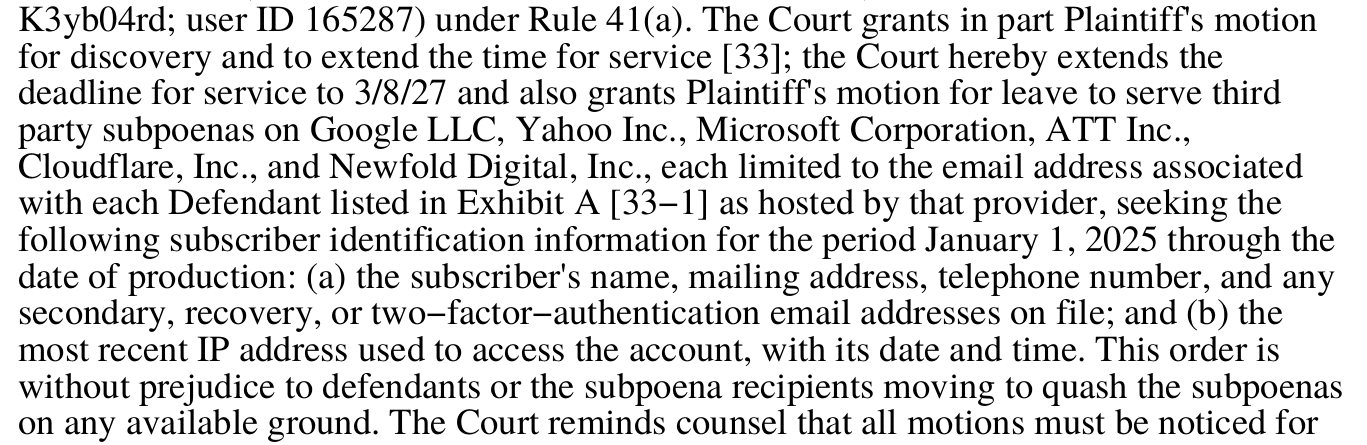
The judicial order authorizes FlavaWorks to serve subpoenas on several prominent technology and infrastructure providers, including Google, Yahoo, Microsoft, AT&T, Cloudflare, and Newfold Digital. However, the scope of these legal demands is not open-ended; each individual subpoena is strictly limited to the specific email addresses or domains directly tied to defendants who have been linked to that particular service provider.
Under the terms of the approved order, the targeted service providers are requested to disclose specific account registration details. This includes the subscriber’s legal name, associated mailing address, and telephone number, alongside any secondary, recovery, or two-factor authentication email addresses linked to the account. Furthermore, FlavaWorks is permitted to request the most recent Internet Protocol (IP) address utilized to access each respective account, covering a designated timeframe stretching from January 2025 onward.
While the court permitted broad inquiries into user registration data, Judge Blakey did not grant FlavaWorks carte blanche authority across all of its requests. The adult entertainment enterprise had also petitioned the court for comprehensive billing names and addresses currently maintained on file by the email service providers. Additionally, FlavaWorks sought a direct subpoena directed at payment processor Stripe in an effort to uncover the individuals operating a Bulgarian corporate entity allegedly connected to the management of the torrent site. The final judicial order declined to include these broader financial requests.
Shifting Legal Tactics: Why an IP Address Is Not a Person

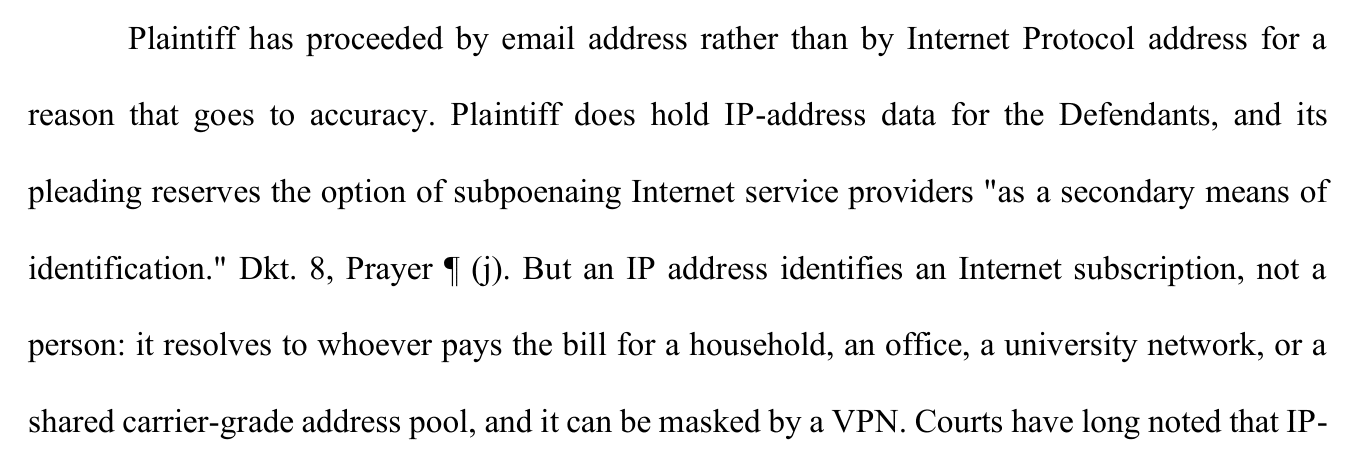
The deployment of subpoenas targeting email and web service providers represents a distinct strategic departure from standard investigative methods deployed in typical copyright infringement and torrent-related lawsuits. Traditionally, copyright holders harvest IP addresses directly from active BitTorrent swarms and subsequently petition Internet Service Providers (ISPs) to disclose the subscriber accounts corresponding to those numerical addresses. While FlavaWorks acknowledges that it possesses traditional IP address logs for the defendants in this case, the company deliberately opted to bypass the standard ISP route in favor of targeting email accounts directly.
To justify this unconventional approach, FlavaWorks deployed a legal argument traditionally reserved for defendants in digital piracy litigation, explicitly asserting that an IP address fundamentally does not equate to a specific individual.
In its legal filings, the company elaborated on this perspective, explaining that an IP address identifies an internet subscription rather than a person. It resolves to whoever pays the bill for a household, an office, a university network, or a shared carrier-grade address pool, and it can easily be masked or obfuscated by a Virtual Private Network (VPN). By contrast, FlavaWorks contends that an email address carries a personal connection to the account holder, making it a far more reliable instrument for positively identifying the individual defendants involved in operating or utilizing the illicit platform.
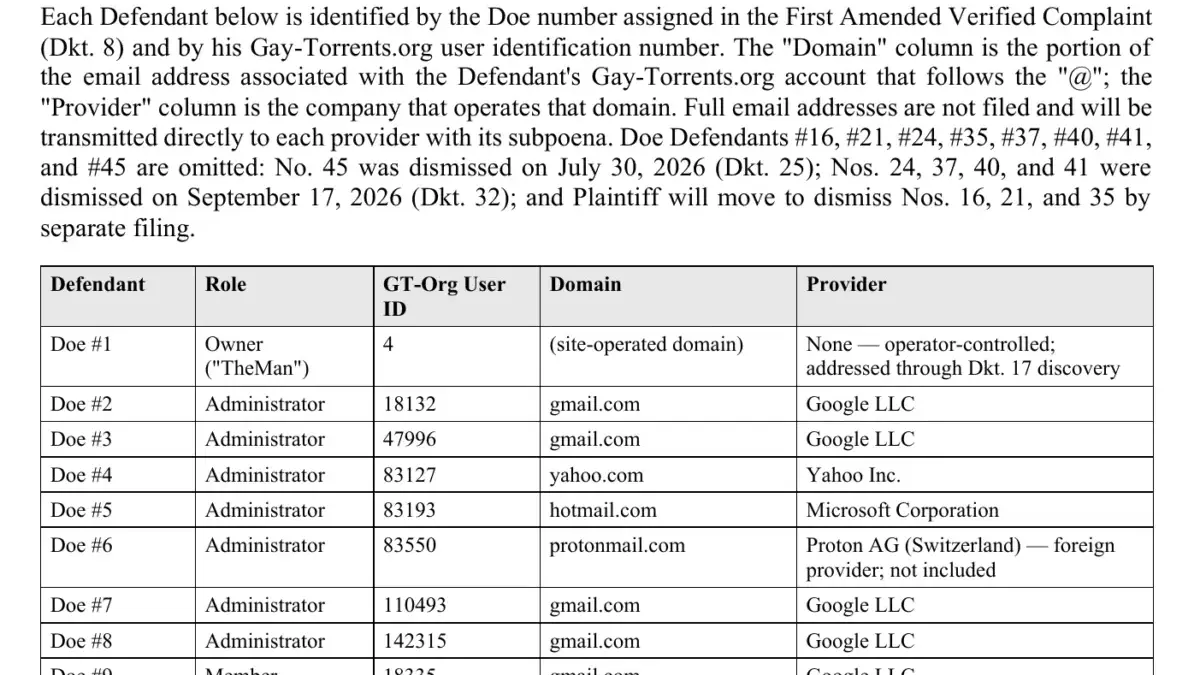
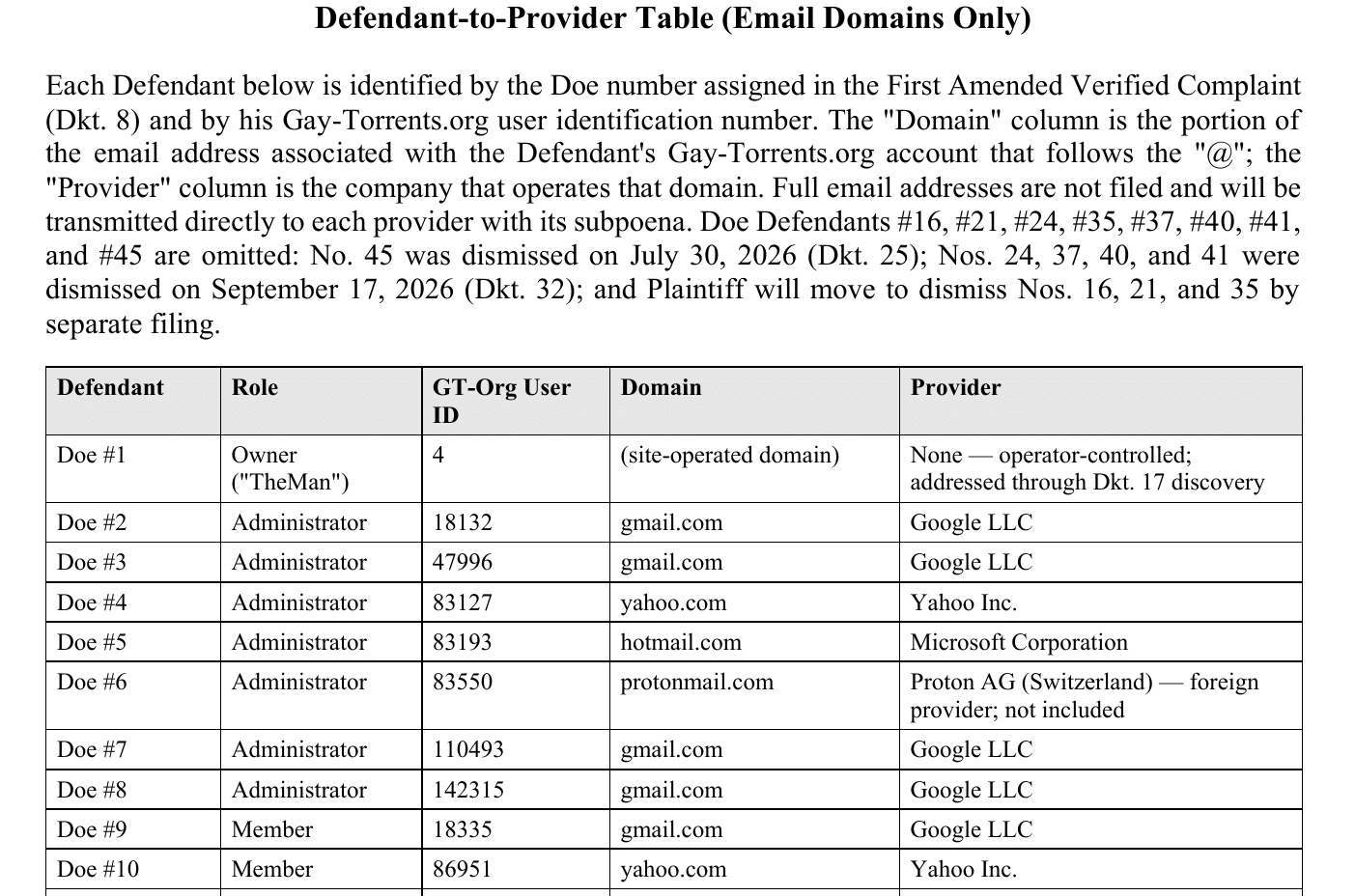
Court exhibits detailing the scope of the discovery motion illustrate the heavy reliance on mainstream email ecosystems among the targeted group. Out of the identified targets, 22 defendants are linked directly to Gmail addresses, nine rely on Yahoo, three utilize Hotmail, and one is connected to an AT&T address. An additional two defendants utilize private domains that were registered through Cloudflare and Bluehost, a hosting brand operated by Newfold Digital.
This diverse roster of targets extends well beyond ordinary, casual members of the private tracker. Several high-level site administrators are explicitly named on the subpoena list, identified through their Gmail, Yahoo, and Hotmail contact points. Notably, one other administrator who utilized a ProtonMail address was excluded from the subpoena requests, as the Swiss-based encrypted email provider remains entirely beyond the practical jurisdictional reach of U.S. federal court subpoenas.
Tracker Users Retain the Right to Object
The issuance of the new court order does not mean that subscriber data will be handed over to the copyright holder immediately. The judicial directive explicitly preserves the legal rights of both the individual defendants and the subpoenaed technology providers to challenge the requests, including filing formal motions to quash the subpoenas in court.
Major technology corporations have previously demonstrated a willingness to push back against aggressive civil discovery tactics in copyright litigation. In February, legal reports highlighted that Google actively invoked First Amendment protections to shield Gmail users from a remarkably similar piracy-related subpoena deployed by FlavaWorks in a separate case targeting users of a different private torrent tracker.
Despite these constitutional pushbacks, subsequent filings indicate that compliance is still achievable. In a July court submission, FlavaWorks noted that Google successfully produced requested subscriber data for that parallel case in April, though the filing did not explicitly clarify whether the production covered every single targeted Gmail account. FlavaWorks further emphasized that the tech giant has previously complied with identical informational requests in earlier legal actions without raising formal objections.
Uncovering Insider Knowledge and Establishing Identity
For FlavaWorks, the court-sanctioned subpoenas serve primarily as a mechanism to corroborate existing suspicions and solidify its evidentiary chain. The individual member defendants selected for this specific lawsuit were chosen because the email addresses registered to their profiles on the Gay-Torrents.org tracker matched active user accounts previously identified across FlavaWorks’ own proprietary adult entertainment websites.
In a confidential status report submitted to the court in September, the company disclosed that its internal records already point toward a probable real-world identity for many of the targeted individuals. However, the firm elected to withhold public disclosure of these names until the respective email service providers officially verify the identity behind each account.
The exact methodology by which FlavaWorks initially acquired the user email addresses from an exclusive, invite-only private tracker remains a point of intrigue. On restricted trackers, sensitive membership data is typically restricted exclusively to administrative staff. While court filings do not explicitly detail the exact genesis of this data, instead broadly citing the company’s internal record-keeping and ongoing private investigations, the September status report indicates that the firm received crucial external assistance.
According to the report, the plaintiff successfully secured the active cooperation of an individual possessing direct, firsthand knowledge regarding the day-to-day operations of the defunct torrent site. Although the court documents do not clarify precisely when this cooperation began or whether this anonymous insider served as the original source of the leaked email database, FlavaWorks anticipates that this insider testimony will prove instrumental in unmasking the core operators and identifying active contributors who shared copyrighted works or provided financial backing to sustain the platform.
Even as the formal litigation grinds forward, legal resolutions are already taking shape behind the scenes. FlavaWorks noted that several regular members opted to resolve their legal exposure through private settlements prior to being formally named as defendants. Furthermore, in a separate, parallel RICO lawsuit initiated against 75 other members of the Gay-Torrents.org community, one anonymous John Doe defendant recently agreed to resolve the claims by paying an undisclosed monetary settlement structured through scheduled installments.
As the legal docket currently stands, neither the affected account holders nor the major technology corporations have formally moved to quash the newly authorized subpoenas, leaving the next procedural phase in the hands of the subpoenaed email providers.