Series.ly, once one of the most prominent and widely recognized pirate link-sharing platforms in Spain, has found itself firmly back in the crosshairs of international copyright enforcement agencies. Although the original operational team behind the website famously abandoned its illegal linking activities back in late 2014—following a high-profile legal crackdown that eventually saw its original administrators acquitted years later—the domain itself has lived on under entirely new management.
In 2021, the domain was purchased at a public auction by a brand-new operating team. Eager to capitalize on the lingering brand recognition of the once-infamous name, these new owners built a fresh iteration of the platform. Requiring users to log in before granting access, the revamped Series.ly quickly grew to command a substantial audience. Before long, it was pulling in nearly two million monthly visits, with roughly 90 percent of that traffic originating directly from Spanish internet users.
This sudden resurgence of popularity did not go unnoticed by rightsholders and anti-piracy watchdogs in the region, who quickly made it clear that they had no intention of letting the platform operate unhindered. In May, the Spanish film and television producers’ collective EGEDA—Entidad de Gestión de Derechos de Audiovisual—filed a formal legal complaint with the Second Section of Spain’s Intellectual Property Commission. Operating directly under the umbrella of the Ministry of Culture, the Commission was urged to take swift and decisive action to shut the platform down permanently.
As part of its standard investigative protocol, a representative from the Commission examined a randomized sample of 42 titles pulled from the total list of 110 allegedly infringing works cited in EGEDA’s initial complaint. The findings revealed that 35 of those sampled titles could be readily streamed or downloaded directly through Series.ly at the time of the inspection. Following this discovery, the Commission formally ordered the site administrators to remove the infringing material back in July. However, according to regulatory authorities, Series.ly never formally acknowledged or responded to the removal directive.

From Google to a Libyan Registrar
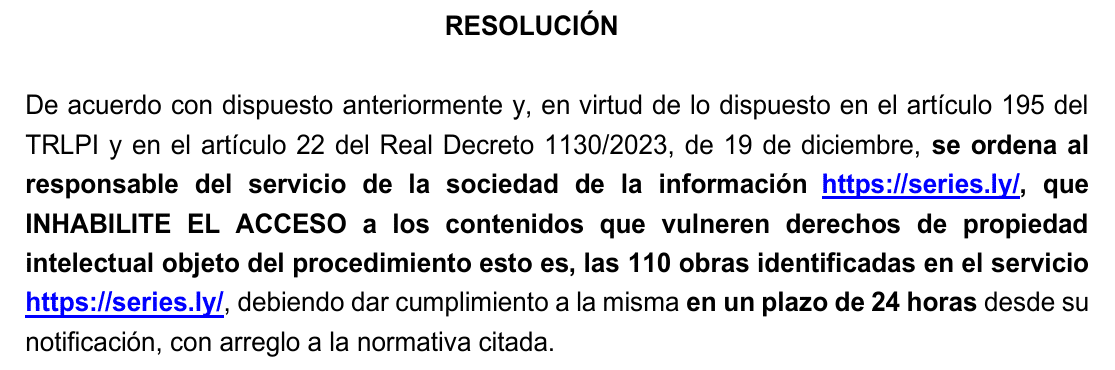
Faced with what it perceived as a blatant refusal to cooperate, the Commission escalated the situation at the end of July by sanctioning a comprehensive wave of anti-piracy measures explicitly targeting third-party internet intermediaries. Under the terms of the formal resolution, major search engine operators including Google and Bing were legally mandated to completely purge the domain from their search engine results pages. Simultaneously, domestic Internet Service Providers (ISPs) boasting a market share greater than one percent were ordered to implement strict network-level blocks against the domain name.
In addition to simply cutting off access, these ISPs were instructed to actively redirect any unsuspecting visitors attempting to reach the site to an official government landing page. This informational notice was designed to inform users that the domain had been blocked by the Commission specifically for having illegally facilitated access to content protected by robust intellectual property rights under Spanish law.
The sweeping enforcement order did not stop at search engines and local ISPs. It also explicitly listed major cloud infrastructure provider Cloudflare, Ukrainian hosting company Virtual Systems—whose primary data centers located in Kyiv were notably impacted by Russian missile strikes earlier in the year—and Series.ly’s designated domain registrar, the Libyan Spider Network. Crucially, the legal restrictions outlined in the resolution were structured to apply not only to the platform’s current domain name but also to any potential alternative domain names that the operators might attempt to spin up in the future for the exact same purpose.
Before these multifaceted enforcement measures could legally take effect, the Commission’s resolution required formal judicial authorization from a domestic court. That necessary legal hurdle was cleared on September 28, when a presiding judge stationed at the Central Court of First Instance in Madrid thoroughly reviewed the case. The judge ultimately concluded that the requested anti-piracy interventions were entirely proportionate and legally justified, officially approving the broad enforcement actions as originally requested by the authorities.

The Libyan Registrar Acts
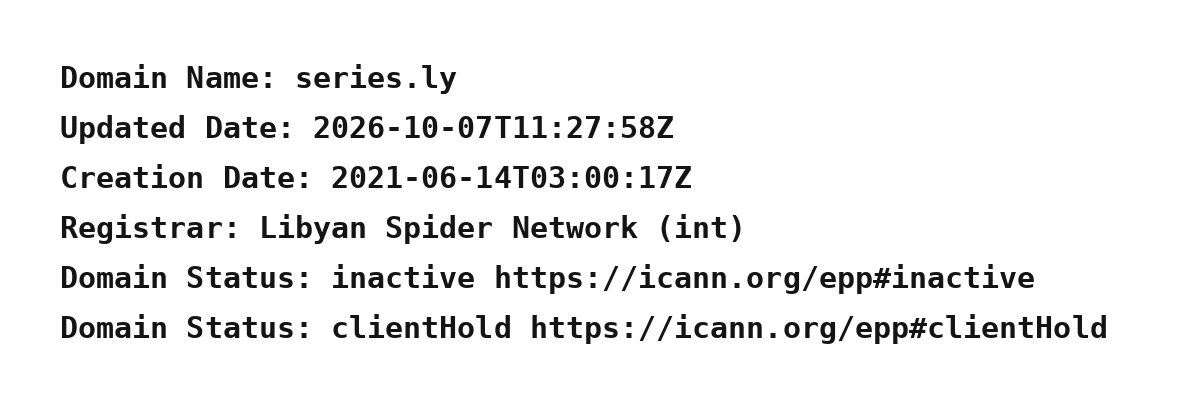
Little more than a week following the court’s official sign-off, the ripple effects of the ruling began to manifest as at least one crucial intermediary took immediate operational action. Earlier in the week, Series.ly experienced an abrupt and unexpected blackout when its designated domain registrar, Libyan Spider, stepped in to enforce compliance.
Public WHOIS registry data quickly confirmed that the series.ly domain name had been placed on a restrictive operational status known as "clientHold." This specialized administrative status is deployed directly by domain registrars to effectively pull a domain completely offline by stripping it from the active .ly top-level zone. As a direct consequence of this registrar-level intervention, the Series.ly domain ceased to resolve entirely, rendering the website unreachable to its massive user base.
While Libyan Spider itself declined to issue a formal public statement regarding the abrupt suspension, representatives for Series.ly revealed that the official notice they received explicitly cited the Spanish regulatory resolution and the subsequent court order authorizing the suspension measures. Interestingly, the warning did not reach the site administrators directly through standard channels; instead, it was relayed to them via the third-party auction house that had originally sold them the domain, which acts as a local reseller for the Libyan registrar.
"The reason they gave us was a Spanish copyright resolution and a court order authorizing suspension measures against the domain," the site operator explained in statements translated from Spanish.
At the time of the registrar’s intervention, it remained entirely unclear whether other listed intermediaries, such as search engines and local network providers, had fully implemented their respective blocks. Nevertheless, the underlying court order remained fully valid and enforceable under Spanish jurisdiction.
Intriguingly, in the immediate wake of the Series.ly domain suspension, digital investigators noticed the sudden emergence of a remarkably similar web platform operating under the brand name Cinubo. Furthermore, the official Telegram and Discord community channels previously utilized by Series.ly were swiftly rebranded to match the new Cinubo moniker, suggesting a rapid contingency plan by the operators.
No Plans to Appeal
Addressing the sudden loss of their digital storefront, the site’s operator admitted that they had failed to notice the regulatory warnings sent prior to the domain’s suspension. Upon investigating the oversight, they discovered that an initial warning email dispatched by EGEDA had been sent to an obscure internal address, while a completely different contact email was publicly listed on the website itself.
Defending the operational model of the platform, the operator maintained that the new iteration of Series.ly functions strictly as a non-profit endeavor that has generated zero revenue since its relaunch. Furthermore, they emphasized that the platform does not host any video files on its own infrastructure. Instead, any links pointing users toward external viewing services are added voluntarily by the platform’s active community members.
"Our position is that complaints about those video files should be directed at the services that host or distribute them," the operator argued. "We think it’s disproportionate that a complaint about content hosted by third parties ends up getting our entire domain suspended, including email and the personal library features."
Despite the severity of the enforcement action, the operator indicated that they had no immediate plans to mount a formal legal appeal against the Spanish court order. Pointing out that the corporate entity legally backing the project is incorporated in the offshore jurisdiction of Nevis, the operator questioned the international reach and jurisdictional overreach of the Spanish ruling.
"We question whether a procedure handled in Spain justifies suspending our domain worldwide, which also affects email and services that have nothing to do with the works in question," the operator noted.
Despite these jurisdictional arguments, the legal pressure facing the operators showed little sign of abating. Because the sweeping Spanish judicial order explicitly encompasses any brand-new domain names utilized for the same overarching purpose, authorities could potentially set their sights on newly minted alternatives like Cinubo, while additional third-party intermediaries continue evaluating their own compliance obligations.

Several days after the initial disruption, however, the landscape shifted once more. By early October, the series.ly domain unexpectedly returned to the active control of its rightful owner. The site operator confirmed that the registrar ultimately chose to lift the administrative suspension, though they stressed an important caveat: the domain could no longer be utilized to host or facilitate links pointing toward copyright-infringing content.
Reflecting this new reality, visiting the main Series.ly web address no longer redirects users to a streaming portal or community linking hub. Instead, the domain now hosts a dedicated informational page documenting the tumultuous history of the domain itself, bringing a quiet and compliant end to the latest chapter of the platform’s storied existence.