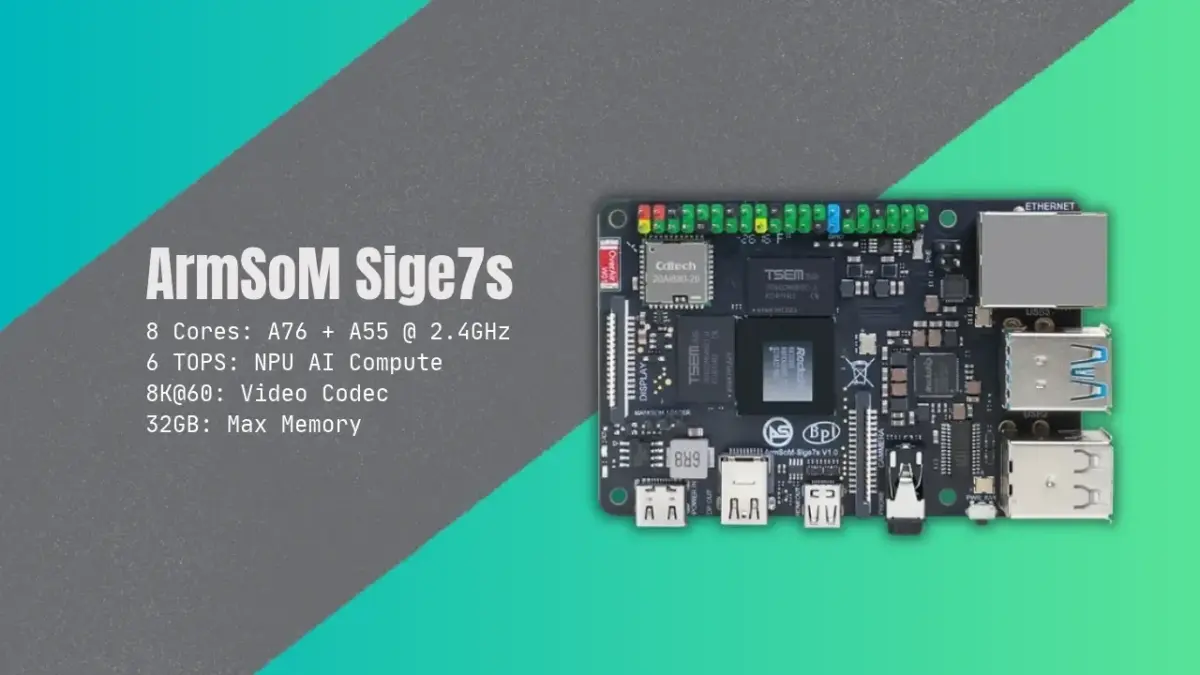
ArmSoM is refreshing its hardware ecosystem with a new addition to its popular single-board computer lineup. After previously capturing attention with the Sige7 and experimenting with alternative silicon through the Allwinner-powered Sige6 earlier this year, the company is returning to Rockchip architecture with the release of the new Sige7s. Alongside this desktop-style board, ArmSoM is also introducing a dedicated compute module variant, offering developers and hardware enthusiasts flexible options built around the same core processing power.
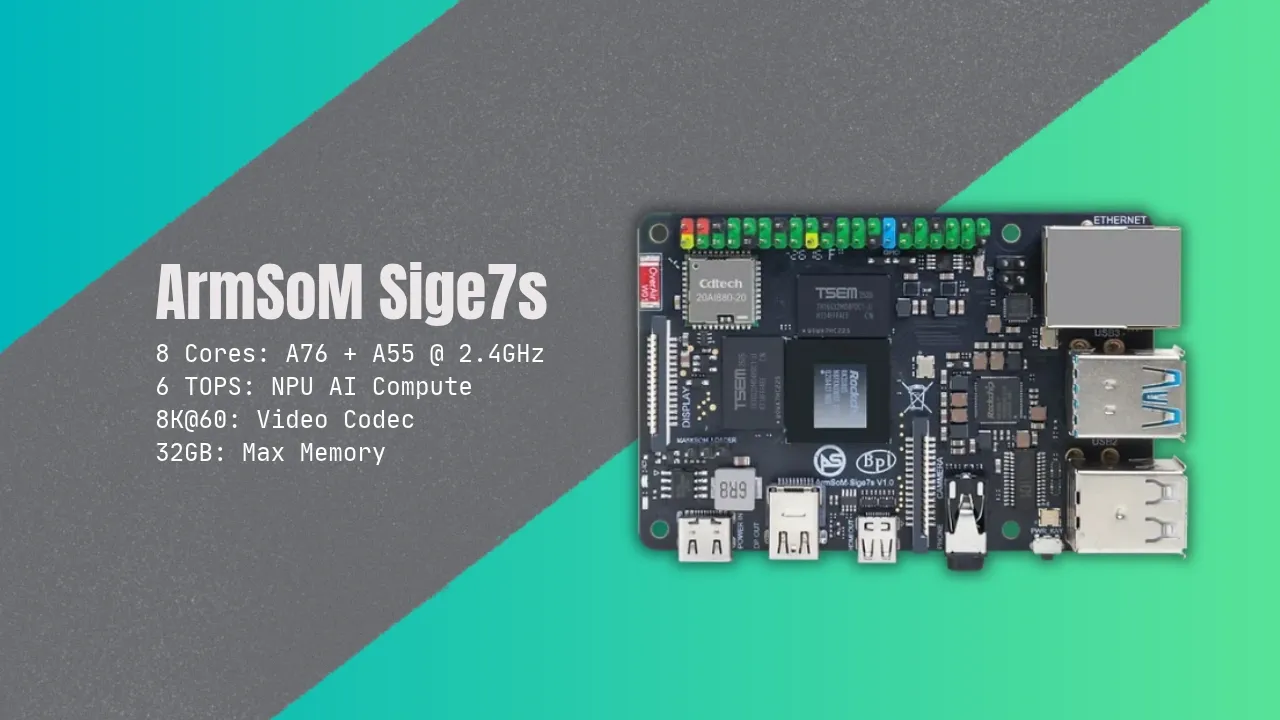
The Sige7s marks a strategic shift in focus compared to its predecessor, prioritizing pure computing power while scaling back certain peripheral bandwidth and input-output capabilities to achieve a more accessible price point. Starting at $153 on ArmSoM’s official store, the board aims to deliver high-end processing capabilities to users who do not require heavy input-output expansion or ultra-fast peripheral interconnects.
Understanding the RK3588S Silicon and Core Specifications
The designation of the "s" in the Sige7s nomenclature points directly to the processor under the hood. The board is driven by the Rockchip RK3588S, which serves as a trimmed-down variant of the full-fat RK3588 processor found in the original Sige7. Despite the reduced peripheral lanes, users retain the identical processing foundation: the same CPU architecture, the same Mali-G610 MP4 graphics processing unit, and the same neural processing unit capable of delivering 6 TOPS of AI performance.

What distinguishes the RK3588S from its sibling chip is the reduction in peripheral connectivity. The architecture omits PCIe 3.0 support, reduces the HDMI output configuration from two ports down to one, eliminates the HDMI input feature entirely, and scales back the networking infrastructure to a single Gigabit Ethernet controller. In practical terms, this means the Sige7s is tailored for applications where intense compute performance takes priority over massive peripheral arrays, high-speed NVMe storage speeds, or multi-port networking configurations.
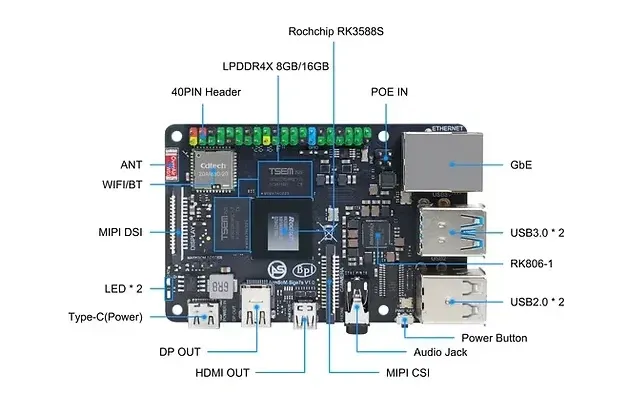
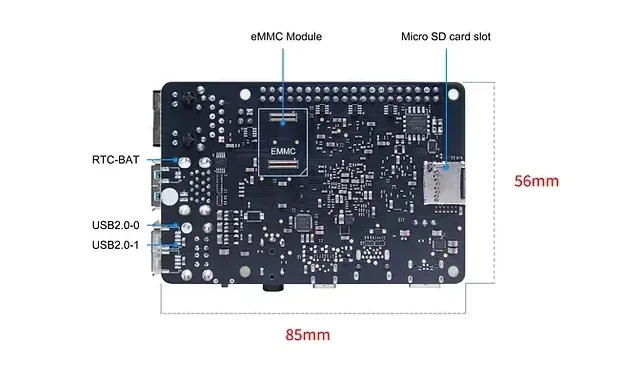
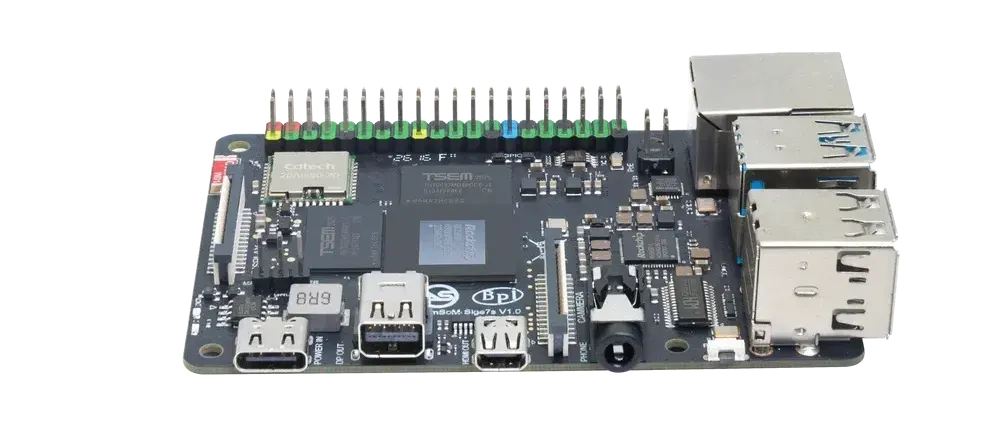
Beyond the core silicon, ArmSoM has integrated several user-friendly design choices that optimize both convenience and cost. The Sige7s accommodates a wide voltage input ranging from 5V to 23V, liberating users from the restriction of using a proprietary or highly specific USB-C power adapter. Furthermore, the board adopts a removable eMMC storage module. This design choice ensures that sensitive operating system installations or precious user data are not permanently soldered to the main board, allowing for easy upgrades or standalone reflashing procedures on a separate machine.
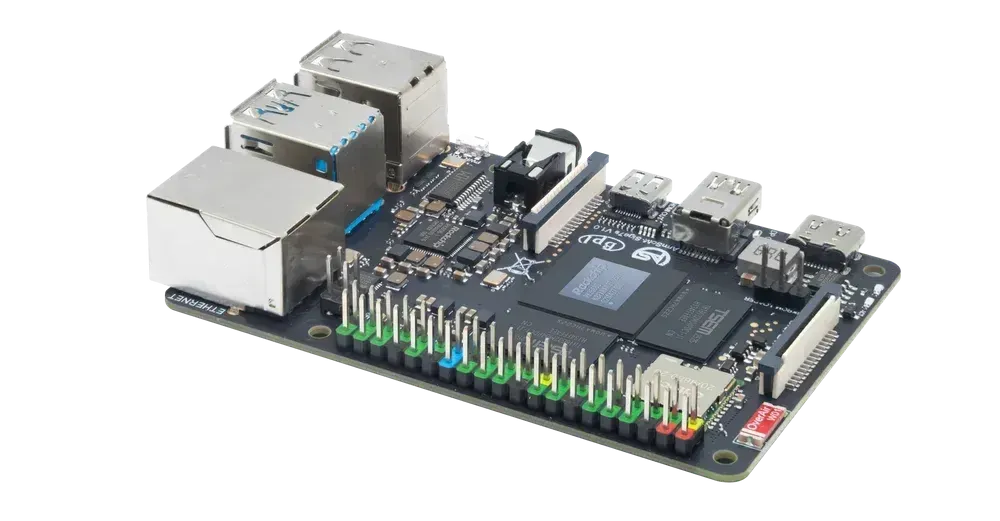
Multimedia capabilities remain a strong point for the platform. The Sige7s features an HDMI 2.1 port capable of handling ultra-high-definition displays up to 8K resolution at 60 frames per second, a DisplayPort 1.4 output routed over a USB-C interface, and a 2-lane MIPI DSI connector for specialized display panels. Integrated hardware video engines support high-resolution decoding of 8K video at 60 frames per second using modern codecs like H.265 and VP9, alongside 8K encoding capabilities at 30 frames per second. These specifications allow the compact board to function effectively as a high-performance media hub or processing node.
Hardware expansion also maintains a familiar standard for makers and hobbyists. The board features a standard 40-pin header that is fully compatible with Raspberry Pi accessories. According to ArmSoM, the layout seamlessly integrates with existing Raspberry Pi HATs, the official Raspberry Pi 7-inch display, IMX219-based camera modules, and even thermal solutions designed for the Raspberry Pi 4, lowering the barrier to entry for anyone transitioning from existing maker ecosystems.
The CM7s Compute Module and Carrier Board Solutions
For industrial developers, embedded systems engineers, and hobbyists looking to integrate the processor into custom hardware designs, ArmSoM has simultaneously introduced the CM7s compute module. Built around the exact same RK3588S system-on-chip, the CM7s matches the computational horsepower of the standalone Sige7s while shifting to a streamlined form factor devoid of standard physical ports.
Compute modules condense the essential computing architecture—including the processor, system memory, onboard storage, and power management integrated circuits—onto a compact printed circuit board. Measuring 55 by 40 millimeters, the CM7s matches the physical footprint of the Raspberry Pi CM5 module. Through its high-density 100-pin connectors, the module exposes robust internal interfaces, including HDMI 2.1, DisplayPort 1.4, MIPI camera and display lines, USB 3.0, PCIe 2.0 or SATA protocols, and standard general-purpose input-output buses.
To support development and prototyping with the module, ArmSoM provides the CM7s-IO carrier board. When paired with the compute module, the carrier board expands the available interfaces to include standard HDMI, a USB-C DisplayPort output, four USB 3.0 ports, Gigabit Ethernet, a 40-pin expansion header, a microSD card slot, MIPI connectivity, and an M.2 M-key slot designated for high-speed NVMe solid-state drives. Unlike the desktop-oriented Sige7s board, the carrier board configuration relies on a standard 12V DC barrel jack for power delivery. To provide long-term viability for commercial deployments, ArmSoM has committed to maintaining production of the CM7s module until at least August 2034.
Pricing, Availability, and Ecosystem Support
Both the Sige7s and the CM7s are currently available for purchase through ArmSoM’s official direct store, alongside authorized retail channels on platforms like AliExpress and Taobao. Pricing for the Sige7s begins at $153, though buyers should note that wireless connectivity accessories, such as Wi-Fi antennas, are sold separately. Meanwhile, the CM7s compute module starts at $179. Customers ordering from the United States should anticipate that ArmSoM collects a prepaid customs duty equivalent to 25 percent of the product value during the checkout process, listed under sales tax, ensuring that packages clear customs without unexpected delivery fees.
The hardware ecosystem surrounding these releases shares design philosophies with Banana Pi boards due to close collaborative efforts between the respective engineering teams, often resulting in shared foundational layouts. Observers of the single-board computer market have also noted a distinct improvement in ArmSoM’s official documentation compared to earlier product generations, a crucial development that helps mitigate the startup friction commonly associated with emerging hardware platforms.