
For well over a decade, copyright holders have relied heavily on United States federal courts to unmask anonymous BitTorrent users, transforming digital piracy enforcement into a systematic legal process. Among the most prolific participants in this space is Strike 3 Holdings, an adult film producer that has turned copyright infringement litigation into a massive, industrial-scale operation. The company files thousands of "John Doe" lawsuits every year in federal courts across the country, targeting individuals whose internet protocol addresses have been flagged for allegedly downloading and sharing its adult content via peer-to-peer networks.
In a typical case of this nature, Strike 3 petitions the court for permission to issue a third-party subpoena to the internet service provider linked to the flagged IP address. Once the ISP hands over the subscriber’s identity, the adult film producer generally contacts the alleged infringer to propose a financial settlement, which effectively resolves and terminates the litigation. This routine process is then repeated on a massive scale, generating a steady stream of legal actions. However, the legal strategy took a dramatic and unexpected turn last summer when Strike 3 set its sights on a significantly larger target within the technology sector.
Teaming up with Counterlife Media, Strike 3 filed a high-profile copyright infringement lawsuit against tech giant Meta. The complaint accused the social media conglomerate of unlawfully downloading thousands of its copyrighted adult films via BitTorrent to train artificial intelligence models. With 2,973 distinct adult films at stake in the litigation, the potential damages in the case could soar as high as $446 million, turning a standard copyright enforcement effort into a multi-million-dollar legal battle over AI data scraping and training practices.
This massive corporate lawsuit has now unexpectedly collided with one of Strike 3’s routine John Doe investigations. According to a legal motion filed in federal court last week, an anonymous pirate operating behind a residential AT&T internet connection has been identified as a high-ranking executive within Meta’s Reality Labs division, the specialized corporate unit responsible for developing hardware and software for the Quest virtual reality headsets.

From John Doe to Reality Labs Exec
The specific John Doe proceeding at the center of the latest development began in March, when Strike 3 filed a formal copyright infringement complaint in a California federal court against the subscriber assigned to IP address 162.192.7.34. Shortly thereafter, in April, Magistrate Judge Virginia K. DeMarchi granted a motion allowing Strike 3 to issue a subpoena to AT&T in order to uncover the identity behind the connection, while explicitly noting that the subscriber’s name should be protected from public disclosure to safeguard personal privacy pending further legal review.
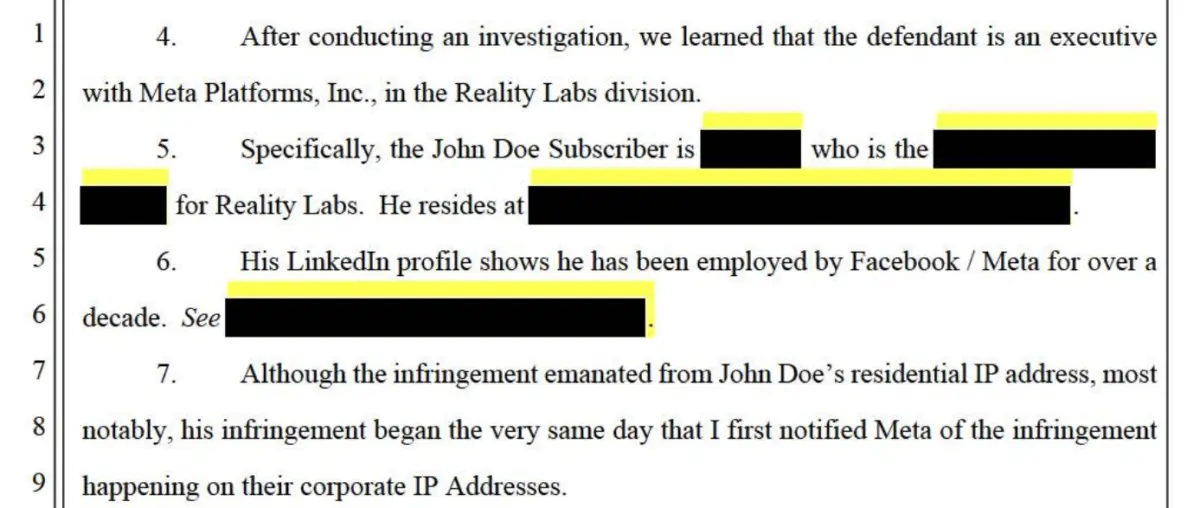
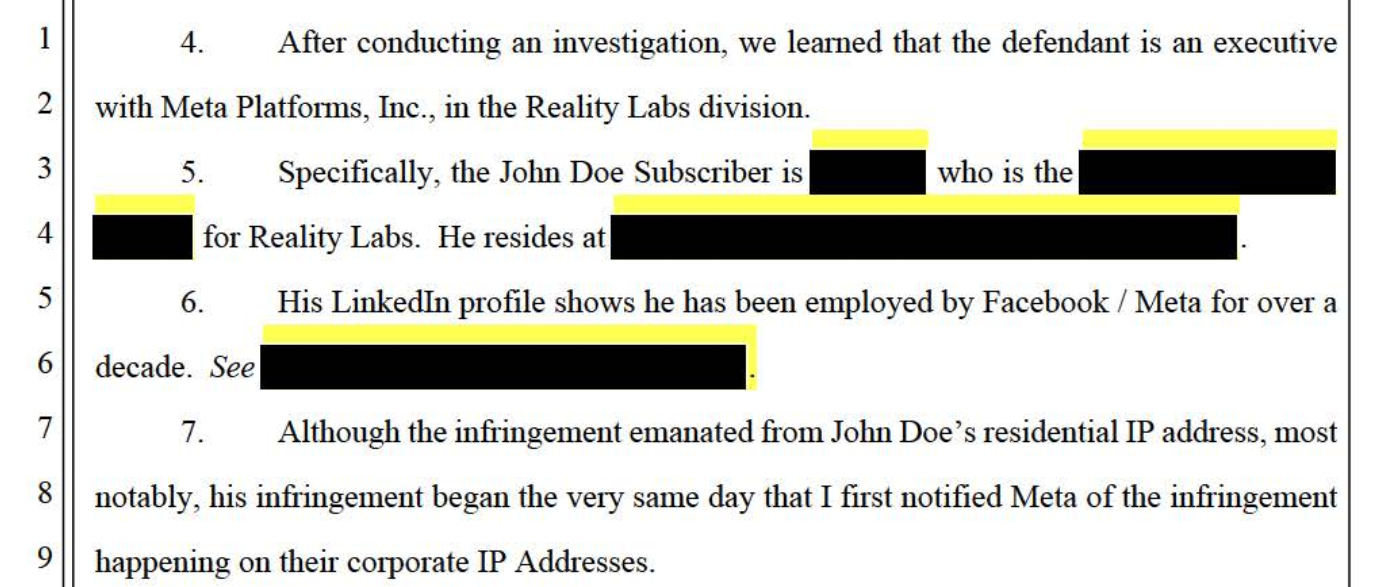
After AT&T complied with the court-ordered subpoena and released the subscriber information, Strike 3 claims that its subsequent investigation uncovered a direct connection to Meta. According to the adult film producer, the subscriber is an executive working within Meta’s Reality Labs division. Citing details gathered from the individual’s professional LinkedIn profile, Strike 3 points out that the executive has maintained a lengthy career at Facebook and Meta, spanning more than a decade of continuous employment.
Although the executive’s name and specific corporate title have been redacted in public court filings, Meta requested that the court keep these identifying details under seal, mirroring a similar protective approach the tech company utilized earlier for two other individuals named in the broader Meta lawsuit.
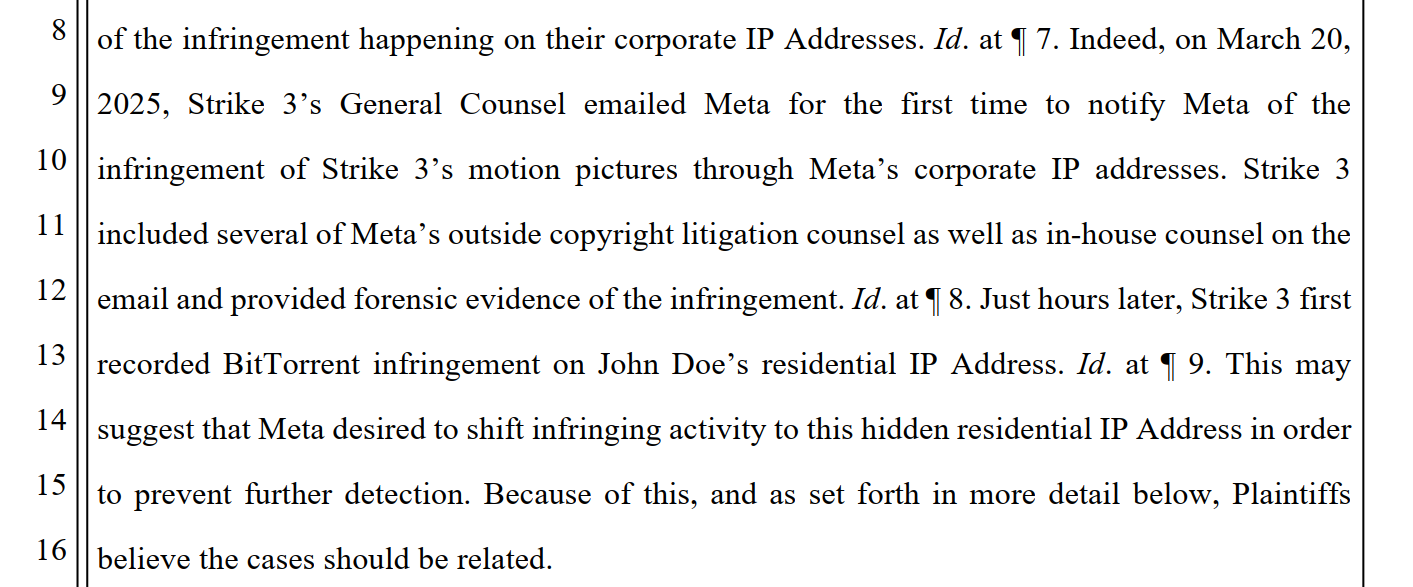
Despite the redactions, Strike 3 argues in its court filings that this residential subscriber is far from an ordinary home internet user, pointing to a striking coincidence in the timing of the downloads as compelling circumstantial evidence. On March 20, 2025, Strike 3’s general counsel first reached out to Meta’s legal team via email, providing them with detailed forensic evidence pointing to widespread BitTorrent activity originating from the tech giant’s corporate IP addresses.
According to the motion filed by the adult film company, just hours after that formal notice was delivered to corporate counsel, Strike 3’s monitoring systems recorded BitTorrent infringement activity on the John Doe’s residential IP address for the very first time. Strike 3 contends in the court documents that this suspicious sequence of events suggests Meta may have attempted to shift its infringing activity over to a hidden residential IP address in an effort to evade further detection by copyright monitors.
Nearly 20,000 Files
Beyond the suspicious timing of the network activity, Strike 3’s legal team points to the staggering volume of downloads associated with the John Doe connection as a primary argument supporting their claims. The company meticulously logged all BitTorrent traffic detected from the executive’s residential connection, revealing a cumulative total of nearly 20,000 files downloaded over a sustained period.
This enormous digital footprint included a variety of virtual reality adult titles specifically produced and formatted for Meta’s Quest headset ecosystem. Strike 3 suggests that the downloading of these specific VR files is entirely consistent with internal corporate research and development work aimed at making Meta’s hardware platform compatible with adult entertainment media.
The scale of the activity noted by the copyright holder was immense. As recently as August 25, Strike 3 reported recording more than 150 daily downloads from the connection. These downloads ranged from multi-language "Mega Packs" containing television shows, commercial movies, software packages, and electronic books, to what the company explicitly describes as AI-generated pornography and specialized VR adult films. That massive daily intake included nearly a dozen titles directly owned by Strike 3.
In its filing, the company emphasizes the sheer impracticality of such heavy usage by a single private individual, writing that it represents an extraordinary volume of data for one person to torrent on an average day, particularly someone who holds a demanding executive position at a major technology corporation. Strike 3 asserts that this consistent and heavy usage pattern makes far more sense when viewed as automated AI training data ingestion or systematic corporate research.
This is not the first time an employee or affiliate associated with Meta’s Reality Labs division has surfaced in connection with the litigation. Earlier in the summer, Meta formally confirmed that a former data engineer within the division was responsible for a Comcast internet connection that had been linked to the unauthorized sharing of 97 copyrighted films.
With its latest motion, Strike 3 is formally asking U.S. District Judge Eumi K. Lee to formally relate the John Doe case to the broader multi-million-dollar Meta lawsuit, ensuring that both legal proceedings move forward before the exact same presiding judge. On paper, relating the cases could streamline judicial administration by avoiding redundant depositions and discovery processes.
However, the legal implications of the motion extend far beyond mere procedural convenience. If granted, the move would effectively transform the executive’s residential downloading history into direct evidence in the pending $446 million corporate lawsuit. Should the cases be successfully related, Strike 3 has indicated it plans to amend its initial John Doe complaint to name Meta directly, argue that the executive bears joint liability for the infringement, and move to compel Meta to appoint a Reality Labs corporate custodian and surrender all internal torrenting records.
Meta: ‘Nothing Ties’ Downloads to Company
Meta responded to the motion to relate the cases in federal court, signaling its initial position on the matter. Officially, the tech company has taken no definitive legal position yet, noting that it cannot independently investigate whether the subscriber is even a current employee without knowing his actual identity. However, Meta argues that even if the subscriber is precisely who Strike 3 claims him to be, there is no factual connection tying the residential downloads to corporate operations or company directives.
In its response, Meta stated that the plaintiffs simply assume the subscriber is personally responsible for every action taken across his home IP address, and then leap to an additional and entirely unsupported assumption that those actions were somehow undertaken on behalf of Meta.
The tech giant is leaning heavily on a defense that is frequently deployed in BitTorrent piracy litigation, emphasizing the well-established legal principle that an IP address alone does not conclusively identify a specific human infringer. Magistrate Judge DeMarchi highlighted this very point earlier in the litigation when she initially approved Strike 3’s request to serve a subpoena on the ISP.
Furthermore, Meta pointed out a significant logical contradiction in Strike 3’s core theory regarding the timing of the downloads. The copyright holder alleges that internet traffic was deliberately shifted to the home connection just hours after the March 2025 warning letter was sent. However, Meta notes that Strike 3’s own corporate complaint simultaneously alleges that Meta’s unauthorized off-infrastructure activity actually began as early as 2018, and that downloads on corporate IP addresses continued long after the formal notices were delivered.
Meta argued that the plaintiffs’ newly minted theory cannot be logically reconciled with the claims they are already actively pursuing in the primary lawsuit. This defense strategy mirrors arguments Meta has utilized previously in related litigation. When a different Reality Labs worker, identified as a former contractor, surfaced in a separate copyright dispute known as the Kadrey case, Meta similarly maintained that its internal investigation demonstrated the individual’s downloads were entirely personal in nature and bore no relation to his official employment duties.
Whether Judge Lee ultimately decides to grant the motion and link the residential John Doe case to the broader $446 million Meta lawsuit remains to be seen. For the time being, the Reality Labs executive at the center of the dispute remains anonymous to the public and even to Meta itself as the legal battle continues to unfold in the Northern District of California.

Leave a Reply