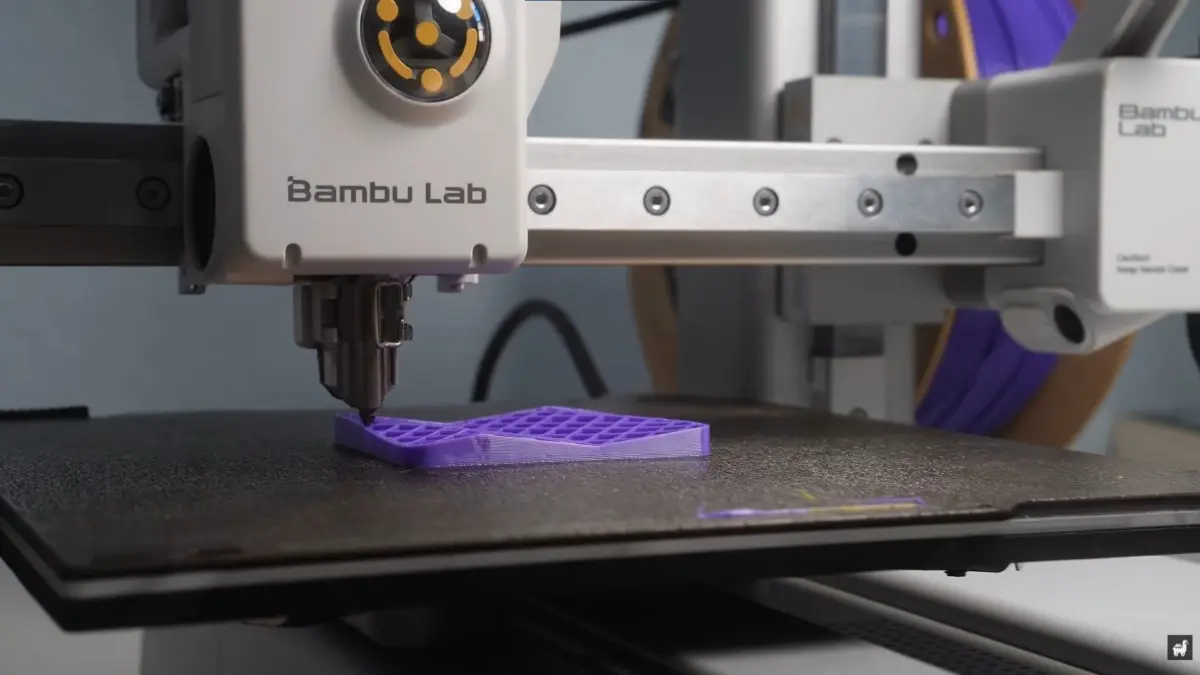
Despite the clear mechanical and aesthetic advantages of printing along three axes, non-planar manufacturing has largely remained confined to academic laboratories, specialized research papers, and sporadic viral internet demonstrations. In the video posted yesterday, Alpaca Engineering addresses this persistent industry bottleneck, explaining that while mesmerizing footage of non-planar printing frequently captures the imagination of the maker community, everyday hobbyists and professionals have had virtually no practical way to integrate the technique into their standard daily workflows. Most existing non-planar experiments rely on half-abandoned GitHub repositories, highly specialized and undocumented scripts, or cumbersome modifications that require advanced programming knowledge to operate.
Alpaca Engineering points out that the lack of widespread adoption is not due to a complete absence of general-purpose non-planar slicing algorithms, but rather a profound barrier to accessibility. Modern 3D printer owners have grown accustomed to polished, highly streamlined software ecosystems. Contemporary users expect seamless, push-button workflows where models are imported, sliced with minimal friction, and sent directly to a connected printer via Wi-Fi or local network protocols. The days of manually compiling firmware, troubleshooting raw G-code, and walking back and forth with an SD card are largely behind the mainstream consumer base. Because previous non-planar tools failed to integrate smoothly into these familiar, modern management workflows, everyday users simply bypassed them in favor of conventional, reliable slicing software.
The newly introduced PancakeSlicer project is designed specifically to dismantle these operational barriers. By making the non-planar slicing algorithm as straightforward to implement as traditional slicing workflows, the project attempts to normalize a technique that has spent years relegated to the fringes of 3D printing experimentation. Furthermore, PancakeSlicer integrates comprehensive 3D printer management features into its architecture, aiming to surpass the convenience of existing software solutions while delivering the structural benefits of true three-axis toolpaths. By wrapping complex mathematical transformations into a user-friendly, self-hostable package, the tool bridges the divide between experimental computer science and practical desktop fabrication.
The release taps into a long-standing fascination within the additive manufacturing community. Every few months, a new video demonstrating non-planar capabilities circulates widely across social media platforms, drawing millions of views and sparking renewed discussions about the future of layer-less manufacturing. Observers marvel at the smooth top surfaces, the elimination of traditional layer lines, and the dramatic increases in part strength achieved by letting the nozzle flow naturally over complex curves. Yet, enthusiasm inevitably wanes as viewers realize that replicating the results requires navigating a maze of obscure software forks, unmaintained codebases, and hardware constraints. PancakeSlicer represents a concerted effort to transform these fleeting viral moments into a sustainable, accessible toolset that the broader community can actually utilize on their own machines.
By focusing on a self-hostable architecture, Alpaca Engineering allows users to run the slicing environment locally, maintaining control over their data and workflows while bypassing the limitations of closed-source cloud platforms. As the software begins to circulate following yesterday’s demonstration, it remains to be seen how the maker community will adopt and build upon the foundation laid by PancakeSlicer. However, by directly tackling the accessibility and workflow integration issues that have historically stifled non-planar research, the project marks a significant step forward in making multi-axis 3D printing a practical reality for desktop fabricators everywhere.