
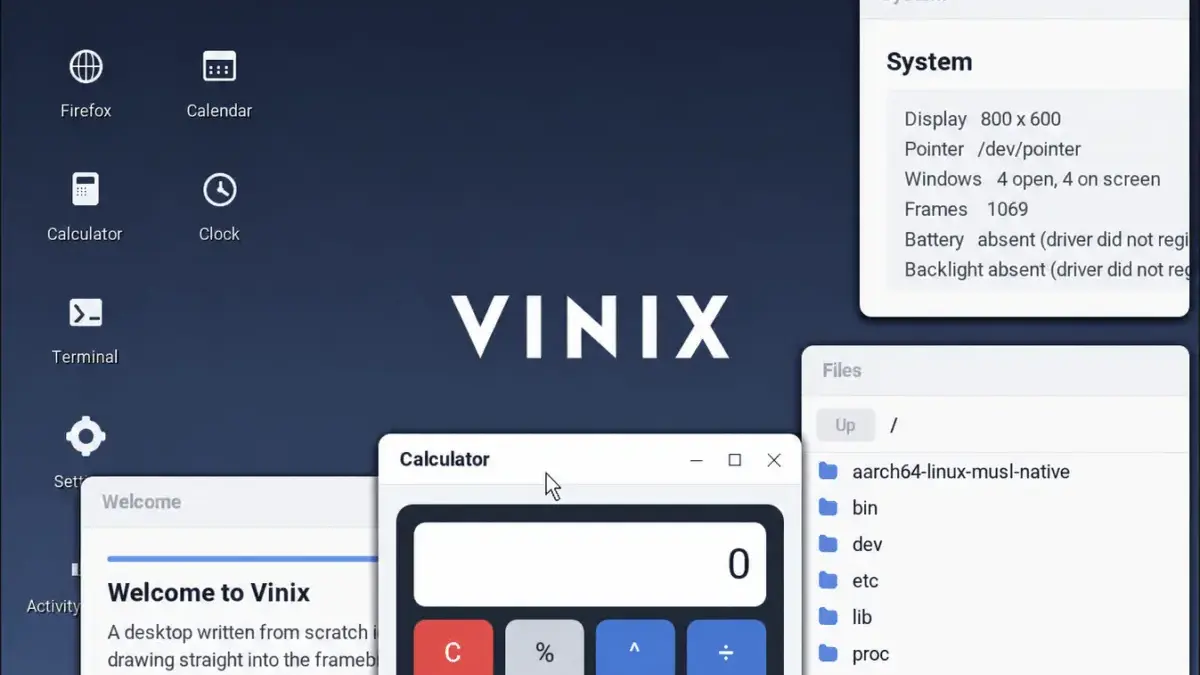
For years, users of Apple’s high-end hardware have watched macOS evolve through countless iterations, accumulating a heavier footprint and more background processes with every major annual release. While Apple Silicon offers unmatched hardware efficiency, the software layer running on top of it has increasingly felt bloated to purists who prefer lean, transparent operating systems. Enter Vinix, an ambitious open-source operating system project initially engineered to give M-series MacBooks a fast, minimal, and highly transparent alternative. Developed largely in the modern V programming language, Vinix bridges the gap between custom bare-metal architecture and the vast ecosystem of existing Linux applications.
At its core, Vinix is not powered by the Linux kernel, nor is it a traditional proprietary operating system. Instead, it relies on a custom monolithic kernel booted via the Limine bootloader, with its essential drivers built directly into the system image. Despite running on its own independent kernel, Vinix has solved one of the most difficult hurdles for alternative operating systems: achieving native compatibility with standard Linux applications. By implementing custom versions of critical Linux kernel features—including namespaces, cgroups, overlayfs, and seccomp—Vinix can execute a stock Alpine Linux Docker engine and run native ARM64 Linux binaries without requiring a heavy virtual machine or software emulator.
A Fresh Take on System Architecture and Performance
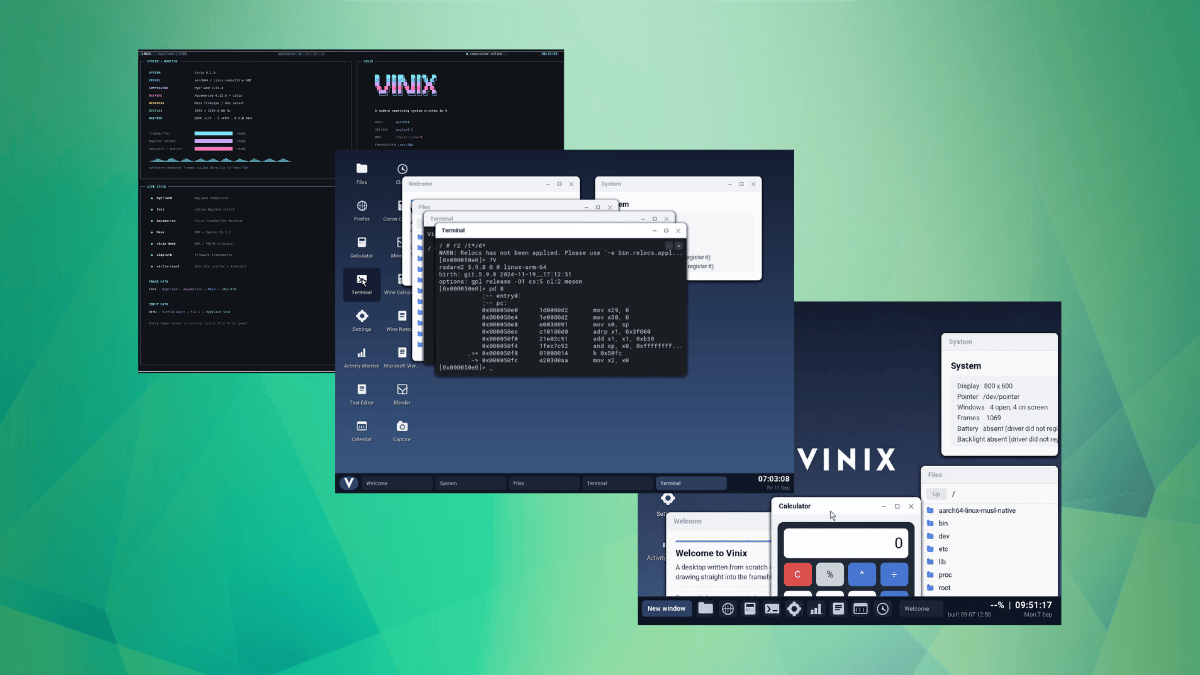
Vinix is built from the ground up to reject the modern trend of background bloat. The project’s philosophy centers on minimalism: nothing runs in the background unless explicitly started by the user, and the entire operating system relies on a single, unified init system, desktop environment, package manager, and binary format. Furthermore, the Vinix kernel handles memory manually rather than utilizing a garbage collector, ensuring that automated memory cleanup passes never interrupt critical system calls or the graphical compositor.
The security model of the operating system draws heavy inspiration from OpenBSD. Features such as pledge and unveil are available to restrict application privileges, and user memory is protected by default to prevent regions from being simultaneously writable and executable. The entire system is lightweight by design, boasting a remarkably small footprint that consumes roughly 50 megabytes of RAM immediately after boot and claims about one gigabyte of disk space once fully installed.

This lean architecture is heavily anchored in the V programming language, which was selected by the development team for its exceptionally fast compilation times, small footprint, and readable syntax. Beyond serving as a functional operating system, the Vinix project effectively doubles as a robust testbed for bare-metal programming and systems development within the V ecosystem.
Running Linux Workloads and Early-Stage Capabilities
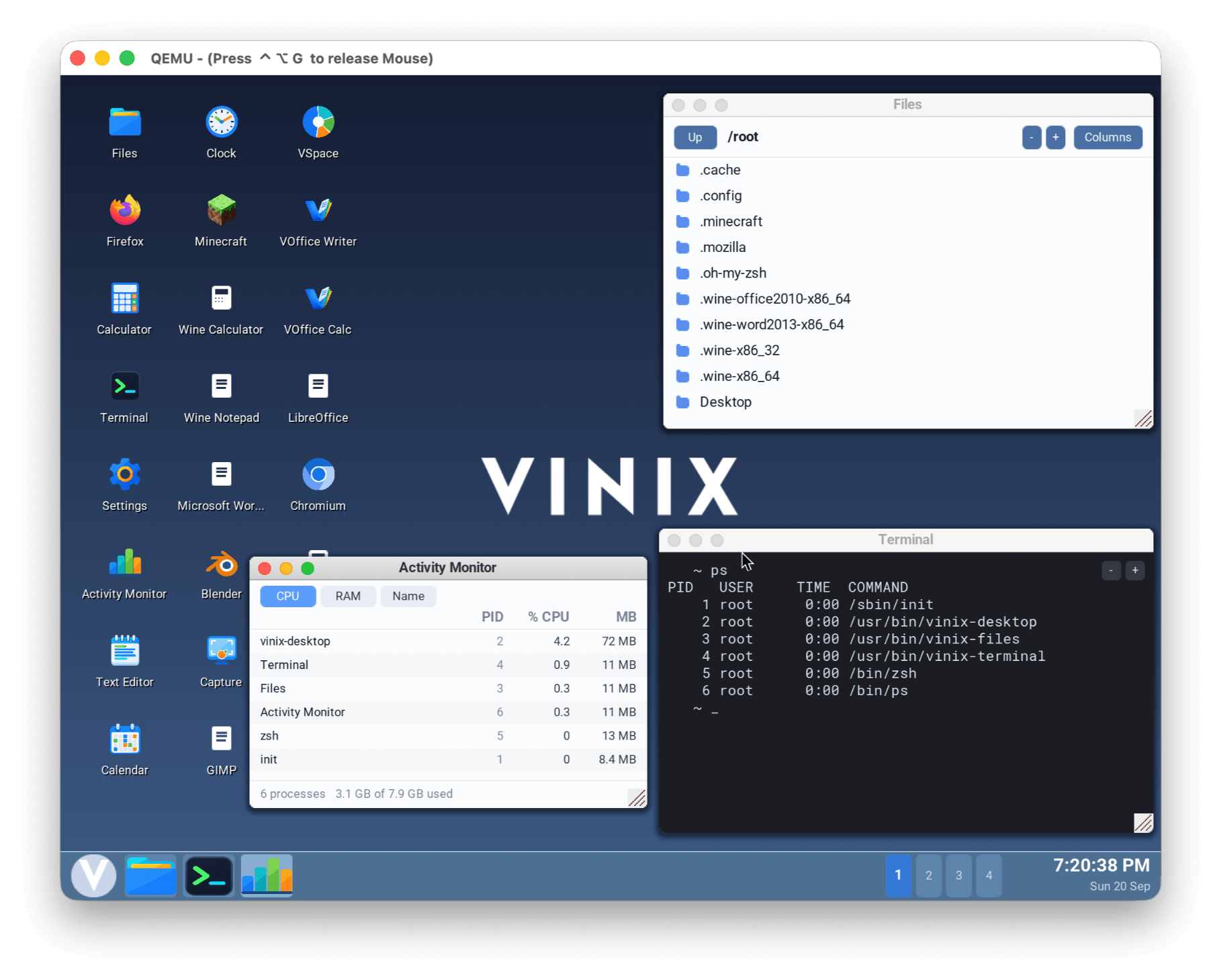
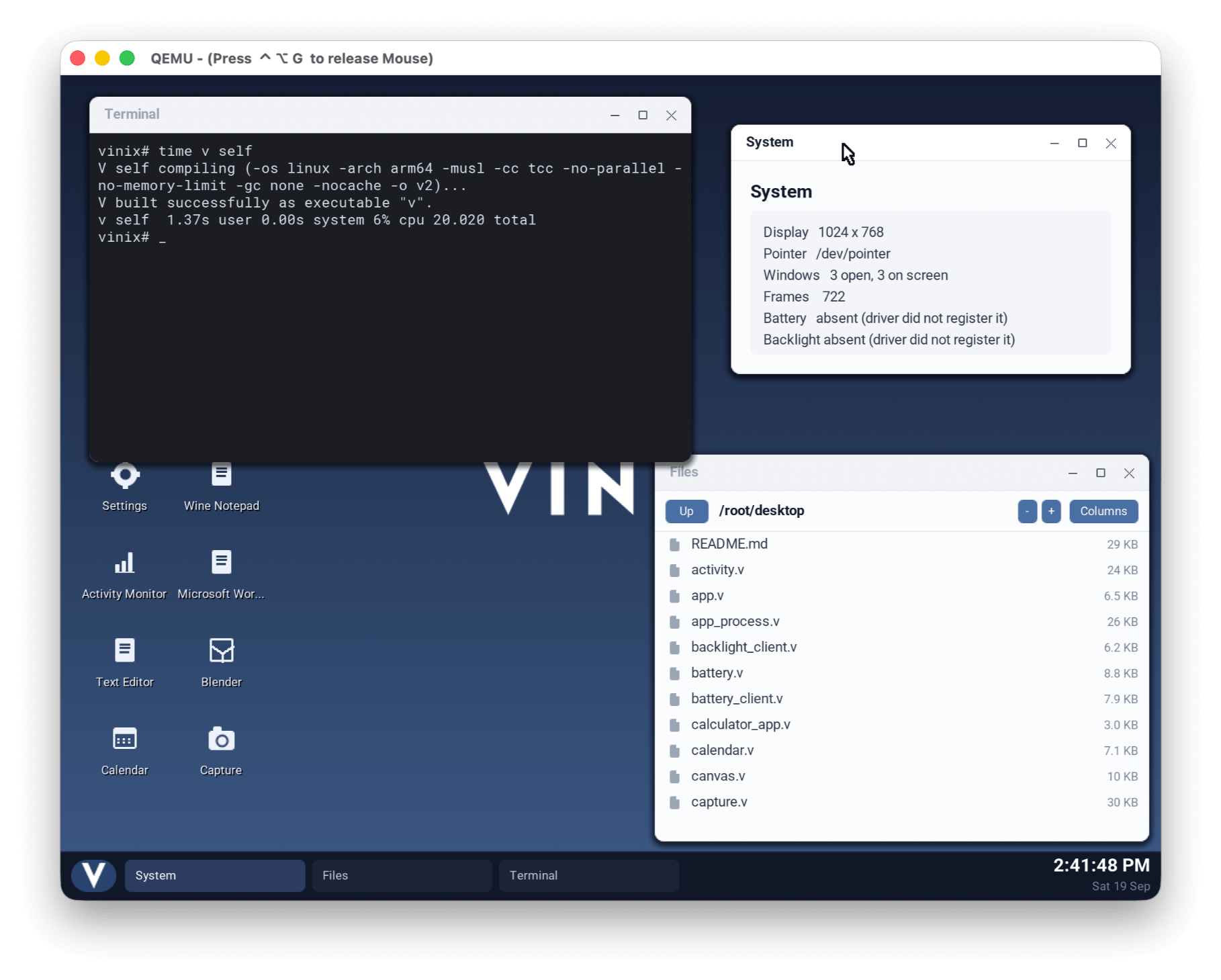
Because Vinix natively answers the system calls made by Linux binaries and comprehends the standard ELF executable format alongside musl behavior, users can install and run familiar applications directly. The operating system utilizes a command-line tool known as pkg to pull software packages directly from Alpine Linux’s ARM64 repositories. Well-known applications such as Chromium, GIMP, Sublime Text, Gnumeric, and the compatibility layer Wine are all known to function on the platform.
Docker support, while remarkably advanced for a custom operating system, currently comes with distinct limitations. The engine lacks bridge networking and iptables rules in its present state. Similarly, graphics and emulation workloads show that the software is still in its early developmental stages. QEMU 9.1.2 runs via software emulation, allowing users to boot a second instance of Vinix inside a window of the first. Gaming and graphical demos—including DOOM, a DOOM 3 demo running at roughly 13 frames per second under software rendering, the Gothic II demo via OpenGothic, and Minecraft Java Edition running in interpreter mode on a single CPU core—demonstrate the feasibility of the platform while underscoring its current hardware and performance boundaries.
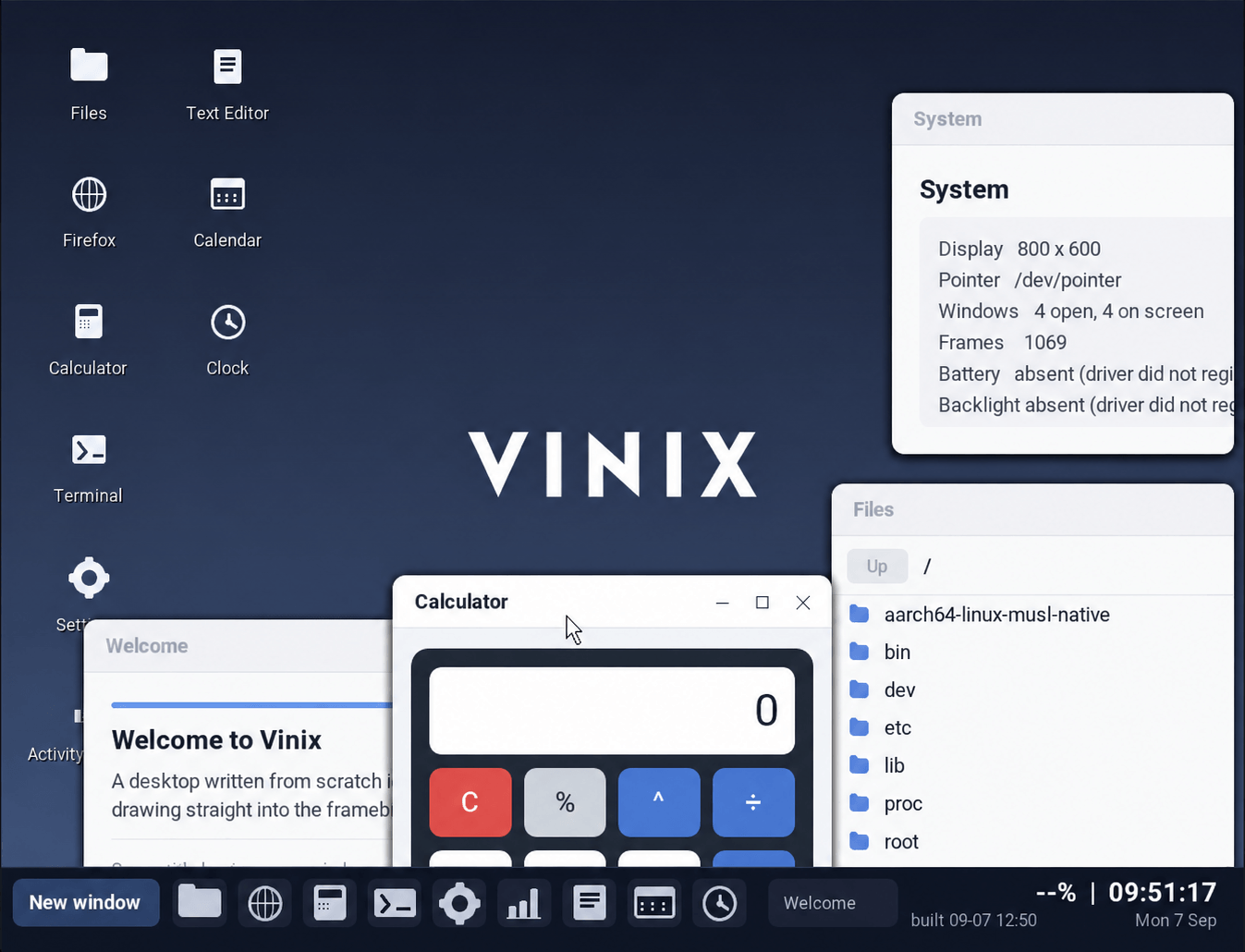
The graphical experience is driven natively by a custom desktop built using V UI2 that renders directly through the framebuffer, while X.org and Hyprland sessions remain available as options for ARM64 users. At present, hardware support is primarily targeted at Apple Silicon devices, with the original Apple M1 chip fully supported, while broader support for subsequent M-series processors and native GPU drivers remains actively under development.
Project Origins and Availability
The history of Vinix spans several years of iterative development, with initial code commits appearing on GitHub as early as March 2021. The original core of the kernel was engineered by Mintsuki, the creator of the Limine bootloader, who built the foundational physical and virtual memory managers alongside the scheduler. After a development pause lasting approximately two years, Alexander Medvednikov, the author of the V programming language, stepped in as project maintainer. Since the handover, the operating system has expanded significantly to include robust storage, networking, input, and graphics support, alongside a complete Unix-style userspace and the Alpine compatibility layers that define its current utility.
For users interested in experimenting with the platform, the project provides accessible installation media. The official Vinix website offers a dedicated disk image installer file tailored for M1 Macs, while the project’s GitHub repository hosts distinct ISO images for both ARM64 architectures—targeting virtual machines like QEMU and VirtualBox on Apple Silicon hardware—and x86_64 architectures aimed at standard Intel and AMD systems. Virtual machine testing requires modest resources, needing at least four gigabytes of memory and four gigabytes of storage space. Developers and enthusiasts can also build the entire operating system directly from source.
While the developers emphasize that Vinix remains early-stage software not yet suited for daily use or production environments, it represents a compelling engineering achievement: a lightning-fast, highly transparent, and minimalist operating system that proves alternative kernels can successfully integrate with the modern Linux software ecosystem.

Leave a Reply