
When examining the pantheon of classic newspaper comic strips, it quickly becomes evident that no two titles can be approached with the same critical lens. Over recent months, cultural analysts and pop culture historians have revisited the greatest-ever quotes and panels from various legendary cartoonists, finding that every strip demands its own unique interpretive approach. For Charles Schulz’s enduring masterpiece Peanuts, the most fitting analysis often leans toward the heartfelt and inspirational, reflecting the deep emotional resonance of Charlie Brown, Snoopy, and the gang. For Bill Watterson’s philosophical triumph Calvin and Hobbes, critics naturally gravitate toward themes of human nature, childhood wonder, and existential contemplation about the world at large.
However, when turning the page to Gary Larson’s iconic single-panel creation, The Far Side, the analytical task shifts entirely. Larson did not construct deep, sentimental worlds, nor did he offer lofty inspirational wisdom. While many of his cartoons required careful inspection from readers, this requirement rarely stemmed from intellectual depth in the traditional sense. Instead, Larson’s brilliance relied on sharp, unconventional joke-telling, often compelling the audience to carefully examine the visual elements simply to untangle the mechanics of a deeply skewed punchline.
Consider, for instance, a classic Larson cartoon featuring an artist painting a portrait of a woman who appears as a half-fly creature. At first glance, a reader might stare at the woman or the canvas, utterly bewildered by the bizarre artistic choice. Only after inspecting the panel more closely does the viewer spot the dead housefly trapped on the artist’s eyeglasses, instantly reframing the entire scenario. Larson’s work routinely invited readers to investigate a scene, but rarely in a ponderous or overly earnest way.
The Far Side was—and remains—a masterclass in brilliant, surreal comedy, yet it was never designed to make audiences ponder life’s heaviest existential questions. Larson channeled his unique genius strictly into comedic subversion, which is precisely what made the strip so sharply funny. Consequently, identifying the ultimate or definitive quote from The Far Side should never have been mistaken for an insightful, inspirational journey—even if initial attempts to categorize his work sometimes trended in that direction.
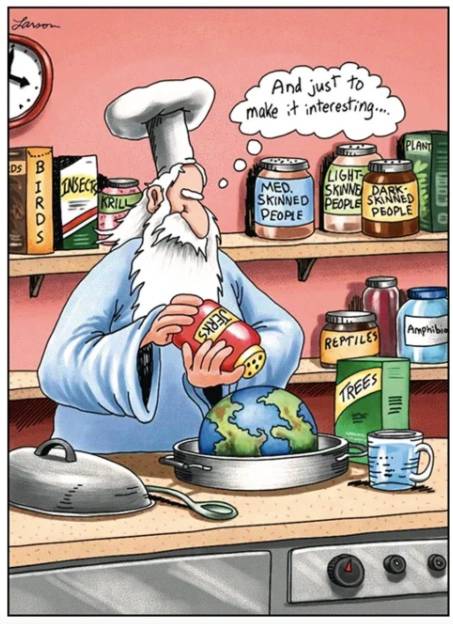
Initial explorations into Larson’s catalog naturally gravitated toward recurring motifs, such as his numerous cartoons featuring God as a central character. Yet, upon closer reading of these divine panels, it becomes clear that Larson’s portrayal of the Almighty was rarely profound or reverent. More often than not, Larson’s God simply emerged as petty, bureaucratic, or downright difficult—a cosmic prankster wielding ultimate power with casual indifference.

Similarly, a brief look at Larson’s frequent explorations of death—a subject naturally suited to his signature macabre sense of humor—revealed little in the way of weighty or solemn philosophy. While mortality populated The Far Side with startling regularity, the approach remained firmly rooted in the absurd, culminating in surreal gags such as a snake hanging itself with its own serpentine body.
The Far Side was never meant to be “deep”
Faced with the reality that The Far Side was never meant to carry deep philosophical weight, the search for a definitive quote required shifting focus entirely toward pure, distilled comedy. Yet, navigating thousands of individual panels presents its own challenge, given the vast range of Larson’s comedic palette. Across his career, Larson proved equally adept at dark comedy, whimsical silliness, and the surgical deconstruction of well-known idioms, song lyrics, and pop culture tropes.
Ideally, a definitive quote would encapsulate all of these stylistic signatures simultaneously. Furthermore, finding a truly standout quote meant looking for something where the visual component, while always a hallmark of Larson’s style, did not act as an absolute barrier to understanding the text. Because The Far Side relied heavily on single panels where the drawing served as the setup and the caption functioned as the punchline, finding a quote that could stand entirely on its own was a monumental task.

For a brief period, consideration was given to the unforgettable line, “Welcome to hell… here’s your accordion.” Featured in a panel contrasting the heavenly reward of harps with the eternal damnation of mandatory accordion playing, the joke resonates as wonderfully dark and silly—the kind of humor found nowhere else in print. Eventually, however, that panel was set aside because the visual contrast remains the driving force of the gag. Without seeing the unfortunate souls trudging toward their musical punishment, the line itself risks reading as a simple non-sequitur, relying entirely on the visual depiction of accordions as instruments of torture to land the joke.
After moving past several other candidates, a 1992 cartoon emerged as the absolute, undeniable fit for the project. The panel depicts a mime caught directly beneath a massive, falling tree in the middle of a dense forest. The accompanying caption delivers the definitive punchline:
“Question: If a tree falls in the forest and no one’s around, and it hits a mime, does anyone care?”
This particular panel succeeds brilliantly because it is dark, absurd, and undeniably funny. More importantly, it takes a universally recognized philosophical idiom—the classic thought experiment regarding a falling tree in an empty forest—and weaponizes it into a pitch-black comedic punchline. While it may not incorporate every single stylistic nuance of Larson’s extensive career, it successfully captures an impressive concentration of his finest creative attributes within a single frame.
Moreover, unlike the vast majority of The Far Side catalog, this specific cartoon leans remarkably heavily on the strength of its text. While Larson’s gags were almost exclusively visual, relying on meticulously crafted artwork to deliver the humor, this particular panel operates on a level where the visual, while amusing, is almost secondary to the linguistic pivot. The drawing of the crushed mime adds undeniable flavor, but the core mechanics of the joke function entirely on the strength of the rewritten idiom.
In the end, the absence of emotional or philosophical depth in the mime panel is precisely what makes it the ultimate representation of Gary Larson’s work. In stripping away any pretense of grand meaning and replacing it with pure, biting absurdity, the cartoon delivers the quintessential The Far Side experience—proving that sometimes the greatest comedic genius lies simply in asking the questions no one else would ever dare to voice.
Leave a Reply