

The artificial intelligence industry is currently experiencing a quiet but significant shift in perspective regarding the true economics of large language models. While consumers and enterprises alike have enjoyed months of generous subscriptions, massive credit giveaways, and heavily subsidized frontier models from major providers, industry observers are beginning to ask a fundamental question: what happens when the subsidy ends?
For many developers and organizations that have rushed to rebuild their entire workflows—and in some cases, their core business architecture—around cloud-based frontier models, the future may look considerably more expensive than anticipated. The pattern has become familiar across the sector. Generous credit allocations arrive first, enticing users to build deep dependencies. Gradually, the models appear less responsive or quietly optimized for lower resource consumption, credits burn through faster, and eventually, prices climb or introductory offers expire.
When token prices inevitably rise, organizations relying heavily on cloud infrastructure may find themselves facing operational costs that scale poorly. This looming financial reality is precisely why local AI infrastructure and smaller, task-specific models are poised for massive growth. Not every operational task requires a massive frontier model. Many routine workflows can be handled effectively by smaller models running on hardware that organizations already own, wrapped in customized harnesses tuned to specific productivity needs.
This economic reckoning forms the backdrop for a wave of recent developments in the open-source and developer ecosystems, ranging from novel agent communication tools to massive migrations of foundational cloud architecture.

On the Bench: Buzz and the Evolution of Agent Tools
Among the open-source projects catching developer attention lately is Buzz, a communication tool built specifically to facilitate collaboration between human teams and autonomous agents. Featuring a dedicated smartphone app that ensures continuous connectivity, the tool offers a streamlined alternative for teams looking to bridge the gap between human chat environments and background automated processes.
At the same time, the fundamental interface for autonomous agents is undergoing a much-needed redesign. For tasks that run in the background while users are offline, traditional chat interfaces have proven to be poorly suited. Two major technology initiatives have independently arrived at the same solution almost simultaneously: giving agents an inbox.
Cloudflare recently open-sourced agentic-inbox, a self-hosted email client integrated with an AI agent that runs entirely on Cloudflare Workers rather than local hardware. Incoming mail is processed through native email routing, with each individual mailbox housed in its own Durable Object backed by a SQLite database, while attachments are routed to object storage. The built-in agent reads the inbox, searches historical conversations, and drafts responses that require explicit human approval before transmission.
A parallel approach emerged from Amazon Web Services with the introduction of Pizza Bot, an open-source, local-first inbox designed for long-running agents. Built on DeepAgents and LangGraph, Pizza Bot operates locally without telemetry, storing conversation threads, execution checkpoints, memories, and system logs as SQLite files within a local directory. Because it supports integration with local model runners like Ollama, developers can operate the entire system completely locally and even offline, routing finished work to unread threads while flagging items that require human intervention.

Divergent Paths in AI-Native Design and Privacy
Further highlighting the diverse directions of modern tooling are two starkly contrasting projects addressing design and privacy.
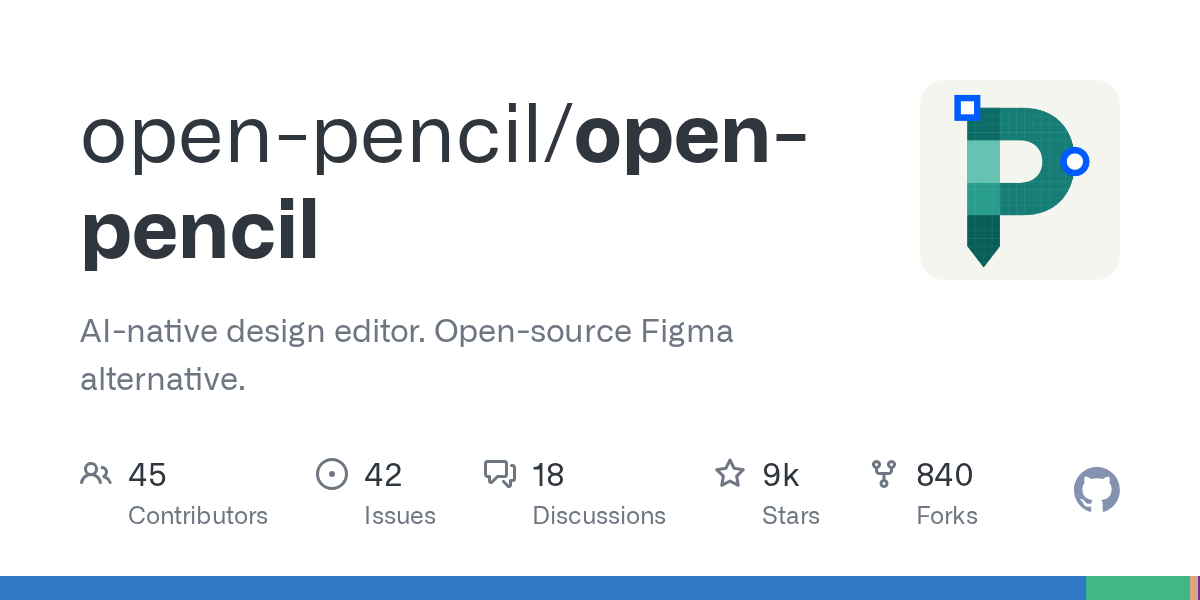
The first is OpenPencil, an MIT-licensed, AI-native design editor capable of opening, editing, and saving native Figma design files with full node-copying interoperability. Weighing in as a lightweight desktop application that requires no user account, it features a headless command-line interface and a Model Context Protocol server, enabling coding agents to read and modify design files directly.
At the opposite end of the spectrum is Kalypta, a project designed to act as an anti-AI tool. Addressing the growing ubiquity of automated meeting transcribers that feed corporate conversations into cloud training pipelines, Kalypta runs a small model locally on the user’s device. It subtly realigns audio streams in real-time to render speech incomprehensible to automated note-taking bots while maintaining absolute clarity for human participants.
Open Model Releases and Architectural Shifts
In the open model space, attention has focused on Qwen-Image-2.1, a compact text-to-image model that has drawn comparisons to alternative nano-scale visual models. However, because its model weights are distributed under the Qwen Research License—which restricts commercial use and requires direct licensing arrangements—it serves as yet another reminder in the developer community that open weights and true open-source licensing are distinct concepts.

Meanwhile, architectural experiments continue to push boundaries. Following the recent attention garnered by TypeSafe AI’s "System One" decision model, developers released an open-source equivalent known as laya-mlx, providing a native MLX port of the typed decision model specifically optimized for Apple Silicon hardware.
Major tech enterprises are also aggressively optimizing their internal infrastructure using generative tools. Microsoft recently completed a massive engineering feat, rewriting the GitHub Copilot agent runtime from TypeScript into more than 800,000 lines of production Rust. Driven largely by a single engineer utilizing a fleet of AI agents across 128 incremental pull requests over roughly fourteen and a half weeks, the migration incurred a token cost of approximately $120,000.
An analysis of the underlying telemetry reveals a crucial insight into modern AI economics. Of the 136.3 billion tokens consumed during the migration, 130.6 billion consisted of cached input reads. Without prompt caching—which bills cache hits at a fraction of standard input costs—the migration would have been financially prohibitive.
This financial reality underscores the importance of prompt caching and KV cache reuse in both cloud and local inference environments. By maintaining stable prompt prefixes and appending only new context, developers can prevent cache invalidation and avoid multiplying their inference expenses tenfold. On local hardware, where per-token billing does not apply, similar optimizations translate directly into latency reductions rather than direct financial savings.
As the industry moves forward, developers are increasingly advised to look past the subsidized, low-cost phase of frontier artificial intelligence. By designing resilient execution harnesses and integrating smaller, locally hosted models where appropriate, organizations can build sustainable architectures capable of weathering future shifts in token pricing.
Leave a Reply