
The legal battle between international sports broadcasters and public DNS resolvers in France has escalated dramatically. Swiss non-profit foundation Quad9 is currently facing potential financial penalties running into the millions of euros after confirming it has deliberately chosen not to comply with a French court order requiring the blocking of pirate sports streaming domains.
Since 2024, French courts have repeatedly ordered public Domain Name System resolvers to block access to unauthorized sports streaming websites. While some providers quickly folded or altered their operations, the regulatory pressure has revealed deep technical and legal fractures regarding the role of DNS infrastructure in combating online piracy.
The latest standoff stems from a May ruling by the Paris Judicial Court, which required major technology firms and DNS operators—including Google, Whalebone (which operates DNS4EU), and Quad9—to block pirate streams of Women’s Tennis Association (WTA) matches for users physically located in France. The initial order, requested by prominent broadcaster beIN Sports, targeted six domains. According to Quad9, subsequent updates added another 52 domains to the blacklist, bringing the total number of targeted addresses to 58.
However, Quad9 has revealed that it is not blocking any of the domains on the list and, in fact, never has. This non-compliance is a conscious and calculated decision by the non-profit foundation, though it is one that now carries severe financial consequences.
beIN Returns for Penalties
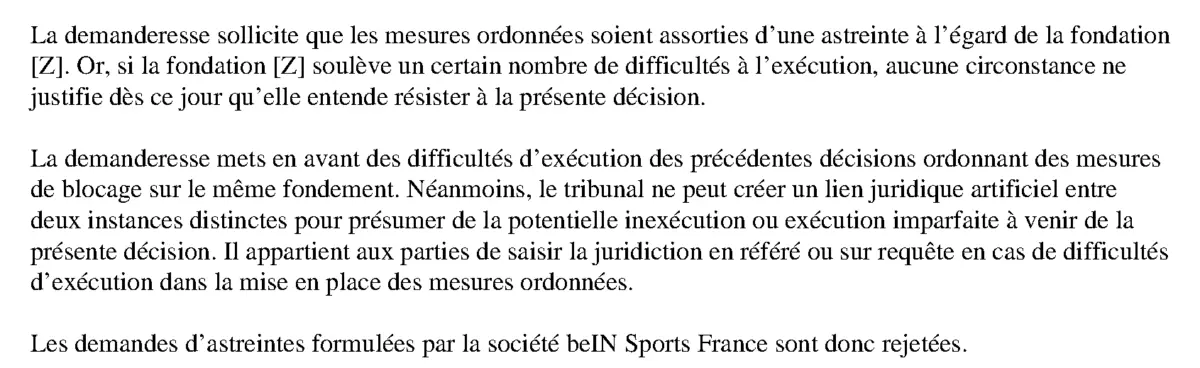
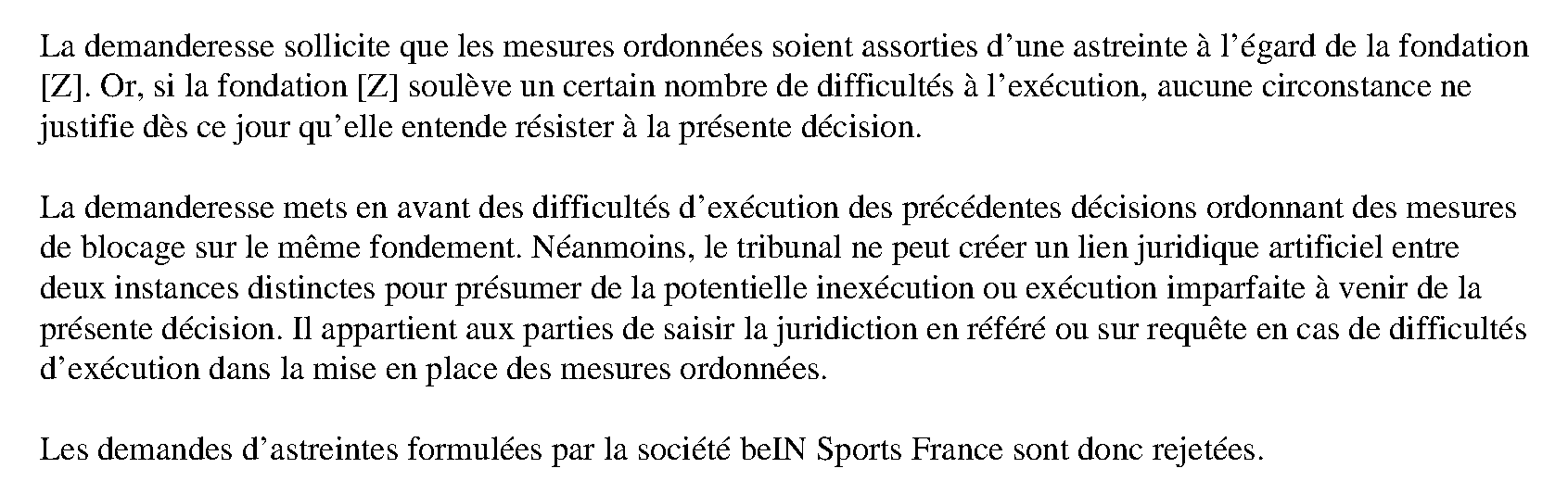
From the outset of the legal proceedings, beIN Sports sought to secure financial guarantees of compliance. When requesting the original blocking order, the broadcaster asked the Paris court to impose a penalty of 2,000 euros per day for every domain that Quad9 failed to block. Notably, Quad9 was singled out specifically for this penalty request, while other DNS resolvers named in the suit did not face the same immediate threat.
At the time, the court declined beIN’s request for fines. The bench reasoned that there was no sufficient indication at that early stage that the foundation intended to actively resist the order, adding that if enforcement problems arose later, the involved parties could return to court.
True to that indication, beIN Sports has returned to the Paris Judicial Court to pursue financial sanctions. Quad9 reported that the broadcaster is now seeking 10,000 euros per domain, per day. Across the 58 domains currently on the blocking list, this aggregates to an extraordinary 580,000 euros per day, translating into millions of euros in potential liabilities per week.

The case was heard before the Paris court, with a formal decision anticipated in the coming weeks. If the court rules in favor of the broadcaster, the penalties would apply retroactively from the moment the initial order was issued, presenting an existential financial threat to the small non-profit organization. Despite the high stakes, Quad9 has detailed the complex technical and legal justifications behind its ongoing refusal to implement the blocks.
The DNS Blocking Problem
From a purely technical standpoint, Quad9 acknowledges that it possesses the capability to block domain names and thereby alleviate the immense pressure from rights holders and courts. However, the foundation maintains that it cannot technically isolate these blocks to users residing in France, which is the explicit geographic scope demanded by the court order.
As a privacy-focused recursive resolver, Quad9 does not collect or track user data. Consequently, to enforce a country-specific restriction, the service would have to rely on third-party geolocation databases that map IP addresses to physical locations. The foundation argues that these databases are fundamentally unreliable, often suffering from gaps, inaccuracies, or out-of-date information.
"There is no legally useful way for us to define a French user," representatives for Quad9 explained.
The foundation’s skepticism regarding geolocation accuracy is rooted in past experience. In Germany, Sony Music previously took Quad9 to court over similar piracy issues. During those proceedings, Quad9 argued that its attempts to limit a court-ordered block exclusively to German users were deemed insufficient by the court. Although Quad9 ultimately won that legal battle on appeal, the underlying technical challenge of accurately restricting DNS responses by geography was never legally or technically resolved in a way that satisfies strict compliance standards.
Persuading the Paris court on these grounds will likely prove difficult. In its May ruling, the court explicitly noted that the defendants failed to adequately demonstrate that limiting the requested blocks exclusively to French territory would be financially prohibitive or technically impossible.
Alternatively, Quad9 could choose to implement the domain blocks on a global scale, mirroring an action it briefly took in Germany in 2023 under the immediate threat of a 10,000 euro fine. When asked why it has opted against a global block in the French case, the foundation clarified that the German action was strictly a temporary measure utilized while the litigation played out. Quad9 emphasizes that every jurisdiction presents unique legal frameworks and that it approaches each case independently.
"We remain entirely confident in our core argument: DNS recursive resolvers are the wrong place to counter the problem of online piracy, and will result in significantly worse outcomes for the citizens of France," Quad9 stated.
These concerns are not unique to Quad9. Earlier this year, a comprehensive report published by the Internet Society warned that jurisdiction-specific blocking orders disproportionately harm smaller, non-commercial infrastructure operators who lack the vast compliance resources of major tech conglomerates.
"Large, well-resourced operators may be able to absorb the compliance costs, but smaller and non-profit operators risk being excluded from the market if they cannot afford the staffing and compliance infrastructure demanded by jurisdiction-specific blocking orders," the Internet Society report noted.
Leaving France?
If the Paris court ultimately grants beIN Sports’ request for massive daily fines, Quad9 will be forced to take decisive action to protect its organizational viability. The foundation has outlined three primary options should the penalties be approved.
The first option involves attempting to implement a geographically restricted block targeting only users in France, an approach the foundation warns remains imprecise and still leaves it vulnerable to ongoing fines due to geolocation errors. The second option is to enact a global block on the domains, a move that Quad9 argues would effectively allow French judicial jurisdiction to dictate internet access worldwide.
The final option is to follow the precedent set by OpenDNS, which completely suspended its service in France in 2024 following the initial wave of piracy blocking orders. Even with a complete service withdrawal, the precision of such geo-blocking measures remains a persistent operational hurdle.
Quad9 officials noted that these options have not yet been formally discussed by its Foundation Council. Any path forward must balance the foundation’s legal obligations with its mandate to protect its organizational existence. Furthermore, the organization is bound by Swiss law to uphold its founding principles of user privacy, internet security, and infrastructural stability in a consistent and predictable manner globally.
Recklessly Dangerous
The broader regulatory landscape in France is complicating matters further as the government moves to expand its anti-piracy enforcement mechanisms. In July, the French Parliament adopted legislation designed to permit the automated, real-time blocking of pirate sports streams, allowing new domains to be added dynamically during live broadcasts with retrospective review by regulatory authority ARCOM.
Quad9 views this legislative expansion as a dangerous escalation layered on top of an already problematic judicial blocking regime.
"An unfettered, unencumbered and delegated power given to an unspecified list of commercial parties to block any content they desire seems to us recklessly dangerous, un-necessary, and counter-productive," the foundation warned.
According to Quad9, automated and rapid-fire blocking systems risk driving everyday internet users toward less secure alternative systems located in unregulated jurisdictions. Furthermore, the foundation argues that the high operational costs associated with maintaining real-time blocklists will inevitably preclude meaningful vetting of the targeted domains.
"Dynamic injection of false answers weaponizes the DNS against end users," Quad9 asserted, adding that such measures will ultimately prove wasteful and ineffective at removing the underlying content, which remains accessible via alternative channels.
For now, the immediate next chapter in the dispute rests with the Paris Judicial Court. A formal decision regarding the financial penalties requested by beIN Sports is expected later this month, after which Quad9 is anticipated to announce its definitive response. Representatives for beIN Sports declined to comment on the ongoing legal procedure.

Leave a Reply