
Cloud infrastructure provider DigitalOcean has quietly moved to end its long-standing Open Source Credits program, catching project maintainers entirely off guard and triggering a scramble across the developer ecosystem. The silent wind-down, which first surfaced through a GitHub discussion among core Node.js contributors, has raised serious concerns about the stability and corporate backing of community-driven infrastructure.
Under the Open Source Credits scheme, DigitalOcean provided approved open-source projects with cloud hosting allowances to offset operational expenses. These grants allowed project maintainers to run essential infrastructure—such as continuous integration (CI) build operations, download mirrors, storage snapshots, and testing environments—without footing heavy monthly hosting bills. Major projects like Node.js relied heavily on this infrastructure to keep their core development pipelines running smoothly. For years, DigitalOcean actively promoted the initiative, encouraging maintainers to apply directly through a dedicated corporate email address.
However, that era appears to be drawing to a close without any formal public announcement or press release on the company’s official blog or social media channels.

How the Quiet Cancellation Came to Light
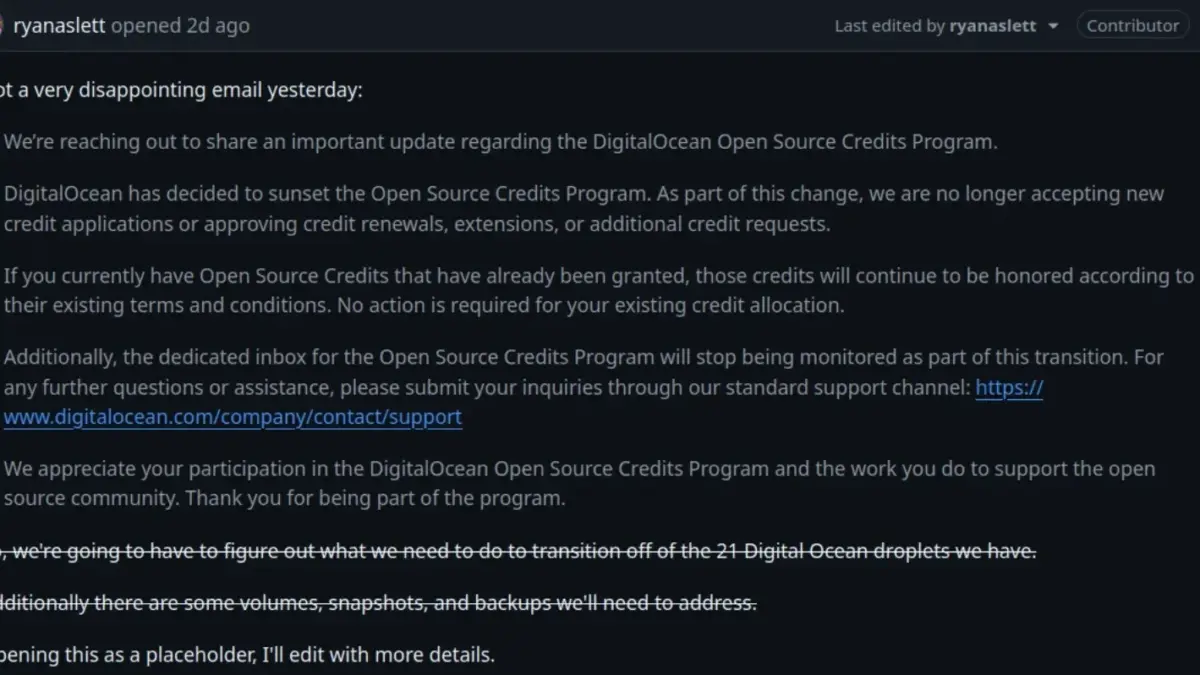
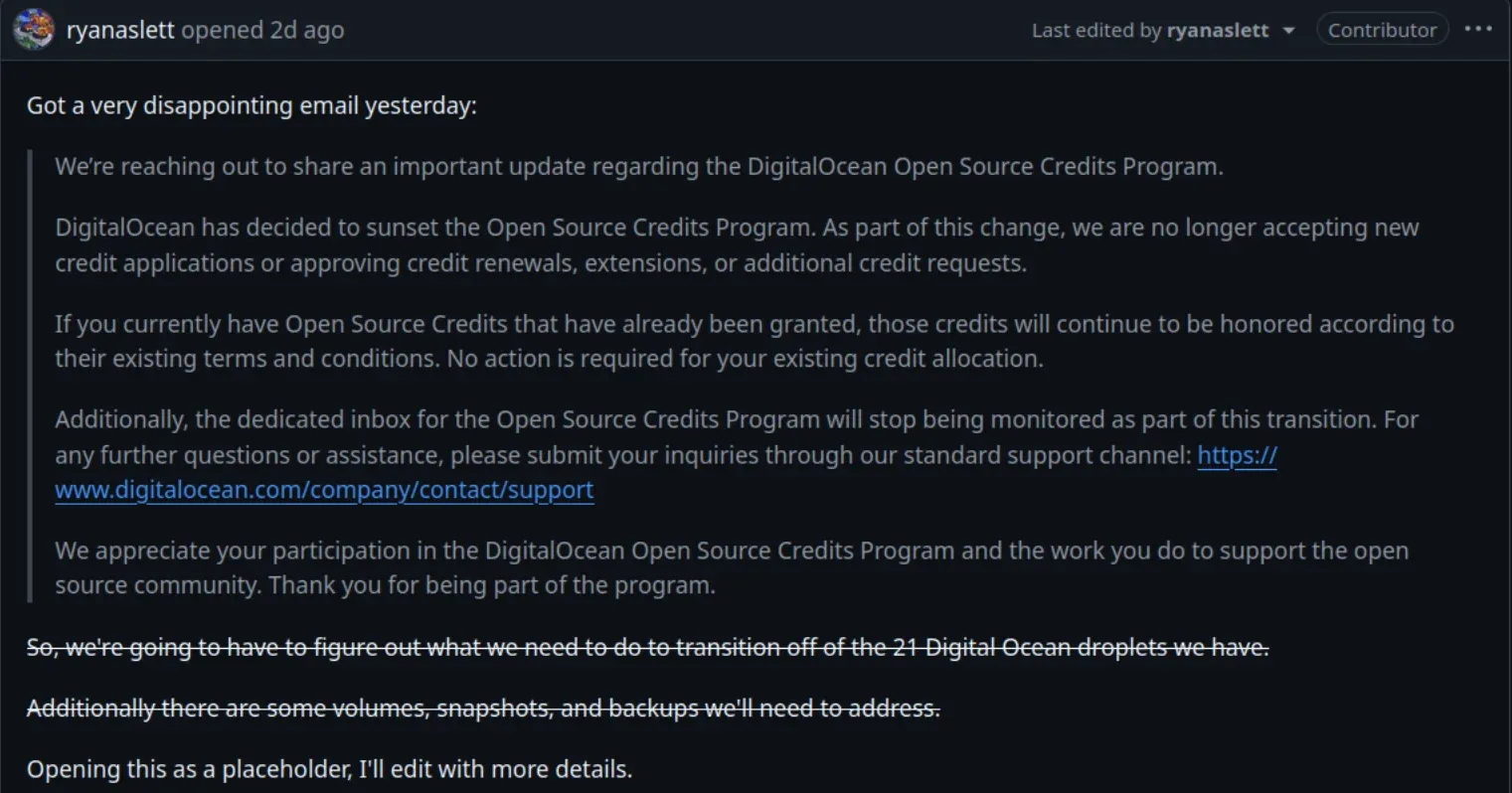
The termination of the program first came to light via a GitHub issue where maintainers of the Node.js project shared an email notification they had received from DigitalOcean. The message stated that the cloud provider had decided to sunset the Open Source Credits program, noting that it would no longer accept new credit applications, approve credit renewals, extensions, or handle additional credit requests.
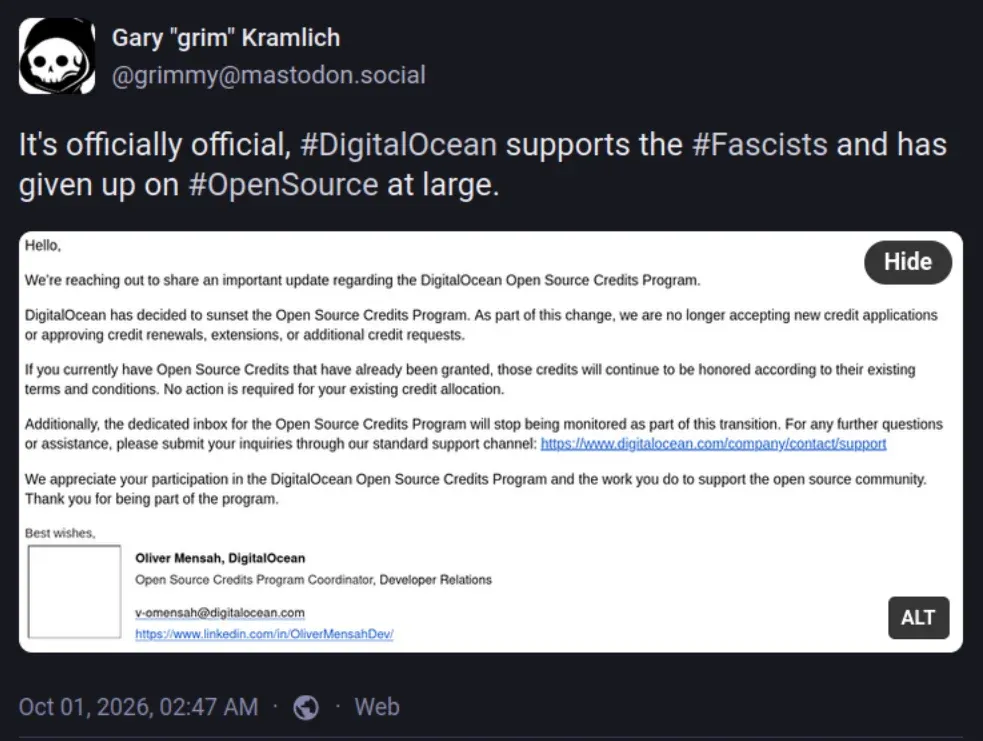
Initially treated as speculation, the news was quickly confirmed as multiple other open-source projects stepped forward to report receiving identical closure notifications. Gray, the lead developer of the Pidgin instant messaging project, shared similar communications on Mastodon, highlighting the sudden industry-wide impact of the decision.
Under the new terms, projects currently enrolled in the program will not receive any fresh allotments of credits. Instead, maintainers must manage their remaining balances until they are exhausted, after which they will be forced to either pay out of pocket for DigitalOcean’s infrastructure or migrate their workloads to alternative cloud providers. Furthermore, the specialized email inbox established for the program has been permanently unmonitored, effectively slamming the door shut on prospective applicants.

A Long-Standing Mutual Partnership
The dismantling of the credits program breaks a mutually beneficial arrangement that had endured for years. When DigitalOcean supplied hosting credits, open-source projects utilized them to power vital digital infrastructure while proudly displaying DigitalOcean branding on their official websites, README files, and documentation pages.
This symbiotic relationship served as a powerful customer acquisition funnel for the cloud provider. Thousands of developers discovered DigitalOcean’s platform through these open-source endorsements, eventually converting into paying individual customers or introducing the cloud infrastructure into their commercial workplaces. Both parties extracted tangible value from the arrangement, making the abrupt termination particularly jarring to the developer community.
A Pattern of Reducing Free Offerings
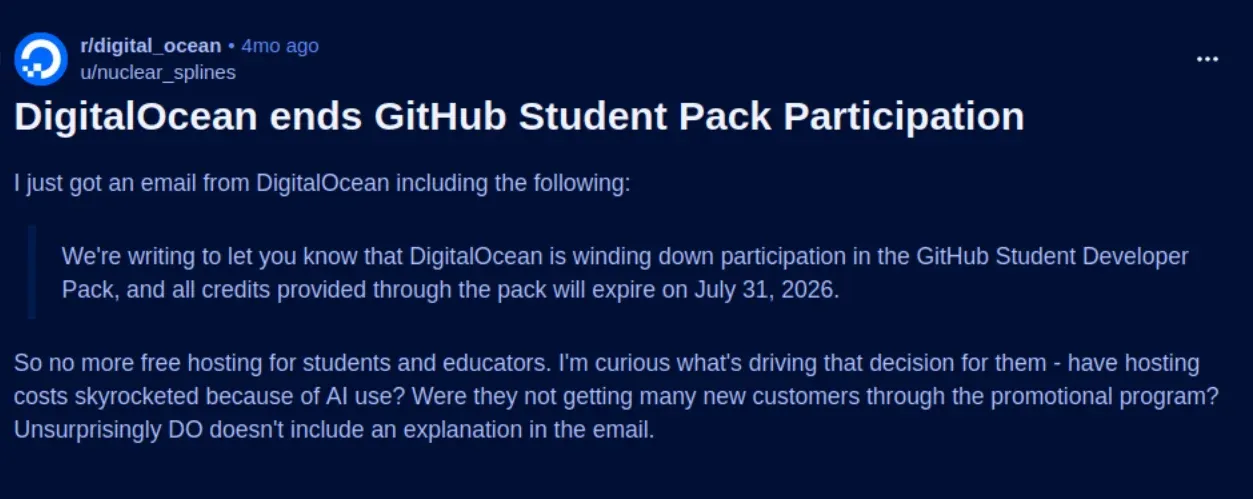
This development follows a broader trend of DigitalOcean trimming its community-facing and educational support programs without clear public disclosures. Earlier in the year, the company quietly removed its participation in the GitHub Student Developer Pack. Students attempting to redeem their standard introductory cloud credits found themselves unable to do so, leaving community forums flooded with confused queries and frustrated users searching for answers in the absence of corporate transparency.
Despite scaling back these community-focused programs, DigitalOcean continues to offer introductory credits to new individual sign-ups, though the long-term viability of even those promotions remains a subject of quiet speculation among developers.
The Node.js Exception and Corporate Re-engagement
While many projects face an uncertain future, high-profile projects retain considerable leverage. During the initial discussions on the Node.js GitHub repository, maintainers not only mapped out an exit strategy away from DigitalOcean but also proposed stripping all promotional branding, homepage mentions, and partner badges referencing the cloud provider.
Faced with the prospect of losing one of its most prominent marquee open-source partners—while direct competitors like Vercel maintained prominent visibility on the platform—DigitalOcean quickly reached out to repair the relationship. Company representatives engaged with the maintainers to discuss what a hypothetical "version 2.0" of the program might entail, suggesting a more selective approach to future project sponsorships. Following this outreach, the Node.js GitHub issue was promptly renamed from a transition plan to a renewed partnership discussion.
Broader Industry Shifts and the AI Factor
The sudden withdrawal of support has left many wondering about DigitalOcean’s financial priorities, particularly given that the company recently donated $3 million to the Omacom Foundation as a founding corporate patron of Omarchy Linux. The apparent contradiction between funding a multi-million-dollar foundation partnership while phasing out a broad credits program for smaller projects suggests a strategic pivot in corporate philanthropy and developer relations.
Observers note that the broader software industry has shifted dramatically over the past two decades. In the early days of the commercial open-source boom, companies eagerly aligned themselves with free and open-source software to build goodwill and leverage community-driven codebases. Today, in an era dominated by artificial intelligence capable of generating software and handling complex workloads on demand, enterprises rely less on traditional, community-driven ecosystems for foundational software generation.
While mega-projects deeply integrated into modern developer workflows—such as Python and Node.js—will likely continue to secure corporate sponsorship, smaller, end-user-facing projects and legacy utilities face a much harsher climate.
The Road Ahead for Impacted Maintainers
For most open-source projects, the resolution found by Node.js will remain out of reach. Smaller communities do not command the corporate attention or brand value necessary to prompt a rapid executive intervention.
Project maintainers, already grappling with rising administrative burdens and an influx of automated pull requests and bug reports, now face the added stress of securing alternative hosting arrangements. Pidgin lead developer Gary Kramlich noted that his project had already gone without DigitalOcean credits for over a year, forcing him to absorb hosting costs personally while actively evaluating sponsored colocation or alternative community hosting solutions and cutting back on running services.
As the open-source landscape continues to evolve, maintainers are left hoping that alternative infrastructure providers will step forward to fill the void left by DigitalOcean’s departure from broad community sponsorship.

Leave a Reply