

Dynamic site blocking orders, long a staple of anti-piracy enforcement across Europe, are rapidly gaining ground in the United States legal system. Traditionally, rightsholders seeking to block infringing domains have been forced to return to court repeatedly to update their injunctions as pirate operations shift infrastructure. However, a landmark case in Florida is pushing the boundaries of what U.S. federal courts can authorize, setting a precedent that could drastically streamline how major broadcasters combat large-scale digital piracy.
Spanish-language media giant TelevisaUnivision (TU) secured a sweeping preliminary injunction from a federal court in Florida, marking a significant escalation in the legal battle against illicit IPTV providers. What began as a targeted legal action against five specific pirate IPTV services quickly snowballed within weeks, expanding to encompass hundreds of domains and a vast network of technical intermediaries. With the defendants failing to make an appearance or mount a defense in court, the broadcaster is now leveraging that default status to pursue a permanent and unprecedentedly broad injunction alongside tens of millions of dollars in damages.
In a formal motion filed before Judge Kathleen Williams, TelevisaUnivision requested a default judgment against the six named defendants operating Thunder TV, Sunset TV, and Tele Latino. Meanwhile, the operators of Pop TV and Kaelus TV, the remaining two services originally named in the initial complaint, continue to evade identification, remaining listed as John Does. While the headline figure of the filing demands a staggering $32.7 million in damages, legal analysts note that the true significance of the motion lies in the unprecedented breadth and self-expanding mechanism of the proposed permanent injunction.

The Self-Expanding Blocking Injunction
The preliminary injunction granted earlier this summer granted TU the rare administrative power to unilaterally append new domains, IP addresses, and pirate services to the judicial order without requiring repeated approval from a judge. Demonstrating the efficacy of this mechanism, the broadcaster utilized the power twice before the initial injunction had even reached its first month.
The newly proposed permanent order preserves this self-expanding framework while introducing several aggressive expansions designed to close loopholes exploited by modern streaming pirates. Most notably, the updated terms would allow the broadcaster to add entirely new defendants to the legal action rather than merely appending infringing domains.
According to the text of the proposed order, plaintiffs may supplement the caption of the action without further leave of the court to formally add any newly discovered person or entity engaging in prohibited conduct as a John Doe defendant. This ensures that underground operations cannot easily escape liability merely by cycling through nominal corporate shells.
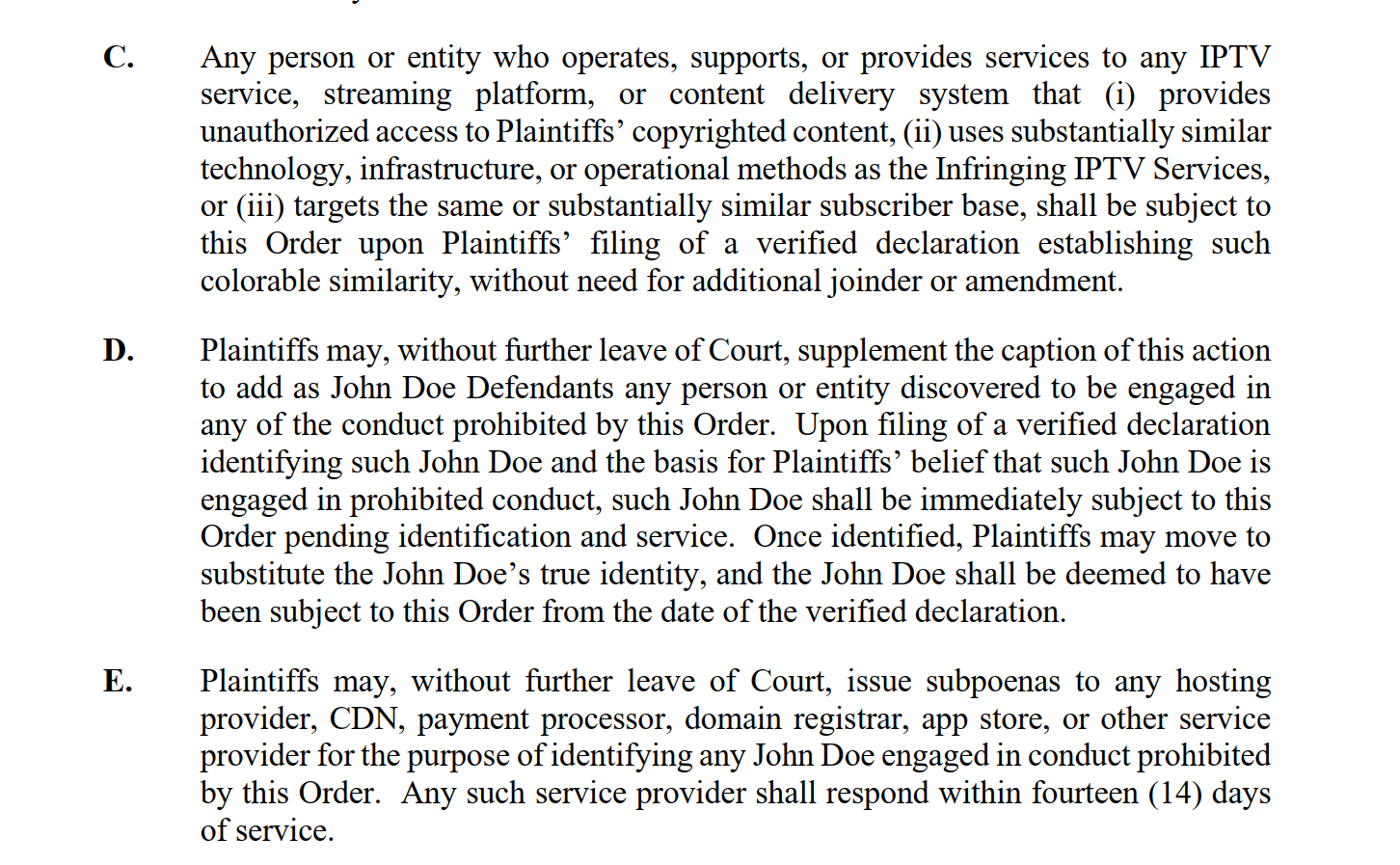
Furthermore, the proposed order introduces a crucial "colorable similarity" carveout. Under this provision, any third-party service that provides unauthorized access to TelevisaUnivision’s proprietary content, deploys substantially similar underlying technology, or deliberately targets the broadcaster’s core subscriber base can be legally compelled to comply with the injunction. This broad net also explicitly captures alter-ego and successor services designed to relaunch the exact same business model under a different banner.
This provision was drafted with a specific target in mind. Supplemental court declarations revealed that Thunder TV, one of the original defendants, had ceased hosting TelevisaUnivision content directly. However, the exact same operators allegedly launched a mirror application named "Black Eye" that continued the infringement. According to court filings, subscribers gained access to Black Eye utilizing the exact same login credentials originally established for Thunder TV, demonstrating the revolving-door nature of pirate streaming infrastructure.
Nearly 600 Domains and 121 Intermediaries Listed
The scale of the operation detailed in the legal paperwork is immense. The court filings list nearly 600 unique domain names, spanning the original five services and seven additional brands that were subsequently incorporated into the action, including XuperTV, Tarjeta Roja, Pirlo TV, and Roja Directa.
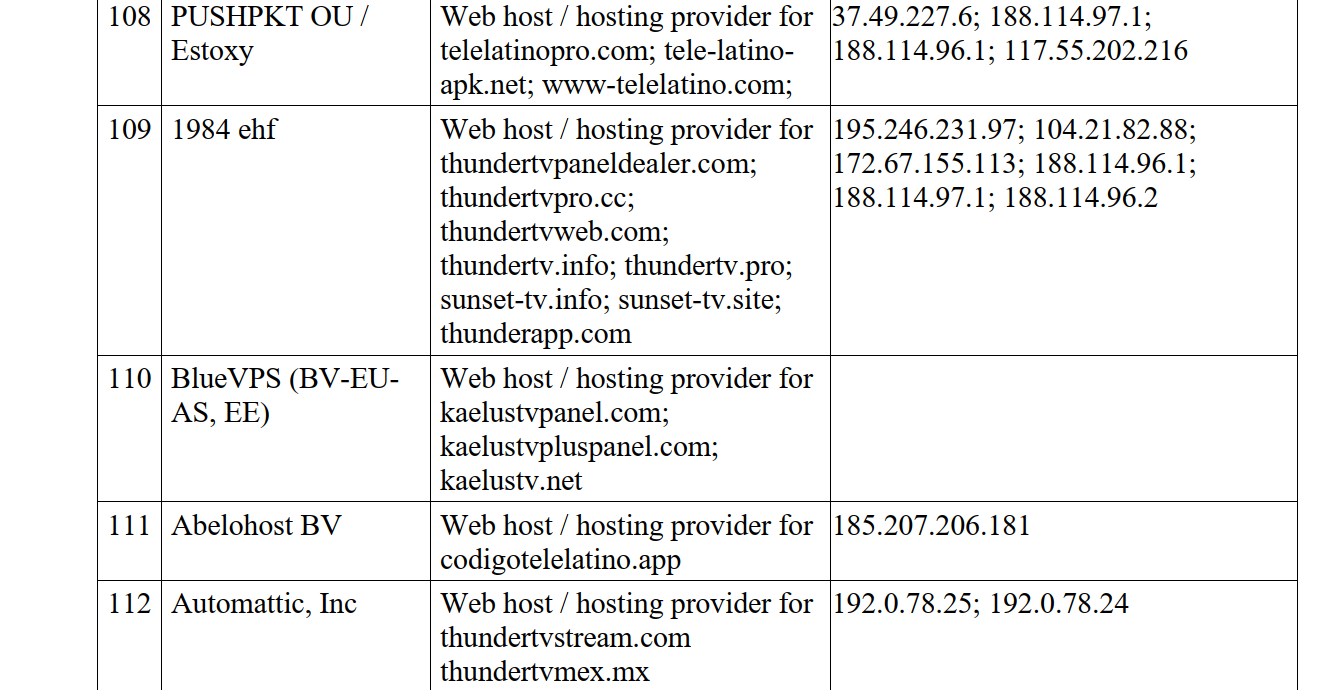
Individual services demonstrated staggering organizational breadth. Thunder TV and Tele Latino each accounted for more than 90 distinct domains. Meanwhile, XuperTV, which TelevisaUnivision characterizes as a white-label service built upon the identical Magis TV infrastructure utilized by Tele Latino, contributed upwards of 110 additional domains to the growing list.
The network of third-party intermediaries drawn into the litigation is equally expansive, listing 121 entities ranging from domain registrars and content delivery networks to payment processors and application distribution platforms. The roster of impacted companies includes prominent U.S. firms such as NameCheap and GoDaddy, alongside international entities including Russia’s REGTIME-SU, Vietnam’s Mat Bao, Peru’s NIC.PE, the Dutch Registrar.eu, Iran’s Aria Shatel, and the Romanian state research institute ICI Bucuresti.
A variety of mainstream digital platforms and hosting providers were also implicated due to their connection with specific pirate domains or services. Companies such as GitHub, Vercel, Canva, Wix, Squarespace, and Automattic—the parent company of WordPress.com—appear in the filings as part of the technical ecosystem supporting the pirate networks.
The litigation also highlighted misunderstandings regarding technical roles within internet infrastructure. The proposed injunction initially targeted regional internet registries RIPE NCC and APNIC, inaccurately characterizing them as web hosts or hosting providers. Because these organizations function by allocating IP address space rather than hosting content or managing direct routing, they lack the technical capability to block access to specific IP addresses, underscoring the complex challenges courts face when navigating the nuances of global network administration.

Cloudflare, a frequent fixture in modern copyright litigation, faces specific, dedicated requirements under the proposed order. For approximately 90 distinct IP addresses tied directly to the pirate domains, Cloudflare is ordered to unmask and disclose the origin servers operating behind its proxy service, alongside the names and email addresses associated with the respective account holders.
Additionally, consumer-facing hardware and software platforms have been drawn into the enforcement mechanism. Roku and the developers of the AFTVnews Downloader application are ordered to actively remove unauthorized pirate apps from their systems and block the numerical short codes frequently utilized by consumers to sideload the software onto connected television devices.
Weighing Multi-Million Damages Against Practical Realities
The request for a permanent injunction accompanies a massive financial demand calculated across both copyright and trademark infringement claims. TelevisaUnivision is seeking $26.7 million for willful copyright infringement, calculating the figure at the statutory maximum of $150,000 for each registered work compromised by the defendants. An additional $6 million is demanded for willful trademark counterfeiting, assessed at $2 million per defendant group.
In practice, legal observers recognize that recovering millions of dollars from anonymous or foreign defendants who refuse to participate in U.S. judicial proceedings is highly unlikely. TelevisaUnivision is well aware of these practical limitations, utilizing the uncollected damages as further justification for the necessity of a permanent, automated injunction capable of actively dismantling domains and technical infrastructure at the source.
The pursuit of multi-million dollar judgments against default defendants has become an increasingly common strategy for major media corporations fighting unauthorized IPTV networks. Similar legal actions have yielded substantial financial awards elsewhere in the United States, including an $18.75 million judgment secured by Amazon and Netflix against a Dallas-based IPTV operator, and a $9 million default judgment obtained by major Hollywood studios in Pennsylvania.
The motion now rests entirely in the hands of Judge Kathleen Williams. Whether the court will ultimately greenlight the most expansive and self-expanding provisions of the proposed order as written remains to be determined, but the outcome could permanently alter the legal landscape for digital copyright enforcement in the United States.

Leave a Reply