
The international music industry is sharpening its focus on open-source media downloaders. The International Federation of the Phonographic Industry (IFPI), a prominent global music advocacy group, has officially flagged the widely used media extraction tool yt-dlp as a major threat to copyright holders. The designation forms part of the organization’s formal policy submission for the European Commission’s upcoming 2027 Counterfeit and Piracy Watch List, signaling an escalation in the recorded music sector’s long-running battle against stream-ripping technologies.
The move marks a notable escalation in regulatory pressure surrounding the utility, which has effectively succeeded the original youtube-dl project as the go-to tool for downloading online media. In its detailed submission to European regulators, the IFPI has explicitly targeted yt-dlp, grouping it alongside other prominent stream-ripping services such as Savefrom.net and various Y2mate domains. Furthermore, the submission goes beyond anonymous project labeling by explicitly naming four prominent developers associated with the software via their public GitHub handles.
A Familiar Battleground Evolving Into Open Source
To understand the weight of the IFPI’s latest policy filing, it is necessary to examine the turbulent history of media downloaders and their interactions with major entertainment labels. In October 2020, the Recording Industry Association of America (RIAA) utilized a Digital Millennium Copyright Act (DMCA) takedown notice to remove the original youtube-dl repository from GitHub. The RIAA contended at the time that the software violated anti-circumvention provisions by bypassing YouTube’s rolling cipher technology.
That enforcement action triggered a fierce backlash within the developer community. Just weeks later, GitHub reversed its decision, reinstated the repository, and even established a $1 million defense fund to protect developers facing similar legal challenges. However, the legal pressure did not vanish entirely. The music industry found more favorable outcomes in European courts, particularly in Germany. Major music labels launched successful legal action against Uberspace, the hosting provider for the official youtube-dl website. That protracted legal battle culminated in November 2024, when the Hamburg Court of Appeal rejected the hosting provider’s final appeal, cementing a precedent for liability among intermediary hosting services.

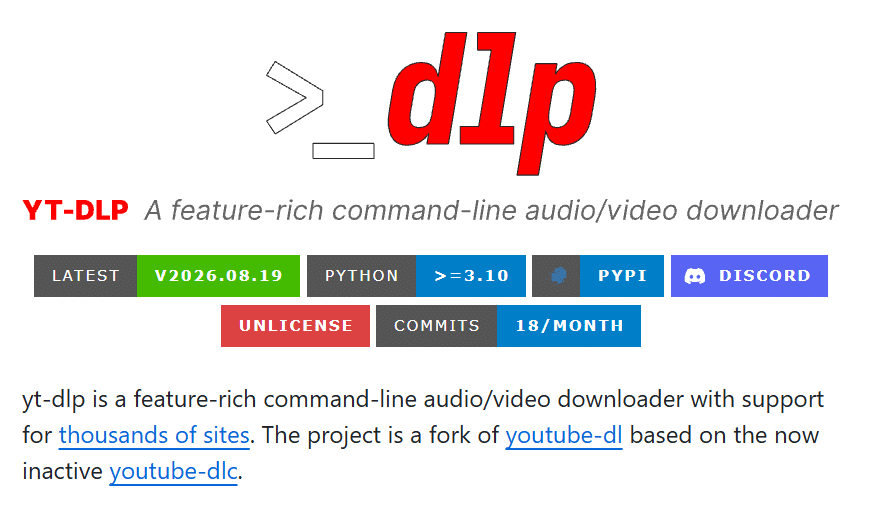
Although the original youtube-dl tool was never formally shut down, its day-to-day active development largely migrated to an open-source fork known as yt-dlp. Today, visitors to the legacy youtube-dl.org domain are automatically redirected to the yt-dlp project. Launched in 2021, yt-dlp has grown into a massive collaborative undertaking, amassing more than 16,000 forks and well over 190,000 stars on GitHub, which positions it as the 32nd most-starred project across the entire platform.
IFPI Flags yt-dlp as a "Major Problem"
Despite its widespread popularity and utility among researchers, archivists, and everyday internet users, the music business views yt-dlp through a strictly economic and legal lens. In its consultation submission for the 2027 EU Counterfeit and Piracy Watch List, the IFPI pulls no punches regarding the software’s impact on the market.
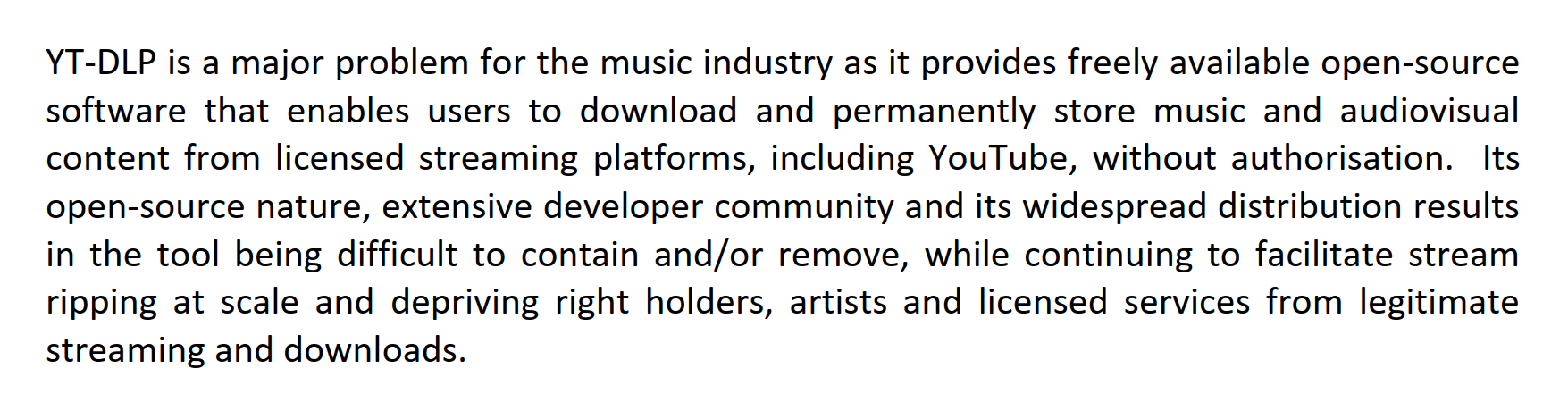
"YT-DLP is a major problem for the music industry as it provides freely available open-source software that enables users to download and permanently store music and audiovisual content from licensed streaming platforms, including YouTube, without authorisation," the IFPI writes in the document.
The organization’s comprehensive overview outlines the project’s historical roots, its expansive stream-ripping capabilities, and the permissive, copyright-critical Unlicense under which the code is published. The submission also underscores why software of this nature presents a unique enforcement headache for copyright holders. Because the project operates on a decentralized, open-source model backed by a large global developer community and widespread independent distribution, rightsholders argue it is extraordinarily difficult to contain or remove. According to the industry group, the tool continues to facilitate stream-ripping at scale, thereby depriving artists, record labels, and licensed streaming platforms of legitimate revenue.
Four GitHub Handles Call Out Maintainers
In a departure from traditional industry filings that target generic domain names or corporate entities, the IFPI’s submission directly identifies individual contributors by their online aliases. The document points to the project’s founder, GitHub user pukkandan, noting that he served as the lead maintainer from 2021 through 2024. Additionally, the submission highlights three current core maintainers: coletdjnz, bashonly, and Grub4K. All four handles correspond to public profiles visible on GitHub.
This instance marks the first time that either yt-dlp or its predecessor, youtube-dl, has been explicitly targeted by name within a formal Watch List or Notorious Markets submission. Interestingly, despite the specific naming of developers and the project itself, the filing does not formally request immediate punitive actions. The submission lacks a direct takedown demand, does not call for mandatory internet service provider blocking measures, and does not formally ask for legal proceedings against the individual developers. Furthermore, the document makes no mention of the various legitimate, lawful purposes for which the software can be employed.
The Question of Circumvention
Legal arguments surrounding software downloaders frequently hinge on the concept of technological protection measures. While the descriptive text regarding yt-dlp avoids explicit use of the word "circumvention," the overarching introduction to stream-ripping within the IFPI document focuses heavily on the topic. The music group contends that platforms like YouTube deploy sophisticated technical barriers specifically to prevent local downloads, and that stream-ripping tools unlawfully bypass those barriers.
"Stream ripping sites are circumventing these measures that enjoy legal protections under the international treaties and EU law," the submission states, while pointing directly to the German court ruling against Uberspace as validation that hosting providers can be held liable for aiding and abetting such circumvention.
Conversely, the technical description provided within the submission itself characterizes the software somewhat differently, noting that it operates by "parsing webpage and player data, and interacting with platform-specific playback endpoints." Exactly how these standard web-parsing activities align with formal legal definitions of technological circumvention remains a central point of contention between developers and copyright enforcement bodies.
Officially Hosted in the United States
The European Commission’s Watch List is specifically designed to highlight digital marketplaces, physical bazaars, and internet services located outside the European Union that allegedly engage in or facilitate large-scale piracy and counterfeiting. While the physical or geographic locations of the individual developers behind yt-dlp are not explicitly analyzed in the text, the submission zeroes in on GitHub as the primary infrastructure supporting the project.
"GitHub is YT-DLP’s official source; it serves as the main platform for accessing the scripts latest updates, source code, pre-compiled binaries and installation instructions," the IFPI notes, while acknowledging that mirrors, forks, and copies exist elsewhere across the web.
Because GitHub is a United States-based corporation owned by Microsoft, the core repository for yt-dlp effectively operates out of the United States, placing it outside the immediate jurisdiction of typical European offline enforcement mechanisms, though US-focused copyright pressure remains a constant background factor.
Emerging AI "Ripping" Threats
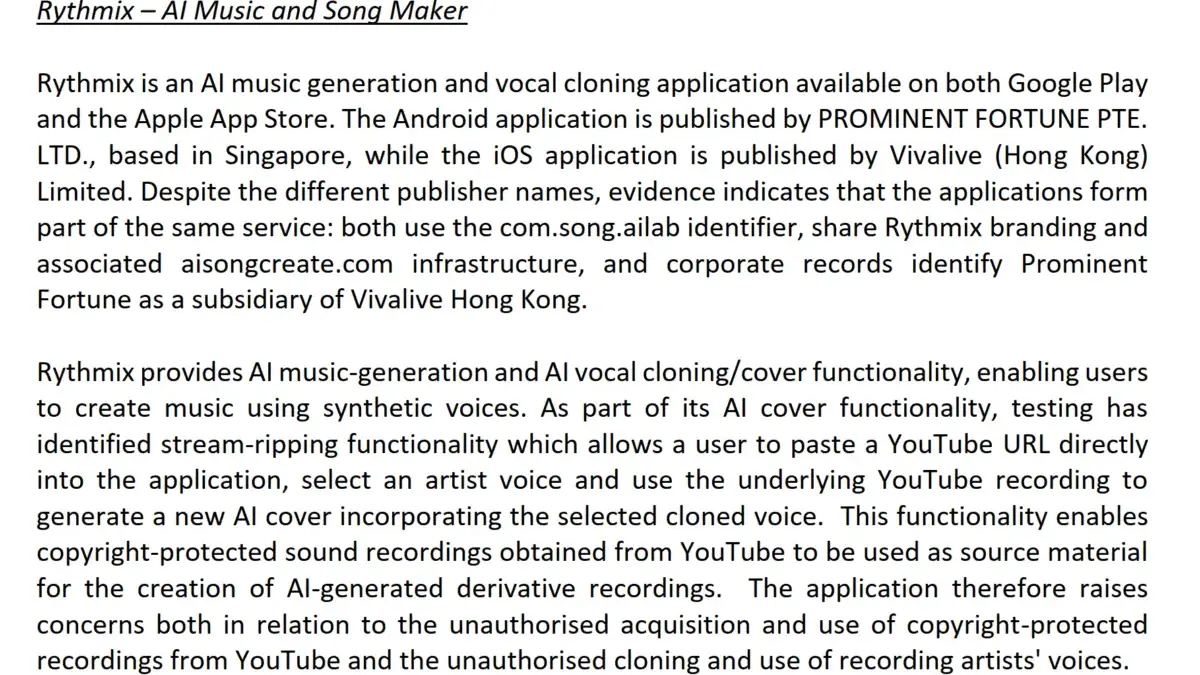
Beyond traditional command-line downloaders and website-based stream-ripping utilities, the IFPI’s broad consultation submission also trains its sights on a newer, increasingly prevalent class of software: artificial intelligence audio tools. The filing explicitly flags consumer mobile applications such as Rythmix AI Music Generator and MusiQ AI.
These applications allow mobile users to paste a public YouTube link directly into the interface and instantly transform the recorded audio into an AI-generated cover song featuring cloned artist voices. Both of these specific tools are readily available for download through Apple’s App Store, and the Rythmix application has also achieved substantial distribution on Google Play, where it has accumulated over five million downloads.
Over the coming months, the European Commission will thoroughly review all submissions gathered during the consultation period to determine which platforms, software projects, and services ultimately warrant inclusion in the final 2027 edition of the Watch List. Whether this review process will result in the formal listing of yt-dlp or the targeted AI applications remains to be seen. Representatives for the yt-dlp maintainer team and GitHub were approached for comment regarding the IFPI filing, but did not provide a statement prior to publication.

Leave a Reply