Swiss non-profit DNS resolver Quad9 has announced it is pulling out of France entirely, becoming the second major public Domain Name System resolver to abandon the French market in the wake of escalating legal pressure regarding pirate site-blocking orders.
Starting November 24, Quad9 will officially cease serving users in France. The decision comes directly on the heels of a Paris court ruling that imposed a €1,000 daily penalty on the foundation for refusing to comply with a court order to block unauthorized streams of tennis matches. Faced with this immediate financial sanction and roughly 20 other pending legal cases across French courts, Quad9 stated that it has been left with no other viable path forward.
Earlier this month, the Swiss foundation had informed researchers and media outlets that it was actively weighing its operational future in France, which included the drastic option of withdrawing its infrastructure from the country. The controversy initially flared up when sports broadcaster beIN Sports sought astronomical penalty requests of up to €580,000 per day because Quad9 elected not to tamper with its DNS resolutions to block pirate tennis streams.
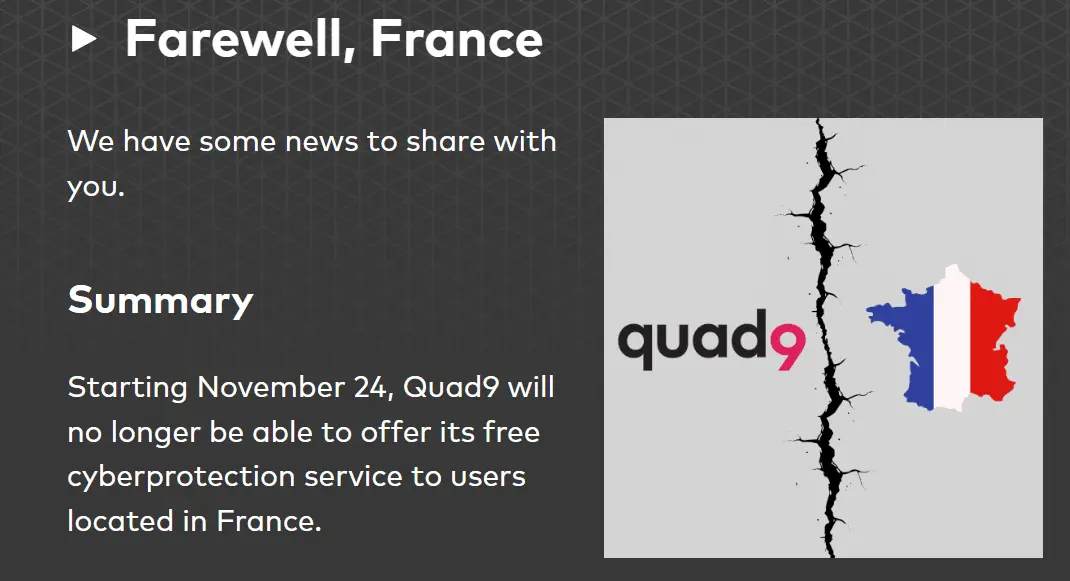
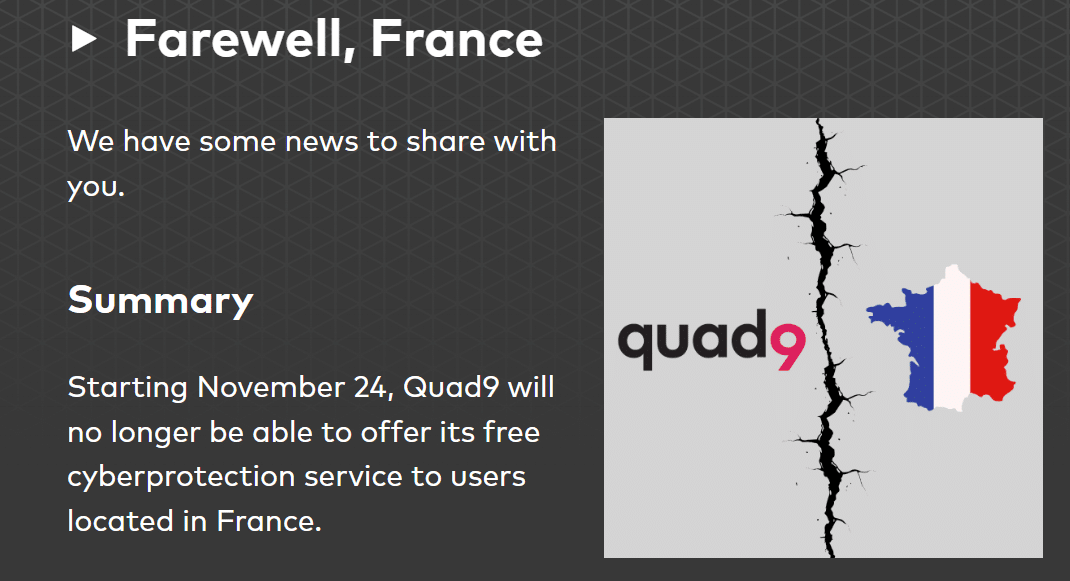
When the Paris Court delivered its final verdict on the matter, it did not rule in favor of the non-profit. Consequently, the foundation published a formal statement titled "Farewell, France," confirming the cessation of its recursive DNS services for the region starting November 24.

€1,000 a Day
Under the terms of the Paris court’s ruling, Quad9 was ordered to implement a May blocking mandate that has since expanded to encompass 58 distinct domain names. Failure to comply would trigger the €1,000 daily penalty. While this figure is a stark reduction from the €580,000 initially demanded by beIN Sports, it still represents a substantial financial burden for a non-profit entity.
beIN Sports had originally petitioned the court for €10,000 per day for every single domain that remained accessible through Quad9’s resolver. The court ultimately chose a blanket penalty of €1,000 per day in total, which was slated to run until the blocking measures officially ended on November 14. According to Quad9’s internal calculations, this specific penalty period totals €24,000, not including the foundation’s mounting independent legal costs.
Quad9 acknowledged that it is technically subject to these daily penalties because it explicitly refuses to block the disputed domains prior to the expiration of the order. In its written judgment, the court highlighted Quad9’s own admissions, noting that while the resolver is expected to make reasonable efforts to block infringing domain names, the organization elected to take no action whatsoever, citing deep-seated technical and philosophical reasons.
This outcome stands in sharp contrast to earlier rulings delivered this month and in September. In previous cases, the Paris court rejected beIN Sports’ penalty requests against Cloudflare and several commercial VPN providers. In those instances, the court deemed the providers’ actions to constitute a reasonable effort because they had successfully blocked at least a portion of the contested domains. Similarly, television broadcaster Canal+ previously lost a comparable penalty request against Cloudflare. Quad9, by contrast, stood firm on its policy and did not block a single domain, a fact it confirmed in formal statements submitted directly to the court.
Leaving France
For Quad9, the controversy has never been merely about monetary fines or legal fees. The foundation views recursive DNS resolution as a fundamentally neutral service that should not be manipulated or co-opted for local censorship mandates.
In its public statements, the foundation articulated its core philosophy, explaining that it categorically refuses to alter or misrepresent DNS responses in a manner that contradicts user expectations. Furthermore, the Swiss foundation pointed out a severe technical limitation: it cannot accurately restrict its blocking measures exclusively to French users. Because its public service is entirely free and requires no registration or user accounts, there is no reliable mechanism to determine whether a given query originates from inside or outside of France.
Applying the block globally would technically satisfy the demands of the French court, but Quad9 firmly refuses to impose a localized French judicial order onto internet users across the entire globe. As of writing, the exact logistical methods the foundation will use to stop serving French users have not been finalized, as leadership continues to evaluate various imperfect options.
Furthermore, the foundation argued that implementing a block would be largely ineffective at curbing piracy. Users determined to access the targeted sites can easily bypass the restrictions by switching to any of the thousands of other open, public DNS resolvers available on the internet. Comparing the measure to an exercise in futility, the organization remarked that it is akin to holding a piece of newspaper in front of a stadium full of people to block their view of a concert.
More Blocking Cases
The decision to withdraw from the French market extends far beyond the single legal battle initiated by beIN Sports. Quad9 emphasized that there are approximately 20 other similar blocking cases currently pending within the French legal system, and the foundation fully expects many of those proceedings to culminate in mounting regulatory pressure, extensive compliance demands, and additional financial penalties.
The foundation noted that its operational model simply cannot withstand the accumulation of fines stemming from dozens of pending cases, nor can it absorb the potential liabilities of future lawsuits mirroring the action brought by beIN Sports.
Quad9 is not the first public DNS resolver to abandon France over escalating piracy disputes. Earlier in 2024, OpenDNS similarly suspended its services in the country in response to a blocking order issued on behalf of Canal+.
Beyond the immediate administrative and financial pressures, Quad9’s departure is driven by a deep-seated matter of principle. The organization fears that legal precedents and blocking demands that appear measured or reasonable today will inevitably pave the way for a broader, unchecked expansion of digital censorship. Summarizing this broader apprehension, the foundation warned that once the infrastructure and tools of censorship are constructed, they are rarely deployed sparingly or justly.

An appeal regarding the underlying legal framework remains pending, and Quad9 has indicated that it will continue to challenge court-ordered DNS blocking where possible. In the meantime, French internet users relying on the service have until November 24 to transition their network configurations to an alternative DNS resolver.