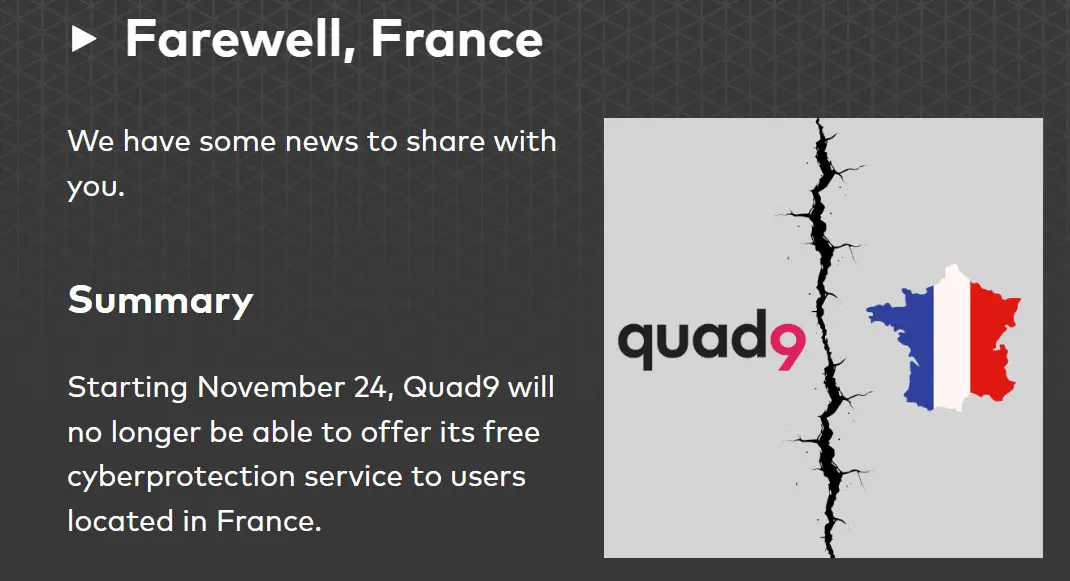
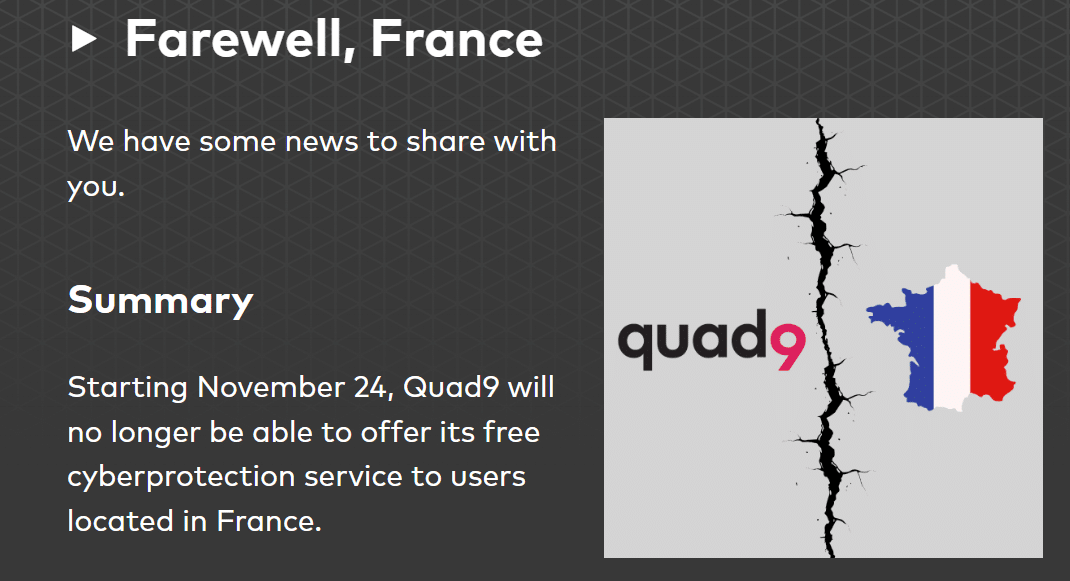
Public DNS resolver Quad9 has announced that it is officially pulling its services out of France, making it the second major global DNS provider to abandon the country in the face of aggressive court-ordered website blocking mandates. Beginning November 24, the Swiss non-profit foundation will completely stop serving users in France, a drastic measure triggered by a Paris court ruling that imposed a daily financial penalty for failing to block pirate tennis streams.
Faced with this adverse judicial order and approximately 20 other pending legal cases across the country, Quad9 leadership stated that they have been left with no other viable operational path. The escalation marks a significant escalation in the ongoing legal battles between rights holders, broadcasters, and neutral internet infrastructure providers over digital piracy and network-level censorship.
Earlier this month, Quad9 representatives informed industry publications that the foundation was actively weighing its future in France, which included the drastic option of exiting the market entirely. The Swiss non-profit foundation had found itself targeted by prominent sports broadcaster beIN Sports, which initially sought catastrophic penalties reaching up to €580,000 per day because Quad9 deliberately chose not to block access to specific pirate tennis streams.
When the Paris Court delivered its final verdict on the matter, it did not rule in favor of the DNS provider. As a direct consequence of the legal setback, the foundation formally announced its decision to withdraw its services from the French market entirely, summarizing its departure with a definitive farewell message to its users.
€1,000 a Day and the Burden of Non-Compliance
Under the terms of the recent ruling, the Paris court ordered Quad9 to implement a sweeping blocking order originally issued in May, which has since expanded to encompass 58 distinct domain names. The court warned that failure to comply would result in a penalty of €1,000 per day—an amount that, while significantly lower than the extreme figures demanded by the broadcaster, still poses a severe threat to a non-profit entity.

Legal representatives for beIN had originally petitioned the court for a penalty of €10,000 per day for every single domain name that remained accessible through Quad9’s resolver network. Instead, the court established a flat penalty rate of €1,000 per day in total. This penalty runs until the expiration of the blocking measures on November 14, a timeframe that Quad9 calculates will accumulate to roughly €24,000, excluding the foundation’s own mounting legal defense costs.
Quad9 acknowledged that it is now technically subject to these financial penalties because it steadfastly refuses to block the designated domains before the order concludes. In its written ruling, the court explicitly pointed to Quad9’s own public statements and legal filings. According to the judicial panel, the foundation was legally obligated to make reasonable efforts to block the contested domain names, yet it deliberately chose to take no blocking action whatsoever, citing core structural and philosophical reasons.
This outcome stands in stark contrast to earlier rulings handed down earlier this month, when the same Paris court rejected beIN’s requests for €10,000-per-day piracy blocking penalties against Cloudflare and several prominent virtual private network providers. In those instances, the court considered the defendants’ actions to have constituted a reasonable effort because they had implemented blocks on at least a portion of the contested domains.
Similarly, French media giant Canal+ lost a comparable penalty request directed against Cloudflare in September. Quad9, however, stands apart because it has consistently refused to block a single domain from the court-mandated lists, a position the foundation proudly and transparently confirmed in formal statements submitted directly to the court.
The Principle of Neutrality and the Impossibility of French-Only Filtering
For the leadership at Quad9, the controversy has never been purely about money or avoiding court fines. At its core, the dispute centers on the foundational philosophy of recursive DNS resolution as a neutral, foundational layer of the internet infrastructure that should remain untampered with by third-party political or commercial interests.
"We categorically refuse to alter or lie to you about the DNS responses you receive in a way that opposes your expectations," Quad9 wrote in a detailed public statement explaining its stance.
Furthermore, the Swiss foundation highlighted the technical impossibility of tailoring its services to comply with regional court orders without compromising its broader operational architecture. Because Quad9 operates a free, public service that requires no user registration or accounts, the organization maintains that it possesses no reliable, privacy-respecting mechanism to identify and segregate users who are physically located in France from the rest of its global user base.
While blocking the target domains globally across its entire network would theoretically satisfy the demands of the French court, the DNS resolver resolutely refuses to enforce local French judicial mandates upon internet users scattered across the rest of the world.
Regarding how the technical disconnection of French users will be executed, Quad9 noted that the exact methodology has not yet been finalized, as the foundation evaluates options that it considers to be universally imperfect. Moreover, the foundation argues that implementing such blocks would ultimately prove futile anyway, given the ubiquitous nature of technological workarounds on the modern internet. Users determined to reach the targeted sites can easily bypass DNS-level restrictions by simply switching to any of the thousands of other open and publicly available DNS resolvers operating globally.
"This is like holding a piece of newspaper in front of a stadium full of people to block the view of a concert," the foundation remarked, illustrating the superficial effectiveness of DNS blocking in the broader landscape of digital connectivity.
Piled-Up Cases and the Threat of Cumulative Penalties
The ultimate decision to withdraw from France was not born solely from the pressure exerted by the single legal battle with beIN Sports. Quad9 pointed out that there are currently roughly 20 other active blocking cases pending against it within the French legal system. The foundation realistically anticipates that these concurrent proceedings will inevitably result in a cascade of additional blocking demands, escalating legal pressure, and crippling financial fines.
"Quad9 cannot survive the accumulation of penalties yet to be assessed in 20 other pending cases, nor those of future cases similar to the one brought by beIN," the foundation noted in its assessment of the unsustainable legal environment.
Quad9 is not the pioneer public DNS resolver forced into this drastic corner by French jurisprudence. Earlier in 2024, OpenDNS similarly suspended its public recursive services in France after running afoul of a strict piracy-blocking order brought by Canal+.
Beyond the immediate administrative and financial hurdles, the conflict represents a deeper ideological fear for the non-profit organization. Leadership has repeatedly warned that legal precedents established today under the guise of combating digital piracy will inevitably expand into broader censorship mechanisms tomorrow.
"Once the tools of censorship are built, they are rarely used sparingly or justly," Quad9 cautioned.

While a formal legal appeal remains pending before higher courts, and Quad9 insists it will continue its long-term fight against mandatory court-ordered DNS blocking where feasible, the immediate reality for French internet consumers is stark. Users relying on the provider’s infrastructure have until November 24 to transition their device configurations to alternative DNS resolvers before service is fully terminated in the region.