Swiss non-profit foundation Quad9 is officially pulling its public DNS resolution services out of France, making it the second major DNS resolver to withdraw from the country in response to aggressive court-ordered piracy blocking mandates. The decision comes after a Paris court slapped the organization with a daily financial penalty for refusing to block domains associated with unauthorized tennis broadcasts.
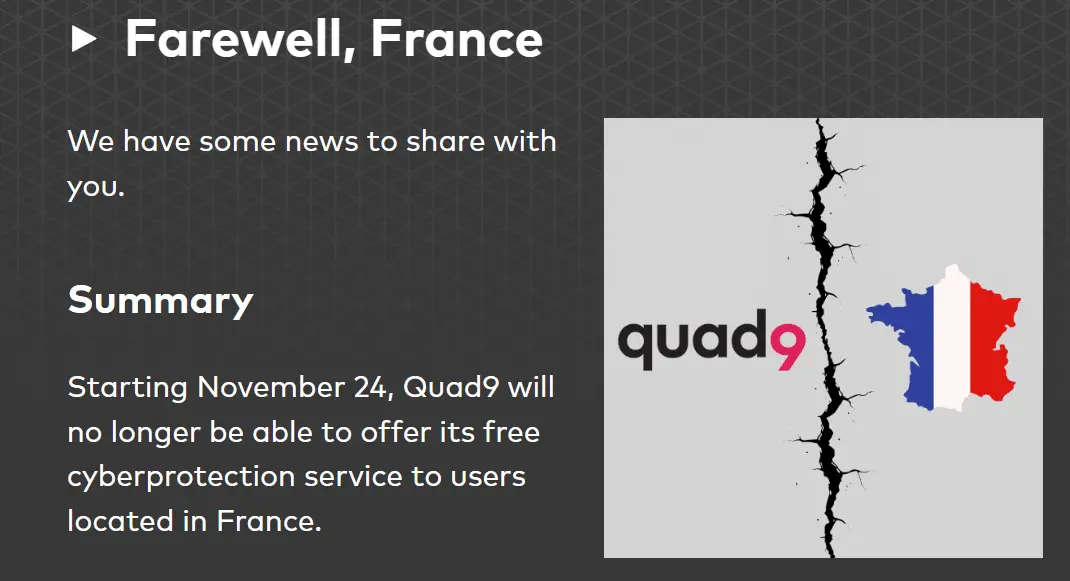
Quad9 will officially cease serving users in France on November 24. The move follows a high-stakes legal battle involving broadcaster beIN Sports, which had originally demanded astronomical daily fines over the resolver’s principled refusal to implement court-mandated website blocks. Facing this immediate financial sanction alongside roughly 20 other pending legal cases in French courts, the foundation concluded it had no other viable path forward while maintaining its core operational principles.
Earlier this month, representatives for Quad9 had already confirmed to TorrentFreak that the organization was actively weighing its future within French jurisdiction, which explicitly included a complete withdrawal from the country. The Swiss foundation found itself targeted by beIN Sports over its choice not to execute blocks against pirate tennis streams, leading to a legal showdown in the Paris Judicial Court.
€1,000 a Day in Fines
In its ruling, the Paris court ordered Quad9 to comply with a previous May blocking order that had since expanded to cover 58 distinct domain names. Failure to comply would trigger a penalty of €1,000 per day. While substantial, this figure was a significant reduction from what beIN Sports had initially requested. The broadcaster had asked the court to levy €10,000 per day for every single domain that remained accessible through Quad9’s infrastructure.

Instead, the court set a blanket penalty of €1,000 per day in total, running until the blocking measures were set to expire on November 14. Quad9 calculated that this period amounts to approximately €24,000 in direct penalties, a sum that excludes the foundation’s own mounting legal costs.
Quad9 openly acknowledged that it is now subject to these penalties because it fundamentally refuses to block the domains before the expiration of the order. In its official judgment, the court pointed directly to the statements submitted by Quad9 itself. The judicial reasoning noted that while Quad9 was legally required to make reasonable efforts to block the listed domain names, the organization elected to take no action whatsoever, citing distinct operational and philosophical reasons.
This outcome stands in stark contrast to earlier rulings delivered by the same Paris court involving other major internet infrastructure providers. Earlier this month, the court refused penalty requests brought by beIN Sports against Cloudflare and several prominent virtual private network (VPN) providers. In those instances, the companies had successfully blocked at least a portion of the contested domains, a measure the court deemed to constitute a reasonable effort under the law. Canal+ experienced a similar defeat in September when a separate penalty request against Cloudflare was dismissed.
Quad9, however, chose a completely different path. The foundation admitted in court documents that it had not blocked a single domain name specified in the orders.

Leaving France on Principle
For the Swiss foundation, the dispute has always transcended financial calculations. Quad9 views recursive DNS resolution as a strictly neutral infrastructure service that should remain untampered by localized censorship mandates.
"We categorically refuse to alter or lie to you about the DNS responses you receive in a way that opposes your expectations," Quad9 stated in its formal communication regarding the matter.
Furthermore, the non-profit foundation highlighted technical and operational hurdles that make targeted compliance nearly impossible. Because Quad9 provides a free public service that requires no user registration, account creation, or login, the organization maintains no reliable way to isolate and identify users based strictly within French borders.
While applying the court-ordered blocks globally to all internet users worldwide would technically satisfy the demands of the French court, the DNS resolver firmly refuses to subject global internet users to localized French judicial edicts.
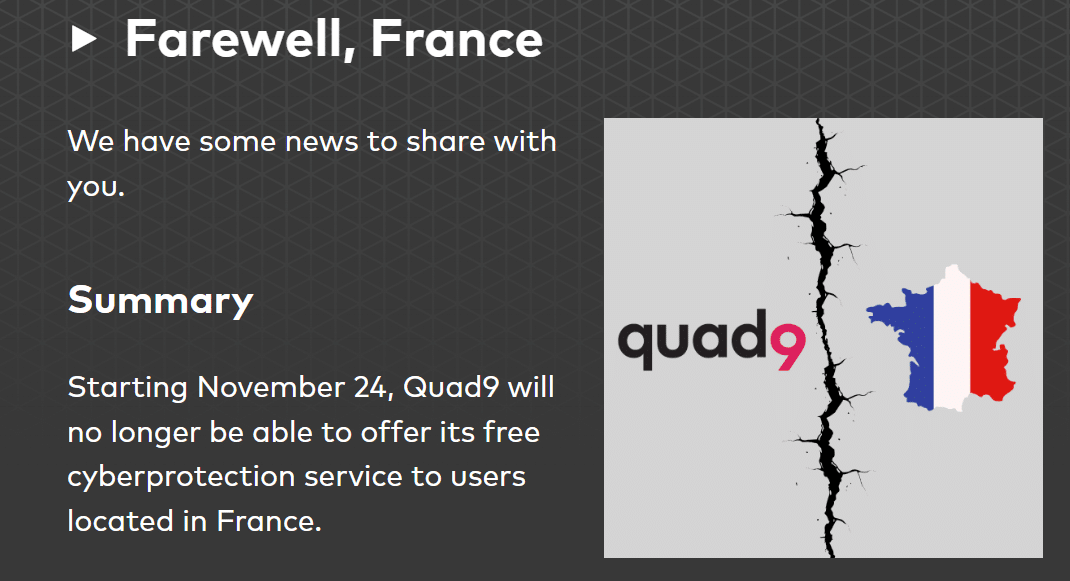
Quad9 is still evaluating the precise technical mechanisms it will use to stop serving French users, noting that all available options carry significant flaws. The foundation has also argued that DNS-level blocking is largely ineffective as an anti-piracy measure. Users seeking access to unauthorized streams can easily bypass the restrictions by switching to any of the thousands of other open public DNS resolvers available globally.
"This is like holding a piece of newspaper in front of a stadium full of people to block the view of a concert," the foundation remarked, illustrating the futility of targeted DNS interference.
Growing Legal Pressure and Additional Blocking Cases
The decision to withdraw from the French market was not triggered by the beIN Sports case alone. Quad9 pointed to approximately 20 other blocking lawsuits currently pending in French courts, anticipating that these ongoing proceedings would inevitably result in heightened blocking pressure and increasingly severe financial penalties.
"Quad9 cannot survive the accumulation of penalties yet to be assessed in 20 other pending cases, nor those of future cases similar to the one brought by beIN," the organization explained.

Quad9 is not alone in taking this drastic step. In 2024, OpenDNS similarly suspended its public resolver services in France following a Canal+ piracy blocking order.
Beyond practical survival, Quad9 frames its departure as a defense of broader digital rights. The foundation harbors deep concerns that temporary or seemingly reasonable blocking demands will inevitably expand into a broader culture of systemic internet censorship.
"Once the tools of censorship are built, they are rarely used sparingly or justly," Quad9 warned.
Although an appeal regarding the underlying legal framework remains pending, and the foundation vows to continue fighting court-ordered DNS blocking where feasible, French internet users now face a strict deadline. They have until November 24 to transition their network settings to an alternative DNS resolver before Quad9 officially departs the region.