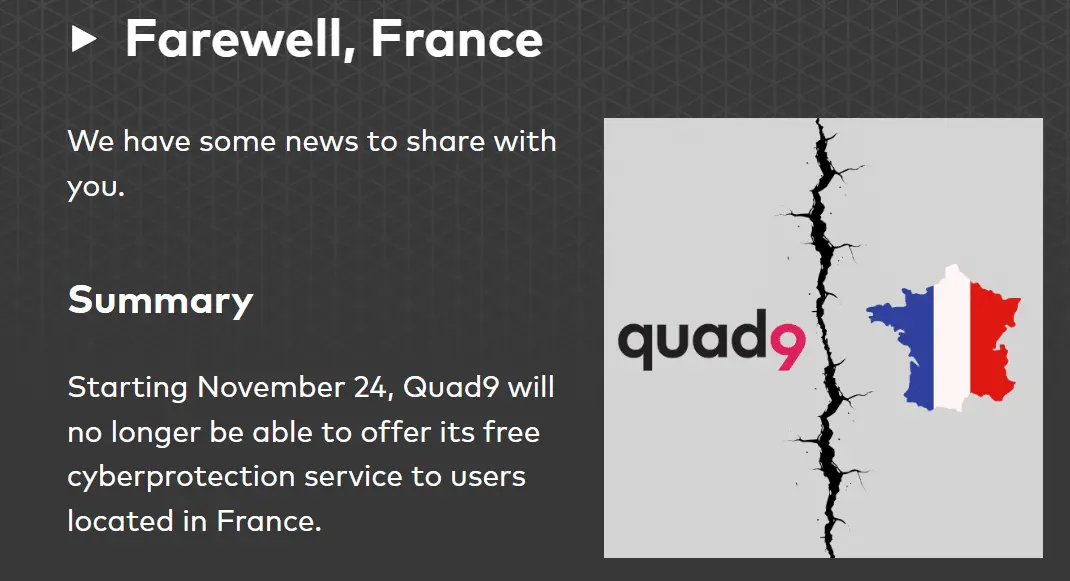
Public DNS resolver Quad9 has announced that it will completely terminate its services for users in France, becoming the second major public Domain Name System provider to exit the country over escalating legal battles concerning pirate site blocking orders. The Swiss non-profit foundation confirmed that it will stop serving French internet users on November 24, following a decisive ruling by the Paris Judicial Court that imposed a daily financial penalty for failing to block unauthorized tennis streams. Faced with this immediate ruling and approximately 20 other pending legal cases across French courts, Quad9 stated that it was left with no other viable path forward without compromising its core operational principles.
The controversy began earlier this month when representatives from Quad9 informed digital rights and legal news outlets that the foundation was actively evaluating its long-term future in France, including the possibility of withdrawing its services entirely. The dispute centered on a legal request initiated by sports broadcaster beIN Sports, which originally sought severe financial penalties of up to €580,000 per day because Quad9 had declined to implement court-ordered blocks against a series of domains streaming pirate tennis content.
The Paris Court subsequently delivered its verdict on the matter, siding with the broadcaster and ruling against the non-profit foundation. As a direct consequence of the legal pressure, Quad9 declared its decision to pull out of the French market, bidding a formal farewell to its users in the region under the banner of its official withdrawal statement.
€1,000 a Day
Under the terms of the Paris court ruling, Quad9 was ordered to implement a blocking directive originally issued in May, which had since expanded to encompass 58 distinct domain names. Failure to comply would trigger a penalty of €1,000 per day—an amount significantly lower than the €580,000 daily penalty originally requested by beIN Sports.

The broadcaster had initially petitioned the court for €10,000 per day for every single domain that remained accessible through the Quad9 resolver. Instead, the court established a cumulative penalty of €1,000 per day in total. This penalty period was structured to run until the conclusion of the specific blocking measures on November 14. According to Quad9’s internal calculations, this accumulated to roughly €24,000 in total financial penalties, a figure that does not account for the foundation’s independent legal expenses.
Acknowledging the reality of the verdict, Quad9 noted that it understood it was legally subject to the penalty because it intentionally chose not to block the targeted domains prior to the expiration of the court’s deadline. In its written judgment, the court specifically highlighted Quad9’s own public statements and submissions during the proceedings. The judicial panel asserted that under the law, the resolver was obligated to make reasonable efforts to block the specified domain names, yet the foundation deliberately opted to take no action whatsoever based on technical and philosophical reasons it had previously outlined.
This outcome stood in stark contrast to earlier legal decisions rendered earlier in the month, wherein the Paris court refused to grant beIN Sports’ requests for €10,000-per-day piracy blocking penalties against Cloudflare and several virtual private network providers. In those instances, the court determined that because those companies had successfully blocked at least a portion of the disputed domains, their actions constituted a reasonable effort under the law.
A similar outcome occurred in September when media giant Canal+ lost a comparable penalty request directed against Cloudflare regarding its 1.1.1.1 public resolver. Quad9, however, stood apart by confirming in its official court submissions that it had not blocked a single domain on the list.
Leaving France
For the leadership at Quad9, the controversy was never merely a financial dispute over potential fines. The foundation views recursive DNS resolution as a fundamentally neutral utility that should not be manipulated or co-opted to alter internet traffic routing.
In a public statement addressing the situation, the organization emphasized its steadfast technical stance: "We categorically refuse to alter or lie to you about the DNS responses you receive in a way that opposes your expectations."
Furthermore, the Swiss foundation highlighted the technical impossibility of restricting its filtering measures exclusively to French internet users. Because its public resolver service is entirely free and operates without requiring user registration or account creation, there is no reliable, privacy-respecting mechanism to accurately determine the geographic location of every user querying the system.
While applying the blocking measures globally for all internet users worldwide would technically satisfy the demands of the French court, Quad9 firmly refused to impose the mandates of a single national jurisdiction onto international users across the globe.
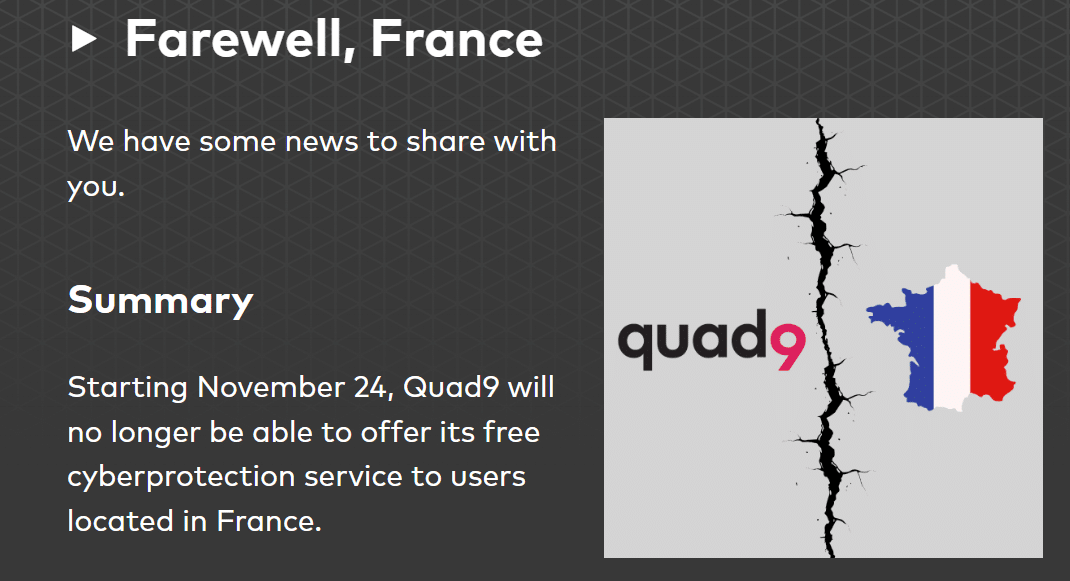
Regarding the mechanics of its withdrawal, Quad9 indicated that the exact technical steps for terminating service to French users had not yet been fully finalized, as the foundation continued to evaluate its remaining options, all of which it regards as imperfect. Moreover, the foundation argued that implementing local blocking would yield little practical benefit in curbing copyright infringement, given that internet users seeking access to pirate websites can easily bypass the restrictions by switching to any of the thousands of alternative open DNS resolvers available online.
Characterizing the efficacy of the measure, the foundation compared the mandate to holding a small piece of newspaper in front of a stadium full of people to block their view of a concert.
More Blocking Cases
The ultimate decision to withdraw from the French market extended far beyond the immediate fallout of the beIN Sports lawsuit. Quad9 pointed out that there are roughly 20 additional blocking cases currently pending against the resolver in various French courts, and the foundation anticipates that these proceedings would inevitably result in mounting regulatory pressure, extensive litigation expenses, and a cascading accumulation of heavy fines.
Summarizing the untenable financial and operational outlook, the foundation noted that it simply cannot survive the accumulation of penalties yet to be assessed across the twenty pending cases, nor could it weather the financial burden of future legal challenges mirroring the one brought forward by beIN Sports.

Quad9 is not the first major public DNS service provider to take such drastic action in response to France’s aggressive judicial stance on online piracy. Earlier in 2024, OpenDNS similarly suspended its public resolution services within France after facing a comparable piracy blocking order issued in connection with Canal+.
Beyond the immediate administrative and financial hurdles, the departure is framed by the foundation as a matter of vital principle. Quad9 leaders have expressed deep concern that censorship mechanisms and blocking demands that appear measured or reasonable today could eventually pave the way for a sweeping, unchecked expansion of digital restrictions in the future. As the foundation noted in its commentary on the broader implications, once the tools of internet censorship are constructed and legitimized, they are rarely deployed sparingly or justly.
An official legal appeal against the underlying rulings remains pending, and Quad9 has indicated that it intends to continue fighting court-ordered DNS blocking in higher legal venues. In the meantime, internet users in France have until November 24 to transition their network configurations to an alternative DNS resolver before the service termination takes full effect.