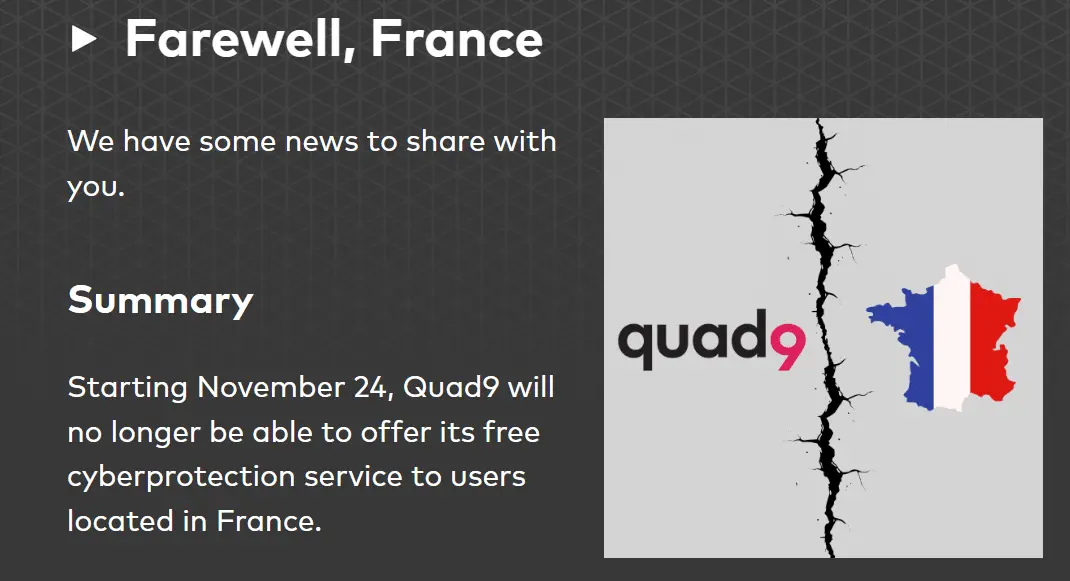
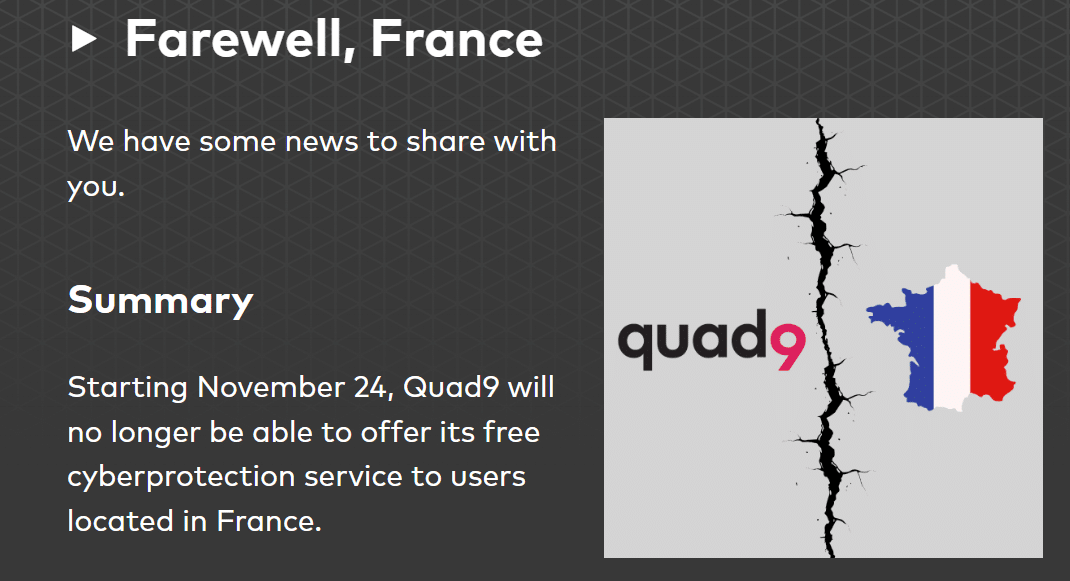
Public DNS resolver Quad9 has announced that it will completely withdraw its services from France following a legal defeat in a Paris court. The Swiss non-profit foundation stated that it will stop serving French users on November 24 after a judicial ruling imposed a daily financial penalty for its refusal to block unauthorized streams of tennis matches.
The exit marks a significant escalation in the ongoing legal battles between copyright holders and neutral internet infrastructure providers in Europe. Quad9 is now the second major public DNS resolver to abandon the French market due to mandatory website-blocking orders, following OpenDNS, which suspended its operations in the country earlier in 2024 following a similar dispute with media conglomerate Canal+.
Faced with a mounting wave of legal challenges and the prospect of compounding financial liabilities, Quad9 leadership concluded that continuing operations in France is no longer viable. The foundation has approximately 20 other pending blocking cases in French courts, creating an existential threat to its non-profit business model.
€1,000 a Day Penalty Set by Paris Court
The immediate catalyst for the departure was a ruling handed down by the Paris Judicial Court. The legal confrontation began when sports broadcaster beIN Sports requested aggressive financial penalties against Quad9, arguing that the resolver should be punished for failing to comply with a May court order requiring the blocking of pirate domains broadcasting tennis content.

Initially, beIN Sports sought penalties of up to €580,000 per day, proposing a fine of €10,000 per day for every individual domain name that remained accessible through Quad9’s recursive DNS service. While the court did not grant the maximum amount requested by the broadcaster, it ruled against the Swiss foundation.
The Paris court ordered Quad9 to implement the blocking measures for a list that has since expanded to 58 domain names, or else face a daily penalty of €1,000. This fine applies to the total set of domains rather than per individual site. According to Quad9’s internal calculations, the penalty period running until the blocking measures end on November 14 amounts to €24,000, excluding the foundation’s own mounting legal expenses.
In its written judgment, the court emphasized Quad9’s own admissions. The judicial authorities pointed out that while providers are expected to make reasonable efforts to block infringing domain names, Quad9 explicitly chose to take no action at all, resting its defense on the neutral nature of its service and technical limitations.
This outcome stands in sharp contrast to recent rulings involving other infrastructure providers. Earlier in the month, the same Paris court rejected penalty requests brought by beIN Sports against Cloudflare and several virtual private network (VPN) providers. In those cases, the court determined that because those companies had successfully blocked at least some of the targeted domains, they had demonstrated a reasonable effort to comply. A similar penalty request brought by Canal+ against Cloudflare met the same fate in September.
Quad9, however, confirmed in its court submissions that it had not blocked a single domain on the list, sealing its fate under the strict interpretations of the French judiciary.
Core Principles and Technical Hurdles
For the leadership at Quad9, the dispute transcends financial figures. The organization operates on the fundamental principle that recursive DNS resolution is a neutral utility that should not be manipulated or co-opted for censorship or targeted content filtering.
In a public statement regarding the decision, the foundation articulated its core philosophy, stating that it categorically refuses to alter or misrepresent DNS responses in a manner that contradicts user expectations. Beyond matters of principle, the foundation highlighted practical technical barriers that prevent it from complying with localized court orders in a targeted manner.
Quad9 operates a free public service that does not require user registration, login credentials, or account creation. Because of this privacy-focused architecture, the resolver maintains no telemetry or tracking data that would allow it to reliably identify and isolate users physically located in France from the rest of its global user base.
While the Paris court order could theoretically be satisfied if Quad9 instituted a global block on the domains for all users worldwide, the foundation firmly rejected this approach. The organization argued that it has no mandate or desire to enforce a French court order on internet users across the globe.
Furthermore, Quad9 questioned the overall effectiveness of DNS blocking as an anti-piracy measure. The foundation noted that internet users seeking to circumvent such blocks can easily bypass them by switching to any of the thousands of other open and public DNS resolvers operating globally. Comparing the mandate to an exercise in futility, the foundation likened the blocking order to holding a small piece of newspaper in front of a stadium crowd to obstruct the view of a concert.
Piled-Up Cases and the Threat of Insolvency
While the immediate penalty from the beIN Sports case represents a manageable financial hit, the broader legal landscape in France proved insurmountable for the non-profit organization. Quad9 revealed that it is currently named as a defendant in approximately 20 other pending blocking cases across French courts. The foundation anticipates that these active lawsuits would result in a cumulative wave of blocking pressure and subsequent financial penalties that would quickly overwhelm its operational budget.
Quad9 explicitly stated that the organization cannot survive the accumulation of penalties yet to be assessed across those 20 pending cases, nor can it absorb the costs of future lawsuits mirroring the action brought by beIN Sports.

The departure of Quad9 follows a precedent set earlier this year when OpenDNS suspended its services in France following a similar Canal+ piracy blocking order. For Quad9, the decision is also framed as a warning about the slippery slope of internet regulation. The foundation has repeatedly expressed deep concern that judicial mechanisms initially established for specific copyright enforcement cases will inevitably expand into a broader apparatus of systemic internet censorship.
Reflecting on this broader philosophy, the foundation warned that once tools of censorship are constructed and legitimized, they are rarely deployed sparingly or justly.
Although an appeal regarding the underlying legal framework remains pending, and Quad9 maintains that it will continue to fight court-ordered DNS blocking in higher judicial forums, its immediate physical presence in the French market is coming to an end. French internet users who currently rely on the service have until November 24 to transition their network configurations to an alternative DNS resolver before service is officially terminated.