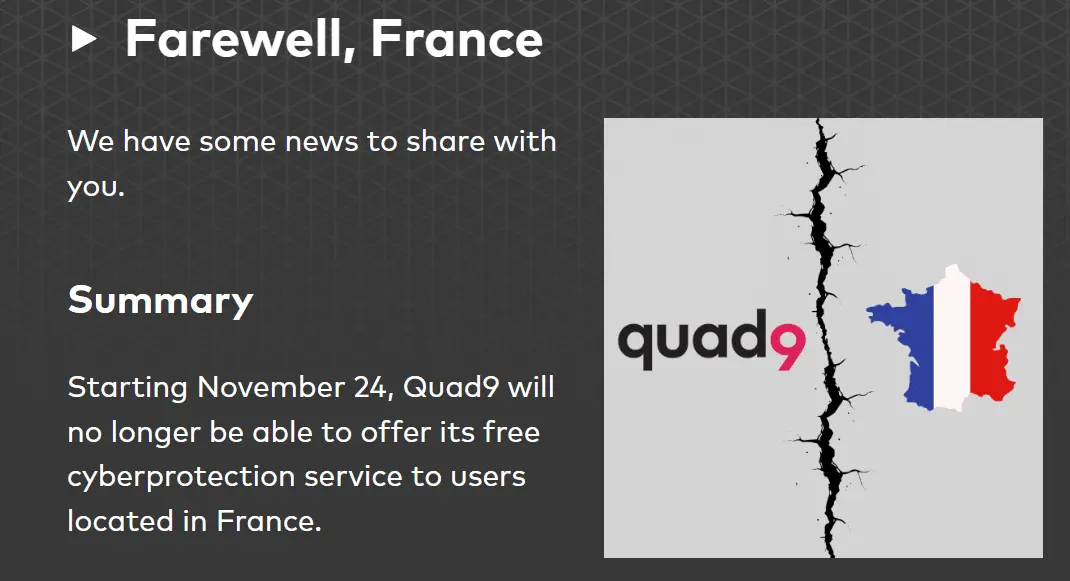
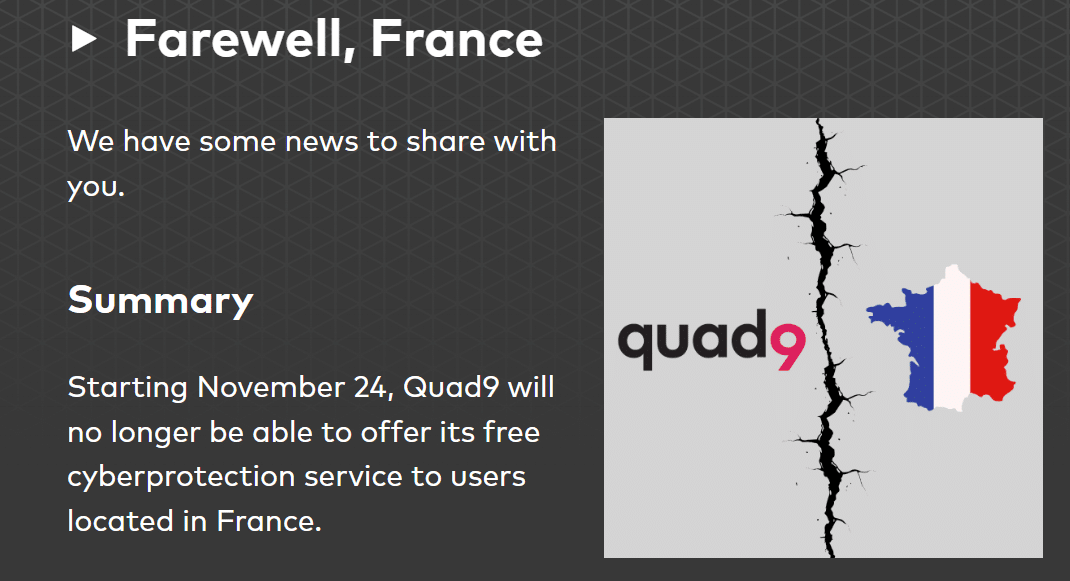
Public DNS resolver Quad9 has announced that it is officially withdrawing its services from France, becoming the second major DNS provider to abandon the country in response to aggressive site-blocking mandates. The Swiss non-profit foundation confirmed that it will completely stop serving French internet users on November 24, following a decisive ruling by the Paris Judicial Court that imposed daily financial penalties for failing to block unauthorized tennis streams.
Faced with this mounting legal pressure alongside approximately 20 other pending cases across French courts, Quad9 leadership stated that the organization had no other viable path forward. The decision marks a significant escalation in the ongoing battle between copyright holders, regional courts, and neutral internet infrastructure providers over how far intermediary services must go to police online piracy.
The Paris Court Ruling and Daily Penalties
Earlier this month, representatives from Quad9 informed investigative technology media that the foundation was actively evaluating its future viability in France. The Swiss non-profit had found itself locked in a high-stakes legal dispute initiated by sports broadcaster beIN Sports, which sought staggering financial penalties of up to €580,000 per day because Quad9 refused to implement court-mandated blocks against pirate tennis streams.
The Paris Court ultimately delivered its verdict, ruling firmly against the DNS resolver. While the judges opted not to grant the exorbitant daily fines requested by beIN Sports, they still established a substantial penalty structure. The court ordered Quad9 to enforce an existing May blocking order—which has since expanded to encompass 58 distinct domain names—or else face a daily fine of €1,000.

BeIN Sports had initially petitioned the court for a penalty of €10,000 per day for each individual domain that remained accessible through Quad9’s recursive resolvers. Instead, the court consolidated the penalty to a flat €1,000 per day in total. This assessment runs until the conclusion of the specific blocking measures on November 14, which Quad9 calculated to total roughly €24,000, excluding the organization’s independent legal defense expenses.
In its written opinion, the court highlighted Quad9’s own admissions during proceedings. The judicial panel noted that while the law requires service providers to make reasonable efforts to block infringing domain names, Quad9 deliberately chose to take zero action based on policy objections it had previously detailed to the court.
This outcome contrasted sharply with earlier legal decisions handed down earlier in the month, when the same Paris court rejected beIN Sports’ penalty requests directed against Cloudflare and several commercial virtual private network providers. In those instances, the court considered the defendants’ actions—such as blocking at least a portion of the targeted domains—to constitute a "reasonable effort." A similar penalty request brought by Canal+ against Cloudflare met a comparable fate in September, with Cloudflare managing to escape fines. Quad9, by contrast, remained resolute in its refusal to block a single domain, a stance it explicitly confirmed in submissions to the bench.
The Principle of Neutrality and Technical Limitations
For Quad9, the conflict has consistently transcended financial considerations. The non-profit foundation views recursive DNS resolution as a fundamentally neutral utility layer of the internet that should remain untampered with.
In a public statement regarding the exit, Quad9 articulated its core philosophy, explaining that the organization categorically refuses to alter or misrepresent the Domain Name System responses received by users in a manner that contradicts their expectations.
Furthermore, the Swiss foundation highlighted the profound technical hurdles of complying with localized judicial orders on a global service architecture. Because Quad9 operates a free public service that requires no user registration or account creation, the organization maintains that it possesses no reliable, privacy-respecting mechanism to accurately identify and isolate users physically located inside France.
While applying the court-mandated blocks globally across its entire infrastructure would technically satisfy the demands of the French court, the DNS resolver adamantly refuses to enforce a localized French judicial order upon internet users across the rest of the world.
Quad9 leadership noted that even if a technical workaround were implemented, website-blocking measures of this nature offer limited practical utility in combating piracy. Internet users seeking to access unauthorized streaming sites can effortlessly bypass DNS-level blocks by simply switching to one of the thousands of alternative open resolvers available globally. Characterizing the enforcement mechanism vividly, the foundation compared the mandate to holding a single piece of newspaper in front of a packed stadium to obscure the view of a live concert.
Accumulating Legal Pressure Across Multiple Cases
The decision to shutter operations in France was not triggered by the beIN Sports dispute alone. Quad9 revealed that it is currently defending itself against approximately 20 separate blocking cases pending across the French legal system. The foundation anticipates that these concurrent proceedings will inevitably result in mounting regulatory pressure, additional court orders, and compounding financial penalties that threaten its organizational survival.
In a formal statement addressing the broader litigation landscape, the foundation emphasized that Quad9 cannot financially survive the accumulation of penalties yet to be assessed across the remaining 20 pending cases, nor can it absorb the liabilities of future actions modeled after the litigation brought by beIN Sports.
Quad9 is not the lone public resolver to take such drastic action in response to France’s aggressive enforcement framework. Earlier in 2024, OpenDNS similarly suspended its services in France following a comparable piracy-blocking order issued in connection with broadcaster Canal+.
Beyond logistics and operational costs, the withdrawal is deeply rooted in principle. The foundation has frequently expressed concern that censorship tools and blocking mechanisms introduced under the justification of copyright enforcement are rarely applied with restraint or proportionality once established.

Although an appeal regarding the underlying legal framework remains pending, and Quad9 has pledged to continue fighting court-ordered DNS blocking where feasible, the immediate reality for French internet users is stark. Users currently relying on Quad9’s infrastructure have until November 24 to transition their device or network settings to an alternative DNS resolver before service is officially terminated.