The openEuler open-source operating system community has rolled out a pair of significant updates, headlined by the long-term support service pack openEuler 24.03 LTS SP4 and the short-term innovation release openEuler 26.09. These updates arrive as the project continues to evolve its offerings across enterprise data centers, cloud infrastructure, and localized developer workstations.
While much of the foundational architecture in the openEuler ecosystem addresses massive-scale SuperPoD deployments, specialized AI hardware accelerators, and confidential computing environments, these latest iterations also introduce substantial enhancements tailored for everyday developers and personal computing hardware. Testing these distributions in virtualized environments like GNOME Boxes reveals a clear focus on modernizing developer tools, streamlining package management, and integrating robust artificial intelligence capabilities directly into the core operating system.
LTS, Service Packs, and Innovation Releases
The openEuler project maintains two distinct release methodologies to cater to contrasting enterprise and innovation requirements: long-term support (LTS) tracks and short-term innovation releases. The mature 24.03 LTS series continues to receive extensive feature updates through sequential service packs, with the community anticipating the next major LTS baseline around 2028.

Unlike traditional service packs in legacy operating systems that primarily compile cumulative security patches and bug fixes, openEuler service packs function as genuine feature releases. They actively introduce new capabilities and optimizations into an established enterprise base.
Conversely, innovation releases mirror the fast-paced development cycles seen in distributions like Ubuntu, delivering cutting-edge technologies and newer upstream software on a compressed support timeline. openEuler 26.09, for instance, is designated as a short-term innovation release backed by support through March 2027, serving as a proving ground for next-generation developer tools and kernel innovations.
What’s New in openEuler 24.03 LTS SP4
The 24.03 LTS SP4 update remains anchored to the robust Linux 6.6 kernel, but openEuler developers have maintained a rigorous backporting schedule to integrate critical upstream features into the stable enterprise foundation.

AI-Assisted Diagnosis and System Tuning
Among the most impactful additions for everyday users and administrators in SP4 is the refined suite of AI-assisted diagnostic and performance tuning tools. The infrastructure relies on an Intelligent Diagnosis Agent that works in tandem with a Known Issue Analysis Agent to detect anomalies, pinpoint root causes, and recommend actionable remediation steps.
Concurrently, the system tuning subsystem systematically collects performance metrics, identifies hardware or software bottlenecks, and offers automated optimization advice, theoretically reducing the time engineers spend parsing raw diagnostic outputs from traditional utilities like top and perf.
These artificial intelligence features are delivered through the native Witty framework, which is readily accessible via the distribution’s package repositories under the witty package name. Administrators can launch the interactive interface using the witty command or through opencode, allowing them to converse with the diagnostic and tuning agents using natural language prompts.
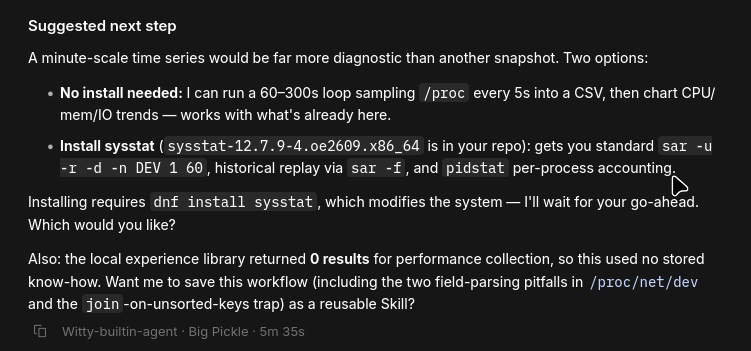
Unlike early iterations such as the EulerCopilot experience, which maintained tight coupling with regional cloud AI services, Witty offers broadened deployment flexibility by supporting both local AI models and a variety of OpenAI-compatible APIs. Furthermore, the inclusion of a lightweight Agent sandbox provides a secure, isolated environment for executing code and tool calls generated by autonomous AI agents, addressing modern security concerns surrounding shell access permissions.
Kernel Changes and Low-Level Optimizations
Beneath the user interface, SP4 introduces profound kernel-level changes designed to improve performance and flexibility. The most prominent inclusion is sched_ext, the innovative eBPF-based scheduler framework that originated upstream in the Linux 6.12 kernel. This framework permits system administrators to load and test custom CPU scheduling algorithms dynamically at runtime without requiring a kernel recompilation. If a custom scheduler encounters issues or misbehaves, the kernel safely falls back to its default scheduling mechanism.
Additional low-level improvements involve the Filesystem in Userspace (FUSE) subsystem, which can now communicate directly with the kernel utilizing the high-performance io_uring interface, substantially boosting data throughput for tools like sshfs. Developers will also find a new programmable page cache mechanism that empowers applications to define custom file caching policies, an optimization specifically engineered to accelerate the loading times of large AI models that are traditionally constrained by disk input-output limitations. Meanwhile, ARM architecture users gain the option to select a 64K page-size kernel during initial installation, though the standard 4K kernel remains the default configuration.
Enterprise Infrastructure and Security
The remainder of the SP4 release targets high-performance computing, cloud service providers, and data centers. These enterprise-grade features include Neural Processing Unit (NPU) compute slicing, accelerated recovery mechanisms for artificial intelligence inference containers, specialized networking and reliability enhancements for SuperPoD architectures, and expanded confidential computing support for Arm CCA, TaiShan, and Hygon platforms. Additionally, openEuler’s custom compiler toolchains, including LLVM, Go, and the BiSheng JDK, have been updated to the latest stable versions.
What’s New in openEuler 26.09
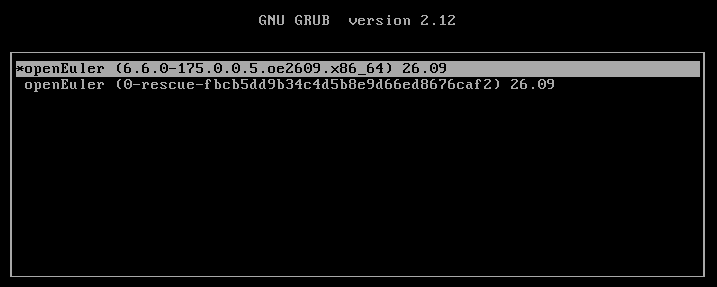
The openEuler 26.09 innovation release adopts a dual-kernel strategy, shipping with the Linux 6.6 kernel for traditional server deployments alongside the modern Linux 6.18 kernel for DevStation, the project’s specialized developer desktop edition. The DevStation environment houses the vast majority of user-facing changes and desktop-centric innovations.
A Modern Installer and User-Space Package Manager
DevStation debuts a streamlined operating system installer known as "heolleo." Built upon a SquashFS image architecture, the new installer facilitates robust offline installations directly from a local ISO image.

More consequential for developer workflows, however, is the introduction of epkg, a dedicated user-space package manager. Designed to operate entirely within a user’s home directory without modifying core system packages, epkg allows developers to maintain isolated software environments for distinct projects. By supporting multiple software repositories and isolated dependency trees, the tool offers functionality comparable to package environments found in platforms like Conda or Nix.
PolyMind and AI Agent Ecosystem Integration
DevStation deeply integrates artificial intelligence into the desktop experience by bundling PolyMind, a self-hosted platform dedicated to managing AI chat interfaces, automated agent workflows, and multiple model backends. PolyMind communicates seamlessly with Model Context Protocol (MCP) services and various autonomous agents through its background agentd service.
To support this expanding ecosystem, openEuler introduced SkillHub, a centralized repository designed for discovering, installing, and sharing specialized AI agent skills. To mitigate security risks, each skill undergoes an automated security assessment before publication, giving users transparent visibility into potential vulnerabilities, though the project notes these checks serve as risk assessments rather than absolute safety guarantees.

Security governance is further bolstered by AgentCensor, a monitoring layer that intercedes between autonomous AI agents and the host operating system. AgentCensor logs all tool invocations, file modifications, and system calls, granting users granular control to approve, block, or review agent actions before execution. Complementing this is SCCS, a subsystem designed to optimize token usage in long-running AI interactions by replacing bulky tool outputs within the context window with concise references, retrieving full payloads only when explicitly required. Additional optimizations like ram-a-kv, MemFabric, and ModelFS focus heavily on maximizing the efficiency of backend AI inference servers, with ModelFS utilizing the programmable page-cache framework to accelerate model startup times while maintaining compatibility with legacy applications.
Availability and Community Context
Both openEuler 24.03 LTS SP4 and openEuler 26.09 are available for download through the project’s official website, with tailored ISO images provided for server architectures, embedded devices, and developer workstations. For users seeking to evaluate the latest desktop advancements and integrated artificial intelligence tooling, the DevStation edition provides the most comprehensive experience.