

For many open-source projects, survival relies on a delicate ecosystem of goodwill, voluntary labor, and quiet institutional backing. While developers frequently donate countless hours of uncompensated labor to write code, review patches, and maintain repositories, software cannot run on code alone. Behind every major distribution, package manager, and update service sits a robust layer of physical hardware, network connectivity, and hosting infrastructure. These foundational needs rarely capture the spotlight, yet they remain absolute prerequisites for any project hoping to scale, remain secure, and serve a global user base.
Gentoo, the prominent source-based Linux distribution built around the Portage package manager, is currently navigating the realities of this heavy reliance on outside support. Operating largely on sponsored infrastructure because it can only independently manage a small handful of vital machines, the distribution has suffered a significant setback. Several long-standing infrastructure sponsors that have backed Gentoo through the years have recently decided to halt their contributions. Faced with this sudden reduction in support, the project has issued a formal call to action, seeking new infrastructure sponsors to step forward and help sustain its operations.
The Vital Role of Sponsorship in Independent Linux Distributions
The modern open-source landscape depends heavily on partnerships between volunteer-driven communities and organizations willing to donate resources. Gentoo’s infrastructure page historically highlights notable industry names such as Oregon State University’s Open Source Lab, CDN77, HP, and Hetzner, though these rosters may not yet fully reflect the recent departures. These entities have traditionally provided the computational muscle required to compile packages, host mirrors, maintain developer toolchains, and keep the core distribution accessible to users worldwide.

When key sponsors withdraw their support, the impact on a source-based distribution is immediate and acute. Unlike binary distributions that distribute pre-compiled packages, Gentoo’s infrastructure must handle heavy computational and bandwidth demands as users fetch source tarballs and build software locally. Maintaining continuous uptime for mirrors, version control systems, and communication channels requires stable physical and virtual environments. Without reliable replacements for the lost hosting arrangements, the project risks operational bottlenecks that can slow down development cycles and affect end users.
To address these shortages, Gentoo has outlined several specific avenues through which organizations and individuals can contribute. Detailed on the project’s sponsorship wiki page, the appeal prioritizes potential supporters whose ethos aligns with Gentoo’s foundational vision: software that respects user choice, maintains transparency, and remains open to community-driven adaptation.
Five Pathways for Infrastructure Support
The project has categorized its current requirements into five distinct types of contributions, designed to accommodate varying levels of resources that potential sponsors might offer.

The first approach involves accepting donated physical machines for Gentoo’s designated hosting locations within the United States. The requirements are pragmatic rather than bleeding-edge; the project is not asking for high-end enterprise hardware, but rather equipment capable of reliably handling modern server-focused workloads.
The second and perhaps most urgent need centers on colocation, a form of physical hosting where a sponsor provides rack space, electrical power, and network connectivity, while Gentoo supplies the necessary hardware to populate the rack. At present, the distribution expresses an urgent need for colocation capacity outside the United States, though domestic offers are welcomed as well.
For organizations leaning toward cloud-based architectures, the third option involves providing virtual machines. Gentoo has specified a minimum threshold of two virtual CPUs, four gigabytes of RAM, and twenty-five gigabytes of storage per instance. While the project notes a gradual shift toward cloud infrastructure where appropriate, many of its core services remain monolithic in design, meaning that container orchestration frameworks like Kubernetes do not always fit their operational workflow.
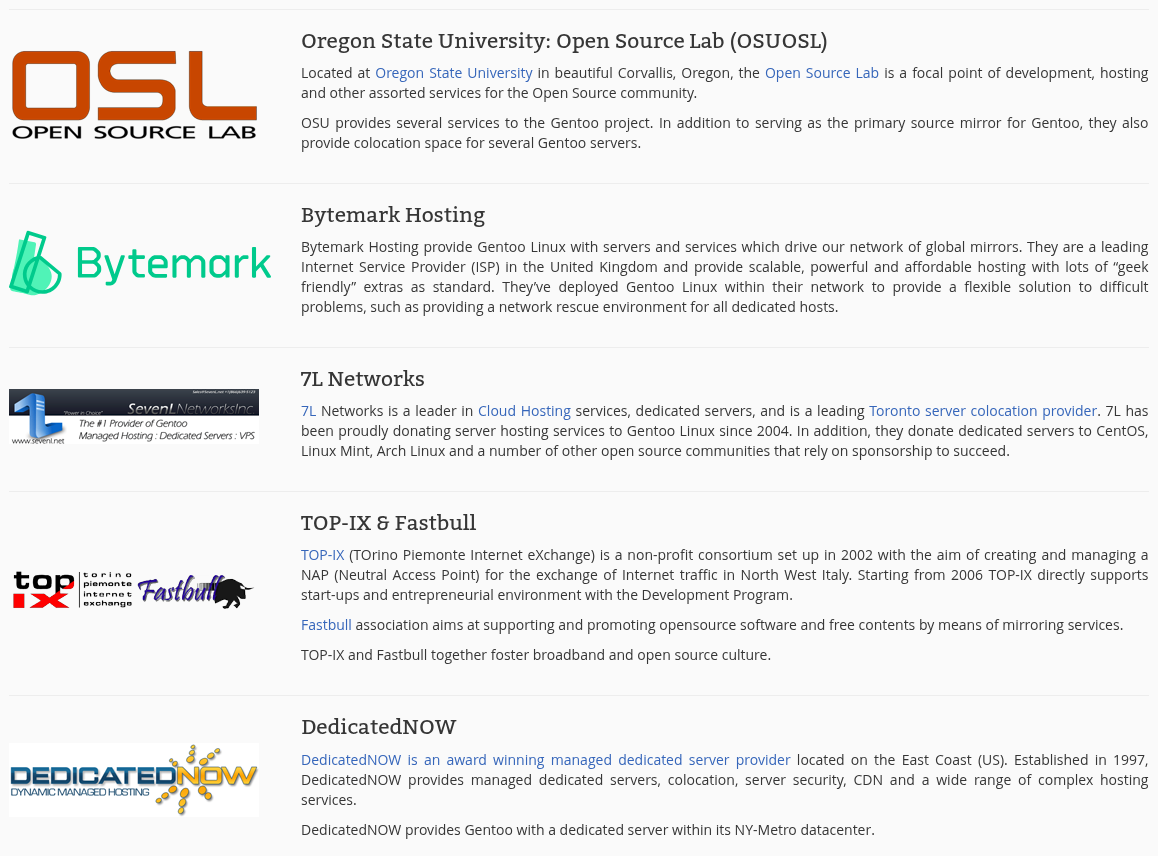
The fourth avenue centers on full-package hosted physical servers. The wiki highlights options such as dedicated root servers—similar to those offered commercially by providers like Hetzner—or alternatively, allowing Gentoo to utilize an organization’s older or underutilized servers while granting the project full remote access. Under this arrangement, the sponsor retains ownership and physical management of the hardware, while Gentoo assumes responsibility for the operating system and remote administration, requesting only advance notice prior to any scheduled migration events.
Finally, the project remains open to direct financial contributions. Any funds donated to the cause are earmarked specifically to cover the ongoing expenses associated with colocation fees and external hosting bills.
A Wider Industry Challenge
Gentoo’s current predicament highlights a broader challenge confronting independent open-source initiatives across the software ecosystem. Securing long-term, stable infrastructure remains a persistent hurdle, even for widely respected projects with decades of history.

Other critical projects face similar battles to secure their underlying operations. For instance, the Linux firmware update service, LVFS, historically relied heavily on backing from the Linux Foundation and Red Hat, alongside annual contributions from Framework and the Open Source Firmware Foundation. The service later secured vital stability when major industry players like Lenovo and Dell joined at the premier tier, committing substantial annual support, followed subsequently by companies such as HP and NVIDIA. These developments demonstrate that sustainable sponsorship models are achievable for projects that actively pursue institutional partnerships and articulate their value to the broader technology sector.
For Gentoo, bridging the current infrastructure gap will require similar engagement from organizations with spare hardware, excess rack space, or philanthropic technology budgets. The project’s infrastructure team has made itself available for direct inquiries from prospective sponsors, hoping to secure the partnerships necessary to keep its development pipelines flowing smoothly into the future.
Leave a Reply