

The open-source community is once again grappling with the fragile nature of corporate-backed open-source projects following a quiet move by a major tech conglomerate. Siemens, the multinational engineering and technology giant, has abruptly shut down the OpenRadioss project, removing its public repository from GitHub entirely without placing it into the customary read-only public archive state that developers typically expect when a project is discontinued.
The sudden vanishing of the OpenRadioss repository has sparked significant discussion and frustration among software developers, researchers, and industry contributors who relied on the simulation tool. When open-source maintainers sunset a project, standard practice usually dictates locking the repository in a read-only public archive state. This allows the broader developer community to continue studying the codebase, learning from its architecture, and forking off it for future endeavors. By completely removing the repository, Siemens bypassed this community norm, though it left the main GitHub organization page intact while redirecting visitors toward its commercial transition page for Simcenter Radioss.
OpenRadioss was originally the open-source release of Radioss, a powerful and industry-proven finite element solver initially developed by Altair Engineering. The software is widely utilized across various demanding engineering fields for complex simulations, including crash testing, blast response, impact analysis, and other rigorous structural loading scenarios. Altair Engineering transitioned the software into an open-source solution in September 2022. That release successfully drew in a diverse, multinational community of researchers, software developers, and industry contributors who actively extended the core solver, optimized its performance, and built upon its code foundation over the years.
The trajectory of the project shifted significantly when Siemens acquired Altair Engineering. While Siemens initially kept the OpenRadioss repository and its contents publicly available for more than a year following the acquisition, the sudden takedown earlier this month caught the contributor base off guard. The abrupt nature of the removal led many in the developer community to speculate that the corporate parent intentionally avoided giving users an advanced heads-up regarding the shutdown.

A Fork Appears
Despite the abrupt removal of the upstream repository, the foundational tenets of open-source licensing have once again proven resilient. Brian Clemens, the co-founder of Rocky Linux, moved quickly in response to the shutdown, establishing a fully functional fork of OpenRadioss named OpenCourant.
The newly established project preserves the complete OpenRadioss commit history and continues to ship under the exact same GNU Affero General Public License version 3 (AGPLv3). The repository for OpenCourant is currently hosted on GitHub and serves as an independent sanctuary for the displaced software.
The name OpenCourant carries deep mathematical and scientific significance. It is a dual tribute to the renowned mathematician Richard Courant and the Courant-Friedrichs-Lewy condition, commonly known as the CFL condition. This stability criterion is central to the mathematical operations and numerical stability of finite element solvers like OpenCourant and its predecessor.
The survival of this codebase underscores the protective power of copyleft licensing. While Siemens was entirely within its legal rights to take down the official OpenRadioss repository, the AGPL license that applied to every commit granted any developer the legal right to fork, distribute, and build upon the existing code. OpenCourant operates strictly as an independent community project and is actively seeking past OpenRadioss contributors to return and pitch in with development efforts.

What is Already Shipping
The resurrection of the project has moved at an astonishing pace. Initially, the upstream build pipeline depended heavily on proprietary Siemens infrastructure, meaning it could not be directly transferred over to the new independent organization. Developers had to rebuild the pipeline completely from scratch, and the early results have proven remarkably promising.
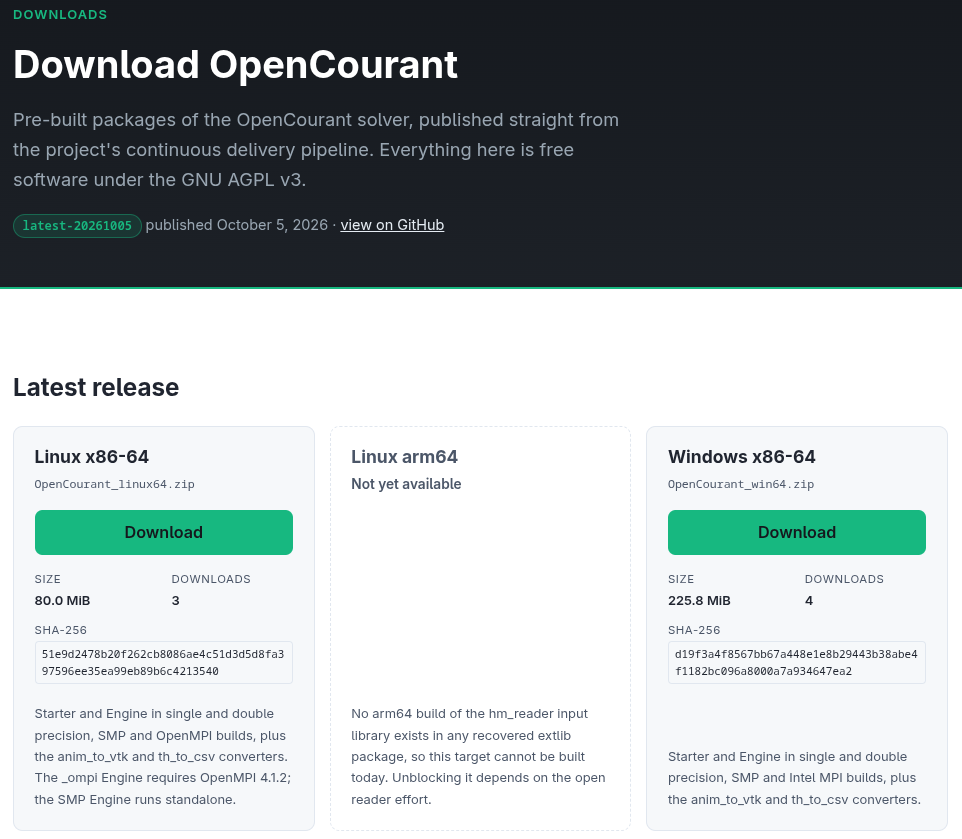
Just days after its inception, the OpenCourant project is already successfully distributing pre-built Linux and Windows x86_64 packages. However, the transition was not entirely without hurdles. A closed-source input-reader binary known as hm_reader, which was never formally committed to the public Git history, vanished alongside the original upstream OpenRadioss repository.
Fortunately, the community rallied to solve the missing binary problem. An unnamed community member who had retained a local copy of the file came forward. The OpenCourant team independently verified the binary, and it now successfully ships with every build. Despite this success, the project is still searching for specific historical release archives to begin the necessary work on ARM64 support and to improve overall platform compatibility for a broader range of hardware configurations.
Users interested in utilizing OpenCourant can choose from a robust variety of package options. The available offerings include the Starter and Engine components in both single and double precision, symmetric multiprocessing (SMP) builds, as well as specialized converters for animation files and time history data. These builds are currently available for download directly through the official OpenCourant downloads page.
For developers navigating the new repository, the existing documentation offers a familiar starting point, though minor adjustments are still underway. The primary installation guide file in the repository remains largely based on the legacy OpenRadioss documentation, as the OpenCourant team continues the ongoing process of updating project resources to fully reflect the new branding and infrastructure.
Leave a Reply