

In a significant shift for the enterprise Linux ecosystem, Canonical has announced a major overhaul of its kernel release strategy for Ubuntu. Moving away from its long-standing split maintenance model, the company is transitioning to a streamlined, high-frequency delivery cycle designed to dramatically accelerate how security patches and bug fixes reach users. The change, which collapses separate operational tracks into a single unified timeline, represents a fundamental adaptation to a rapidly shifting cybersecurity landscape increasingly dominated by automated systems.
Historically, Canonical maintained a split kernel Stable Release Update (SRU) cycle for Ubuntu. Under this established framework, regular bug fixes and critical security patches lived on separate operational tracks. This meant a full update typically landed every four weeks, complemented by a dedicated security-focused release at the two-week midpoint specifically tailored for urgent Common Vulnerabilities and Exposures (CVE) fixes. For those unfamiliar with the terminology, a Stable Release Update is the formalized mechanism through which Canonical delivers ongoing bug fixes, performance improvements, and security patches to Ubuntu operating systems long after a major version has been officially released to the public, with the core Linux kernel historically occupying its own dedicated maintenance track.
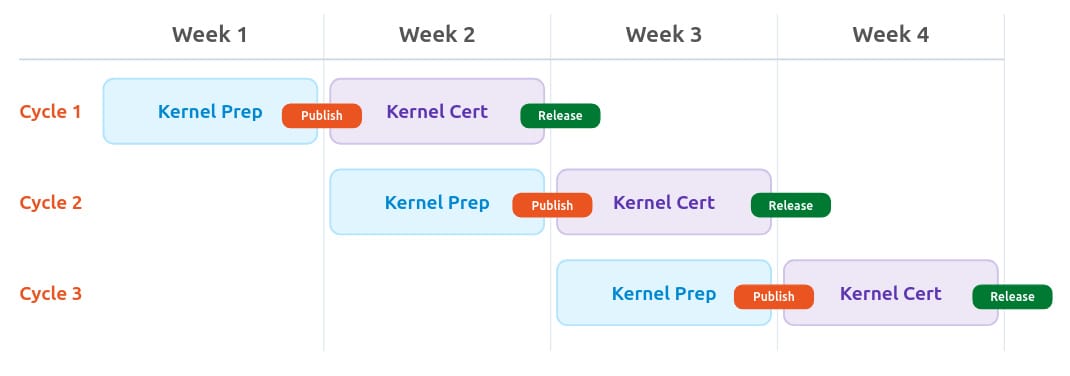
Under the newly instituted strategy, Canonical is completely replacing both legacy tracks with a single, highly compressed two-week cycle. Because a fresh cycle kicks off precisely one week into the current one, the operational overlap results in a brand-new kernel release landing every single week. This continuous pipeline aims to eliminate the artificial delays inherent in waiting for scheduled mid-point updates, ensuring that production environments receive validated fixes with significantly reduced latency.
The New Two-Week Cycle
The mechanics of the new two-week release framework are structured to balance rapid deployment with rigorous validation. Each individual cycle begins with an intensive initial week dedicated entirely to patch integration and heavy preparatory work. During this phase, Canonical’s kernel engineering team carefully selects which upstream and vendor-supplied fixes land on each specific kernel branch, builds the requisite software packages, and executes a battery of basic smoke tests designed to catch any obvious regressions or build failures before the package moves any further down the pipeline.

Once the first week wraps up, these freshly compiled builds are immediately pushed into Ubuntu’s -proposed software pocket. In the Ubuntu development ecosystem, the proposed pocket serves as the staging ground where kernel release candidates live before they have undergone full commercial certification. While these packages are technically accessible to advanced administrators and developers who know where to look, they are intentionally kept out of reach for general, mainstream users until thorough verification can take place.
Week two shifts the focus heavily toward quality assurance and compatibility verification. During this subsequent phase, Canonical runs the candidate builds through its rigorous Ubuntu Certified hardware testing program. This process subjects the kernel builds to a diverse array of enterprise machine types, server architectures, and client hardware configurations to guarantee that no unforeseen regressions slip through and break real-world deployments when the kernel officially rolls out to the wider public.
Because a fresh cycle initiates every single week regardless of where the preceding cycle happens to be in its validation schedule, the pipeline establishes a continuous conveyor belt. There is always a kernel finishing its rigorous hardware test run and preparing for public distribution. This overlapping design is precisely how a nominal two-week testing and integration cycle ultimately succeeds in delivering a fresh, updated kernel release to users every week.
In situations where a critical vulnerability emerges and a newly built patch is deemed temporarily unsafe to ship due to potential stability risks, Canonical has indicated that it will be entirely transparent with its user base, explicitly directing system administrators toward general system hardening advice and temporary mitigation strategies until a robust, fully tested patch can be reliably deployed.

For enterprise engineering teams and technical organizations that simply cannot afford to wait the full duration of the traditional release window, Canonical is explicitly pointing to the -proposed archive as a viable fast path. The underlying philosophy here is that sophisticated organizations can pull candidate builds directly from the proposed pocket and run their own internal acceptance tests and workload validations rather than waiting for formal OEM and hardware certification to officially wrap up.
AI and Automated Threats Made This Inevitable
This sweeping strategic pivot by Canonical did not emerge in a vacuum; rather, it was forced by the rapid evolution of automated cyber threats and the advent of aggressive artificial intelligence tooling. The pressure on open-source infrastructure has mounted visibly over recent months. Only last week, industry observers and maintainers witnessed how automated systems and scraping agents were severely draining compute resources from core repositories like git.kernel.org simply by aggressively harvesting source code and history for large language model training data.
For Canonical, the decision to compress its kernel release cycle was directly catalyzed by the proliferation of LLMs and specialized AI agents. These technologies have fundamentally transformed vulnerability hunting from a painstaking, manual process conducted by human security researchers into something automated, relentless, and industrial in scale. Autonomous systems are now discovering subtle kernel bugs and zero-day vulnerabilities at a speed and volume that no individual human researcher—or even a large team of security analysts—could possibly replicate manually.
Faced with an environment where malicious actors can leverage identical AI-driven techniques to weaponize newly published CVEs within hours, traditional software release cadences have become dangerously obsolete. Canonical’s overarching objective with this new weekly delivery mechanism is to narrow the window of vulnerability, ultimately aiming to have reliable workarounds or initial patches published within 24 to 48 hours of a CVE going public. While an immediate fix may not always be ready instantly, providing rapid guidance helps get affected enterprise and consumer systems into a significantly safer state while permanent engineering solutions are being finalized.
By fundamentally restructuring its kernel engineering pipeline, the team behind Ubuntu is directly responding to a rapidly shifting technological paradigm. As artificial intelligence continues to accelerate both the discovery and exploitation of software flaws, Canonical’s shift to a high-frequency, weekly release rhythm demonstrates a proactive effort to stay ahead of automated threats and protect the vast global ecosystem of servers, cloud deployments, and desktop computers running Ubuntu.


Leave a Reply